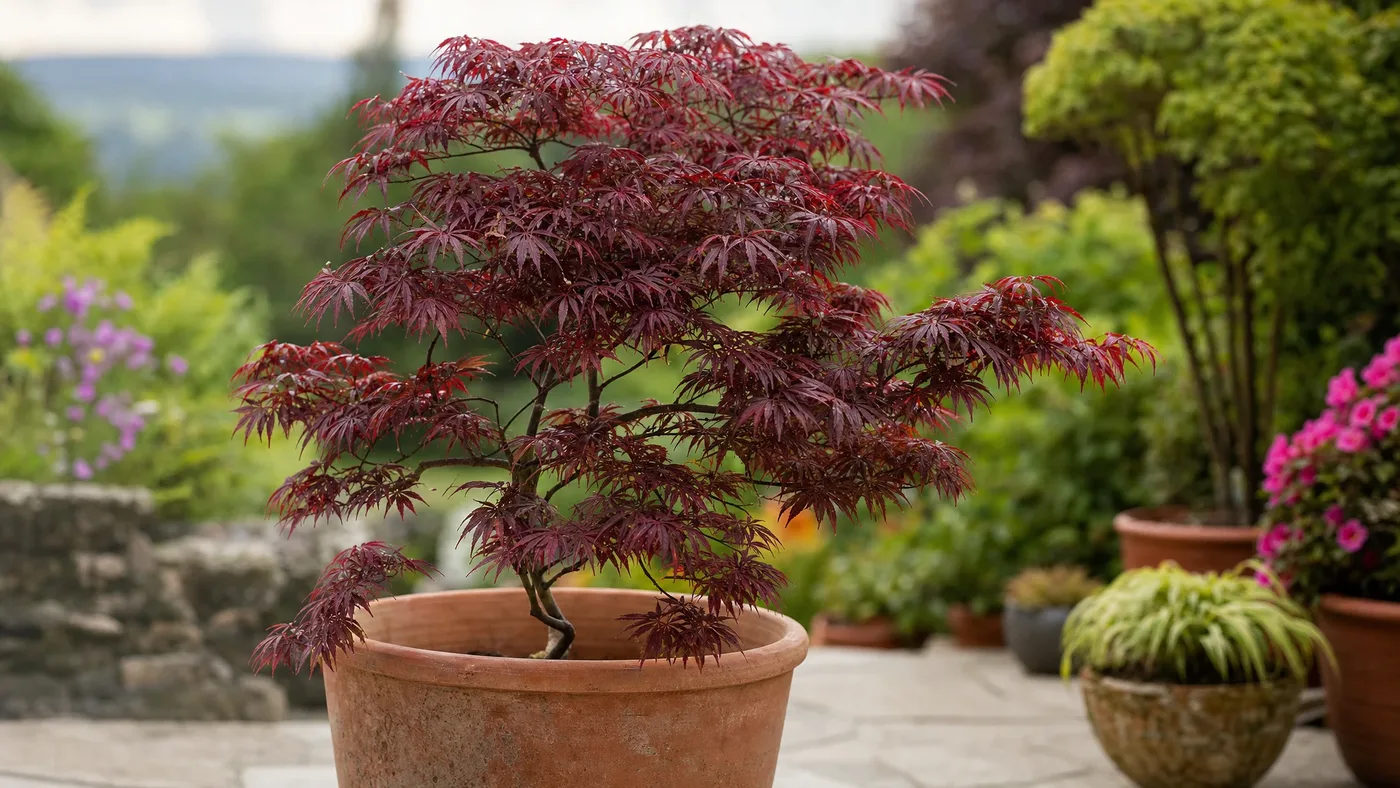
The Best Japanese Red Maples for Containers
Pick the pot for the tree you will have in year 4, not the tree you unbox. That one rule decides whether a potted red Japanese maple thrives or crisps up by August. Undersized pots are the top container killer, because a small root mass dries out faster than you can water it in summer.
This list ranks container Japanese maple varieties from easiest yes to most demanding, with honest limits for each. For the full routine on soil, watering and winter protection, see our guide to growing Japanese red maple in pots and containers. Here we focus on which tree to choose.
1. Shaina: the easiest yes
Shaina is a dwarf upright red selection, and it is the closest thing to a safe answer when someone asks for the best Japanese maple for containers. Standard upright red forms of Acer palmatum reach 15-25 ft, while dwarf cultivars often stay 6-10 ft. A dwarf starts that race far behind, so its roots outgrow a pot slowly.
It is also the pick that tolerates being kept small the longest. Growth for the species runs roughly 6-12 in per year, and a dwarf will usually sit at the low end of that. Slow top growth means longer between repotting jobs.
Who should skip it: anyone who wants a big sculptural canopy. A dwarf stays modest by design.
Practical takeaway: if you only want to buy once and not think about it for years, start here.
2. Red Dragon: compact laceleaf that holds color
Red Dragon is a compact laceleaf (dissectum type) with finely cut foliage. Its appeal in a pot is the color. Many red-leaf maples shift greener in summer heat or deep shade depending on the cultivar, and Red Dragon is a selection growers choose when they want red to last through the season.
Laceleaf foliage is delicate, though. Fine leaves lose moisture quickly in wind and hot sun, so leaf scorch is the common failure. Put the pot where it gets morning sun and afternoon shade, and shelter it from wind. Hot-summer climates make afternoon shade especially important.
Who should skip it: anyone with a windy, baking rooftop or south-facing patio with no relief.
Practical takeaway: choose Red Dragon for color and texture on a protected patio or courtyard.
3. Crimson Queen: a weeper that needs width
Crimson Queen is a dissectum weeping form, and a raised pot shows it off better than any garden bed. The branches cascade over the rim and the pot becomes part of the design. Set it on a stand or tall planter and the cascade has room to fall.
The trade-off is width. Weeping and dwarf types spread roughly 8-12 ft at maturity, and the canopy is wider than it is tall. A pot that looks right for the trunk can look absurdly small under a spreading mound. Plan floor space as well as pot volume.
Who should skip it: small balconies, or anyone who does not want to lift or step a heavy pot as the tree grows.
Practical takeaway: great in a tall, wide pot with room around it. Poor in a cramped corner.
4. Tamukeyama: another weeper that spills beautifully
Tamukeyama is the second weeper worth considering. It shares Crimson Queen's strengths and its limits: a graceful cascading habit from a raised container, and a canopy that wants space to spread. Choose between the two on the look you prefer, not on a big difference in pot needs.
Weeping forms have another quirk in pots. Because the canopy hangs low, the pot's soil surface is shaded by foliage, which helps keep roots cooler. That is a point in its favor in summer. The downside is that heavy foliage can hide dry soil, so check the root zone by hand rather than judging by the leaves.
Late fall to midwinter is the time for corrective cuts on any of these. Our guide on when to prune a Japanese red maple covers the timing and how to avoid heavy sap bleed.
Who should skip it: anyone who wants a compact, upright shape.
Practical takeaway: pick a weeper for the silhouette, and budget for the width.
5. The honest wildcard: any young red maple
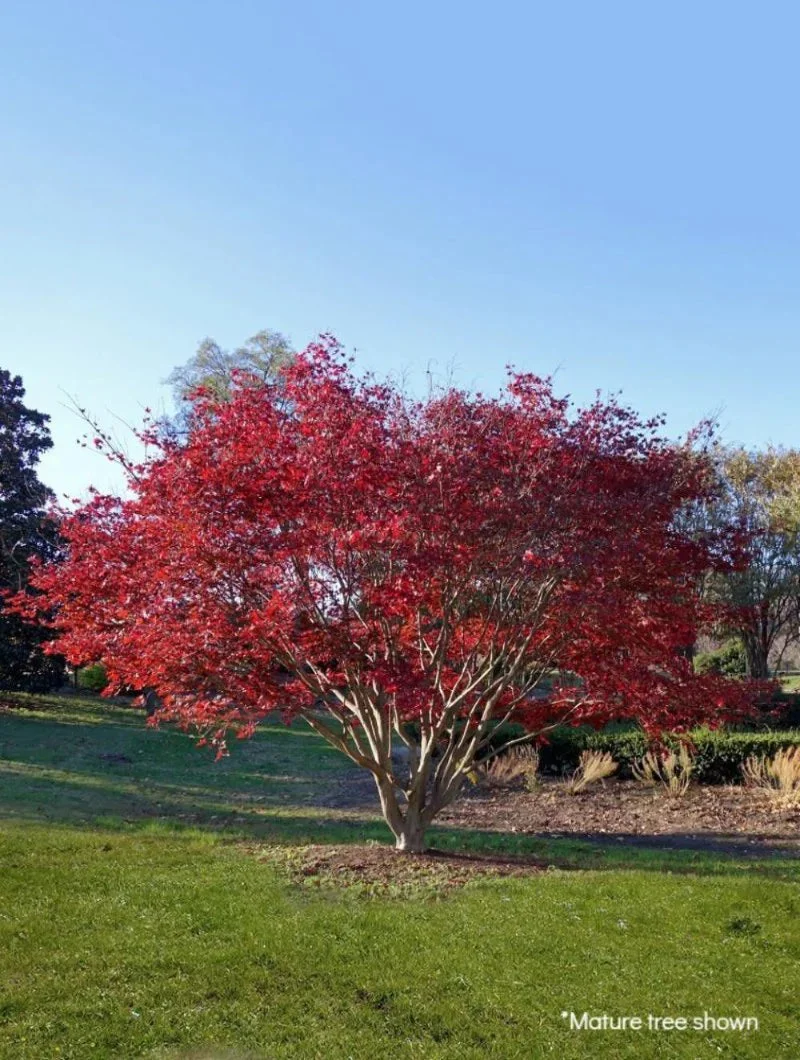
Here is the position most listicles avoid: any young red maple works in a pot for 3-5 years. That includes seed-grown plants sold as plain Japanese Red Maple and the big upright forms. Seed-grown stock can vary in mature color and habit, and an upright type is heading for 15-25 ft. But in its first few years, none of that matters yet.
Containers buy time, not permanence. A tree built for 80-100+ years will eventually outgrow any pot. Root-pruning and repotting at intervals can extend the stay, and the containers guide walks through that cycle. Plan an exit, whether that is a garden bed or a final oversized planter.
If you want a young tree to start in a pot, our 3-gallon size (2-3 ft) is the natural container start, and you can see the sizes in the shop.
Who should skip it: anyone who wants a final, never-move-it answer. Pick a dwarf instead.
Practical takeaway: a young tree in a pot is a stage, not a destination.
Three things that kill potted trees
- An undersized pot. Summer dry-out is the main killer. Roots need even moisture, and the species has low to moderate drought tolerance.
- Frozen roots. Container trees need root protection in freezing winters. Zones 5-8 is the species range, and a pot exposes roots far more than the ground does.
- Poor drainage. Standing water leads to root rot. Use a pot with drainage holes and a well-drained, organic mix.
Extension guidance generally treats consistent, even moisture as the key to leaf health. For your region's winter protection advice, check your local cooperative extension office.
Quick reference
| Pick | Form | Realistic years in pot | Minimum pot size |
|---|---|---|---|
| Shaina | Dwarf upright | Longest of the group, with periodic root-pruning | Size for the year-4 tree; step up from the nursery pot |
| Red Dragon | Compact laceleaf | Several years with root-pruning | Moderate; wide enough to buffer summer dry-out |
| Crimson Queen | Weeping laceleaf | Around 3-5 years before the width becomes the issue | Wide, raised pot |
| Tamukeyama | Weeping | Around 3-5 years before the width becomes the issue | Wide, raised pot |
| Any young red maple | Seed-grown or upright | 3-5 years | Size for the year-4 tree; plan a move to the ground |
Cultivar-specific mature sizes vary, so check the plant tag or a source such as Missouri Botanical Garden profiles before buying.
Japanese Red Maple
Nursery-grown Japanese Red Maple in sizes from 3 Gallon 2-3 ft, shipped to your door.
From $118.33
Shop Now →