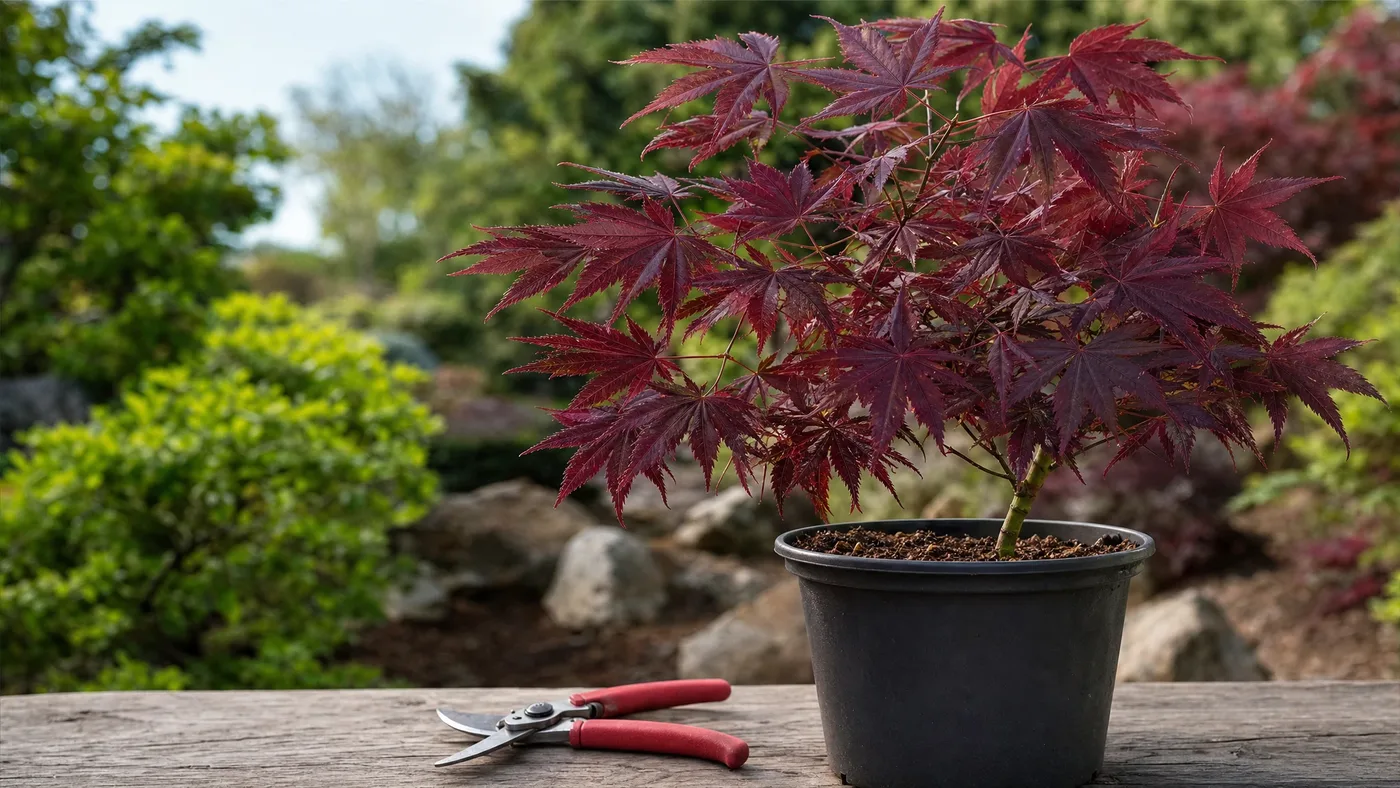
When to Prune a Japanese Red Maple
It is early October. The leaves on your red maple are just starting to color, one branch crosses another, and you are standing there with pruners in your hand. Put them down for a few weeks. Almost every pruning mistake we see on this tree comes down to timing, not technique.
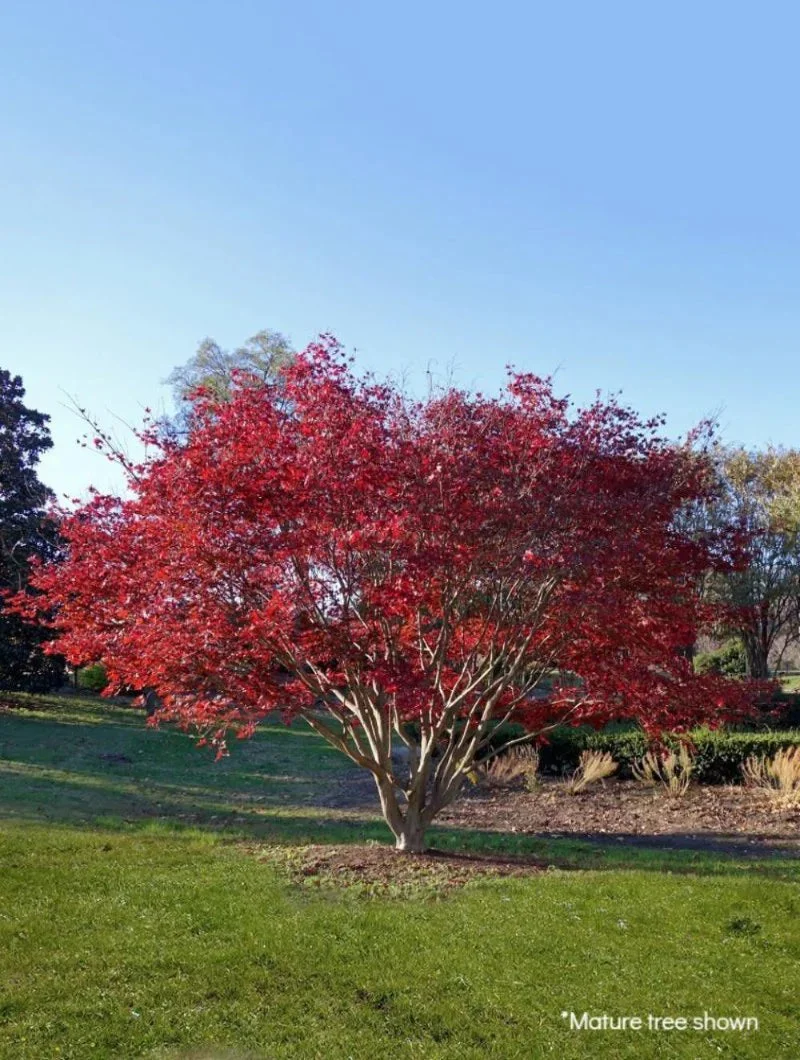
A well-timed cut heals clean and leaves the layered shape intact. A badly timed one can weep sap for days, expose inner leaves to scorch, or set back a young tree that grows too slowly to waste a season. We'll walk you through the first year after planting, then the dormant window and sap bleed, then the summer, spring and fall rules, and finally the jobs you can do at any time.
Timing at a Glance for a Japanese Red Maple
Start with the short answer, then check the season you are in on the table below.
The best time to prune a Japanese maple is dormancy, from late fall to midwinter, after the leaves drop and before sap starts to rise. Dead wood can come out at any time, and pencil-thin touch-ups are fine in summer. Skip heavy cuts during leaf-out and right before a hard freeze.
This page answers timing only. For where to make the cut and how much to take, use our full guide on how and when to prune a Japanese red maple tree.
This table shows what is safe and what to avoid in each season.
| Season | What is safe | What to avoid |
|---|---|---|
| Late fall to midwinter (dormant) | Structural pruning: dead, crossing and crowded branches | Cutting right before a hard freeze |
| Late winter to early spring | Deadwood only | Structural cuts, because sap is pushing and cuts weep |
| Spring leaf-out | Deadwood only | Any real pruning |
| Summer | Pencil-thin touch-ups, deadwood, rootstock suckers | Shearing or heavy thinning in heat |
| Early fall | Deadwood, light tidying | Heavy cuts that trigger late growth |
Leave a New Japanese Red Maple Alone in Year One
The first year is the easiest to get right, because the answer is to do almost nothing. Follow these rules from the day the tree goes in the ground.
Remove only dead or broken wood in the first year. The tree needs every leaf while it establishes roots. Shaping can start the following dormant season, once you can see how the branches are building.
One of the most common questions we get from customers is whether to cut a young tree back to make it bushier. Don't. A small red maple that arrives at quart size looks sparse, and that is normal. Our first-30-days care guide covers what the tree does need while it settles in.
Dormant Pruning: The Window for Structural Work
Most of your real cutting happens in one short window, so it pays to understand why it works and where it ends.
When is the best time to prune a Japanese maple?
Late fall to midwinter, while the tree is fully dormant. The bare branches show you exactly which ones cross or crowd, and the tree is not spending energy on leaves. This is the window to do your structural work.
Why does dormancy beat every other season?
Dormant cuts heal before the tree has leaves to support or heat to endure. You also get the clearest view of the framework. A Japanese maple's layered silhouette is much easier to judge without foliage in the way.
One piece of common advice we don't follow is to prune in late winter, just before the buds swell. It works for many trees, but maples push sap early, and a late-winter cut on a Japanese red maple is the one most likely to weep. We would rather you finish by midwinter.
What is sap bleed, and should I worry about it?
Maples push sap hard in late winter and early spring, so cuts made then weep for days. Extension guidance describes it as unsightly and mildly stressful but rarely fatal. Winter pruning in true dormancy usually avoids the worst of it.
Will a maple bleed to death if I prune it in winter?
No, and this is the folklore we would retire first. Bleeding is cosmetic. The cuts that actually hurt a Japanese red maple are made in August heat, when the tree is already fighting leaf scorch.
Can I prune in late winter if the buds have not swollen?
You can, but you are close to the sap push, and one warm spell will start the weeping. If you missed the dormant window, remove only dead wood and wait until next winter for structural work. Mild climates shift the calendar, so ask your local cooperative extension office when sap typically starts running near you.
Why not prune right before a hard freeze?
Fresh cuts need a little time to seal. A deep freeze on open wounds invites dieback at the cut. In zones 5 to 8, do the work once the leaves are down but before the coldest stretch, or wait for a mild spell.
Summer Pruning on a Red-Leaf Maple
Summer is where red-leaf forms get hurt most often, because the cut and the heat arrive together. Here is what the tree tolerates.
Can I prune a Japanese maple in summer?
Yes, but only lightly. Pencil-thin twigs, a stray shoot, or a branch tip rubbing the house are all fine. Summer is not the season for reshaping.
Why is shearing in August so hard on the tree?
Red-leaf forms already face leaf scorch and other stress in hot spells, and the foliage can fade to green or bronze in summer heat even without a cut.
Red-leaf forms already face leaf scorch from hot sun, wind and drought stress. Removing a large share of the canopy exposes inner leaves and bark that were never built for full sun. The tree loses its shade and its food factory at the same moment.
Does summer pruning cause sunscald?
It can on young trees. Trunk sunscald is a documented problem for young Japanese maples in full sun, and thinning the canopy removes the shade that protects the bark. Leave young trees fully leafed through summer.
What can I safely do in summer?
These three jobs are safe in any summer, so do them whenever you spot the need.
- Snip pencil-thin shoots that cross or rub.
- Remove any dead, brittle branches.
- Pull or cut rootstock suckers the day you see them.
Spring, Fall and Your Zone
The shoulder seasons are where people get tempted, so here are the rules for leaf-out, early fall and local climate.
Is it okay to prune during spring leaf-out?
No. The tree is moving sap and spending stored energy on new leaves, so cuts bleed and the loss hurts more. Wait for dormancy unless the branch is dead.
Can I prune in early fall?
Only lightly. Heavy cuts can prompt tender new growth that has no time to harden off. Tidy deadwood now and save the real work for after leaf drop.
Does my zone change the timing?
The window shifts, but the rule holds: dormant season, ahead of the sap push. Japanese red maple is rated for zones 5a through 8b, and no source we trust goes past 8b. Your county extension office can tell you the local dates.
Dead Wood, Suckers and the Mature Tree
Some jobs ignore the calendar, and a mature tree needs far less cutting than most owners expect.
Can I remove dead branches at any time?
Yes. Dead wood does not bleed and cannot be harmed further. Cut back to healthy tissue whenever you spot it, in any season.
What about green branches or shoots coming from the base?
Those are often rootstock suckers, and they should go immediately regardless of season, since they steal vigor from the red-leaf top. Our guide to rootstock suckers and green branches explains how to tell them apart from normal growth.
Do container-grown trees follow the same schedule?
Yes. Prune in dormancy, and protect the roots in freezing winters since pots offer less insulation. Dwarf and cutleaf selections stay small, so they need less cutting overall.
How often should I prune?
Rarely. Japanese red maples need minimal pruning, just dead, crossing or crowded branches. Growth is slow to moderate, and a heavy cut takes years to regrow.
Who should skip pruning altogether?
Anyone whose tree is healthy and well sited. If the shape already looks right, leave it. Pruning to keep a standard tree small is a losing fight, and the better fix is a dwarf cultivar placed where it fits.
Where do I fit pruning into the yearly routine?
Put it in winter, between planting and feeding in early spring. Our month-by-month care calendar shows where each job lands.
Quick Reference
Use this table as a one-glance reminder of when each pruning job belongs.
| Job | When |
|---|---|
| Structural pruning | Late fall to midwinter |
| Deadwood removal | Any time |
| Rootstock suckers | The day you see them |
| Pencil-thin touch-ups | Summer is fine |
| Heavy cuts | Never in summer heat, leaf-out, or just before a hard freeze |
| Young tree, first year | Dead or broken wood only |
Cut in Winter and Your Japanese Red Maple Will Thank You
Prune in dormancy, take dead wood whenever you find it, pull suckers the day you see them, and leave a new tree alone for its first year. Skip heavy cuts in summer heat, during leaf-out and ahead of a hard freeze.
Japanese Red Maple
Nursery-grown Japanese Red Maple in sizes from 3 Gallon 2-3 ft, shipped to your door.
From $118.33
Shop Now →On our farms we grow our red maples in afternoon shade, in even moisture and well-drained soil, and we prune only in winter dormancy. We are growers with our own farms, and we raise and sell top-quality trees we would be glad to plant ourselves.