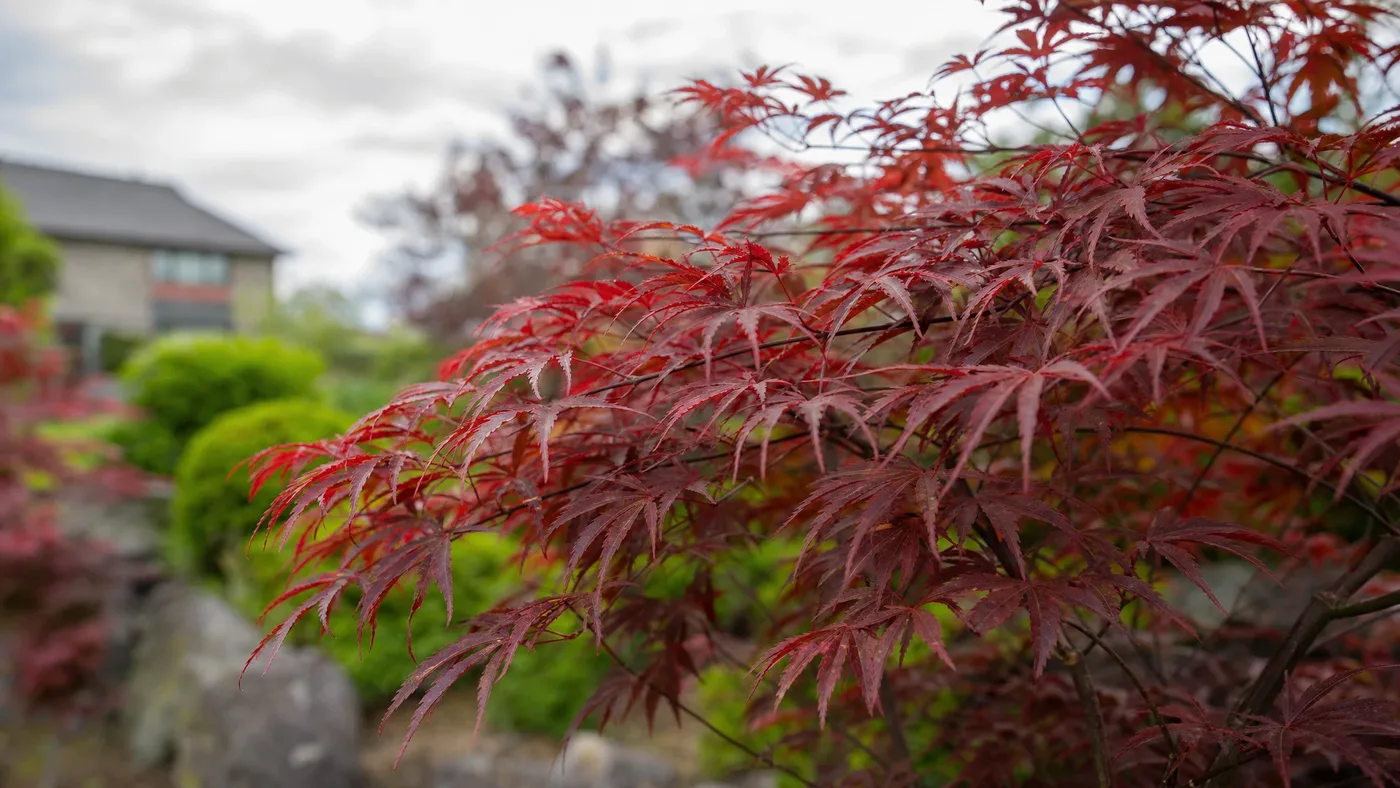
Japanese Red Maple Care Calendar: Month by Month
Most Japanese maple care advice reads like a chore chart. This one is mostly blank, and that is deliberate. A healthy Japanese Red Maple (Acer palmatum, red-leaved forms) is a slow grower, roughly 6 to 12 inches a year, and it does best when you leave it alone between a few well-timed jobs. Budget something like 10 hours of real work across the whole year, most of it in the first three years after planting. The rest is looking, not doing.
This japanese maple care calendar covers when to fertilize, prune and water a Japanese maple, month by month. For the reasoning behind each task (light, soil, watering, pruning), see our complete Japanese Red Maple care guide. Here we stick to timing.
The Position This Calendar Takes: Less Is Better
Common advice says to feed in spring and summer, prune whenever a branch looks wrong, and water on a fixed schedule. We disagree with all three.
- Feeding. Overfeeding causes leggy growth and weaker color. One light feeding in early spring is usually sufficient.
- Pruning. Cutting in the growing season invites heavy sap bleed and removes the branch structure that makes this tree worth owning. Prune only in dormancy.
- Watering. A calendar cannot tell you when to water. The soil can. Young trees need consistent moisture, but waterlogged roots are a bigger killer than a missed day.
This tree is also the wrong fit for some people. It does not tolerate standing water or drought extremes, and its salt tolerance is poor. If your site is a soggy low spot, a windy exposure, or a roadside bed that gets de-icing salt, fix the site first or choose a different plant.
Timing by Climate: Shift the Whole Calendar
Japanese Red Maple is rated for USDA zones 5 to 8, with some cultivars tolerating zone 9 given afternoon shade. Spring arrives on different dates across that range. As a rule of thumb, zone 5 runs 2 to 3 weeks behind zone 8. Every month below assumes a middle-of-the-range climate. Slide tasks earlier in zone 8 and later in zone 5, and let the tree guide you: do spring jobs as buds swell, not by the date on the wall. For local frost dates, check your cooperative extension office.
What You Need
- Balanced, low-nitrogen fertilizer (for the one spring feeding)
- Organic mulch (shredded bark, leaf mold or similar)
- Clean, sharp bypass pruners and a small pruning saw
- A hose or watering can, and a trowel for checking soil moisture
- Burlap or similar wrap, if you have a young tree or a container in a freezing climate
The Month-by-Month Table
Each month has one to three tasks, and two stretches have none at all.
| Month | Tasks |
|---|---|
| January | Do nothing. This is a true rest stretch. Look at the branch silhouette and enjoy it. |
| February | Finish any overdue dormant pruning in mild zones. In cold zones, check that mulch has not blown off the root zone. |
| March | Light feeding with balanced, low-nitrogen fertilizer as buds begin to swell (zone 8). Zone 5 waits for April. |
| April | Plant bare spots and new trees in early spring. Feed now in zone 5 to 6. Start watching soil moisture as leaves open. |
| May | Water young trees deeply when the soil starts to dry. Protect new leaves from wind and hot sun where you can. |
| June | Keep up consistent moisture on trees in their first 2 to 3 years. Scout for aphids on new growth. |
| July | Do nothing extra. No pruning, no feeding. Water only as the soil demands, and check for leaf scorch in hot, windy spells. |
| August | Same as July. No pruning, no feeding. Watch for Japanese beetles. |
| September | Fall planting window opens as the heat breaks. Keep watering young trees until the ground freezes. |
| October | Plant if you missed September. Rake and bin diseased leaves. Enjoy the fall color. |
| November | Top up mulch after leaf drop. Start structural pruning once the tree is dormant. |
| December | Finish corrective pruning. Wrap young trunks and protect container roots in freezing climates. |
Spring: March to May
Spring is the busiest stretch, and it is still light work. Red-purple flowers are small and easy to miss, and they appear early to mid spring, before or with leaf-out. Do not mistake them for a problem.
Feed once. Use a balanced, low-nitrogen fertilizer, and follow the rate on the label. If you want the full rundown, read fertilizing Japanese Red Maple: what, when and how much. Skip a second feeding in summer. More nitrogen means leggy growth and weaker color, which is the opposite of what you planted this tree for.
Planting is also a spring job. Early spring is one of two good planting windows (the other is fall). Standard upright forms need roughly 10 to 15 feet from structures and other trees. Plant the root flare level with the soil surface, water in well, and mulch.
Summer: June to August
June is for establishing moisture habits. July and August are the first of your two honest do-nothing stretches.
Do not prune in midsummer and do not feed. The tree is working hard just to stay cool. What it needs is steady water and, in hot-summer climates, afternoon shade, which helps preserve leaf color and prevents scorch. Full sun is fine in cooler regions, but red leaves in strong afternoon sun are the classic setup for scorched edges.
How do you know when to water? Dig down with a trowel a few inches near the drip line. If it is damp, wait. If it is dry, water slowly and deeply. Young trees need regular watering in their first 2 to 3 years, while established trees have low to moderate drought tolerance and still dislike extremes in either direction.
Summer Problem and Fix
| What you see | Likely cause | What to do |
|---|---|---|
| Brown, crispy leaf edges | Leaf scorch from hot sun, wind or drought stress (environmental, not a pathogen) | Check soil moisture, add mulch, consider afternoon shade next year |
| Leaves going greener than expected | Deep shade or intense heat can shift color, depending on the cultivar | Usually no action. Reassess sun exposure over a full season |
| Curled new growth, sticky residue | Aphids | Try a strong water spray first. If you use a pesticide, always read and follow the pesticide label; the label is the law |
| Skeletonized leaves | Japanese beetles | Hand-pick where practical. Local extension offices can advise on region-specific control |
| Sudden dieback on one branch or section | Possible verticillium wilt or borers | Contact your local cooperative extension office for diagnosis before cutting or treating |
Fall: September to November
Fall is the second planting window, and many growers prefer it because the soil is warm and the heat is gone. Plant in September or October and keep watering until the ground freezes. If you are choosing a tree, we grow nursery plants in 3-gallon, 5-gallon and 7-gallon sizes, available at our shop.
Fall color is vivid red, orange or crimson, though intensity varies by cultivar and season. A seedling-grown red selection can show variable color and habit, so treat color expectations as a range rather than a promise.
Once the leaves drop, top up the mulch. Keep it off the trunk itself. Rake up and discard diseased leaves, since anthracnose and similar problems can overwinter in leaf litter. As the tree goes fully dormant in November, structural pruning can begin.
Winter: December to February
The pruning window runs from late fall through midwinter. Pruning in dormancy avoids the heavy sap bleed you get in the growing season. Remove only dead, crossing or crowded branches. Step back often. The graceful branching silhouette is half the appeal, and a tree pruned like a hedge never recovers it. For cut-by-cut detail, see how and when to prune a Japanese Red Maple.
January is your second do-nothing stretch. Finish pruning in December if you can, and then put the pruners away. Cold-protection details for young trees and pots are covered in winter care for Japanese Red Maple. Two points matter most: young trees in full sun can get trunk sunscald, and container-grown trees need root protection in freezing winters.
Common Mistakes to Avoid
- Feeding in summer. It pushes soft growth and can wash out leaf color.
- Pruning in July. Sap bleed and stress, for little gain.
- Watering on a fixed schedule. Check the soil first. Root rot is a risk in poorly drained ground.
- Piling mulch against the trunk. Keep it a hand's width away.
- Treating zone dates as law. Zone 5 runs 2 to 3 weeks behind zone 8. Follow the buds.
What to Expect
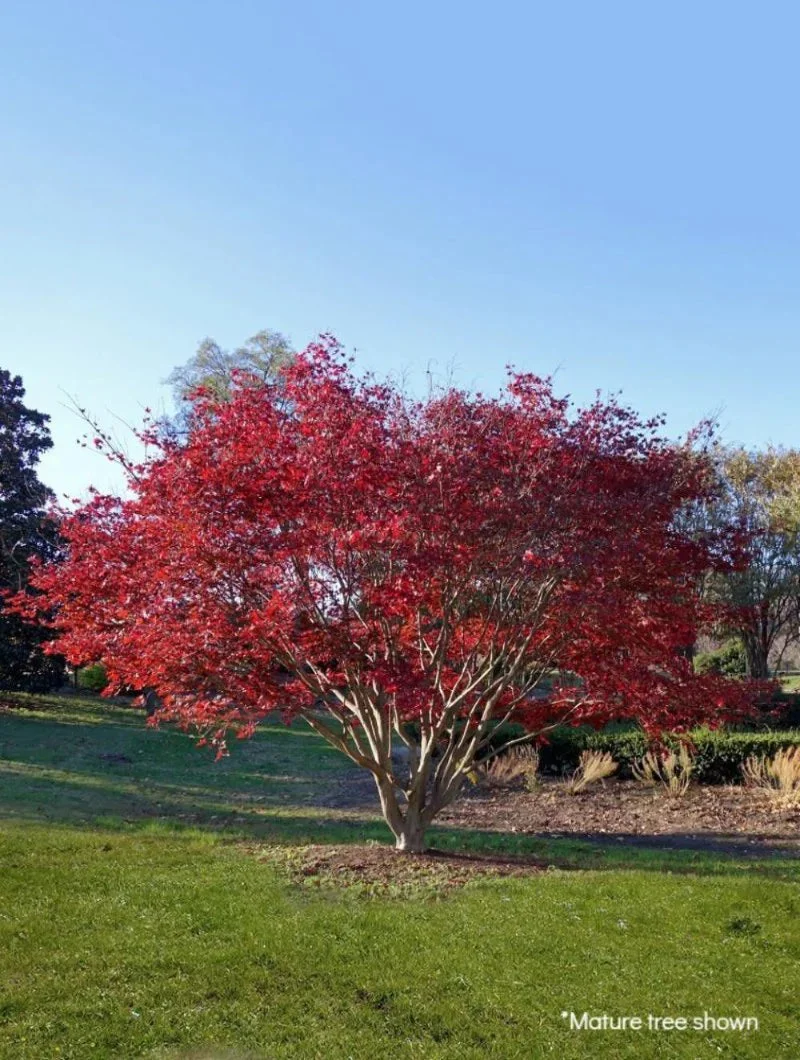
With good siting and this light routine, the tree may settle into steady, slow growth and reliable seasonal color. Flowers can appear within a few years, but significant landscape size usually takes 10 to 15 years. A well-sited tree can live 80 to 100 years or more. Standard upright forms may reach 15 to 25 feet, while dwarf and cutleaf types often stay at 6 to 10 feet, and an unnamed seedling-grown selection can vary from either range.
Quick Reference
| Job | When | Skip it when |
|---|---|---|
| Fertilize (balanced, low-nitrogen) | Once, early spring as buds swell | Summer and fall |
| Prune (dead, crossing, crowded only) | Late fall to midwinter dormancy | Midsummer |
| Water | Whenever soil a few inches down is dry, steadily for the first 2 to 3 years | When soil is already damp |
| Plant | Early spring or fall | Peak summer heat |
| Mulch top-up | After leaf drop in fall | Piled against the trunk |
| Winter protection | December, young trees and containers in freezing climates | Established trees in mild winters |
| Do nothing | July to August, and January | Never skip the checks for scorch and pests |
Japanese Red Maple
Nursery-grown Japanese Red Maple in sizes from 3 Gallon 2-3 ft, shipped to your door.
From $118.33
Shop Now →