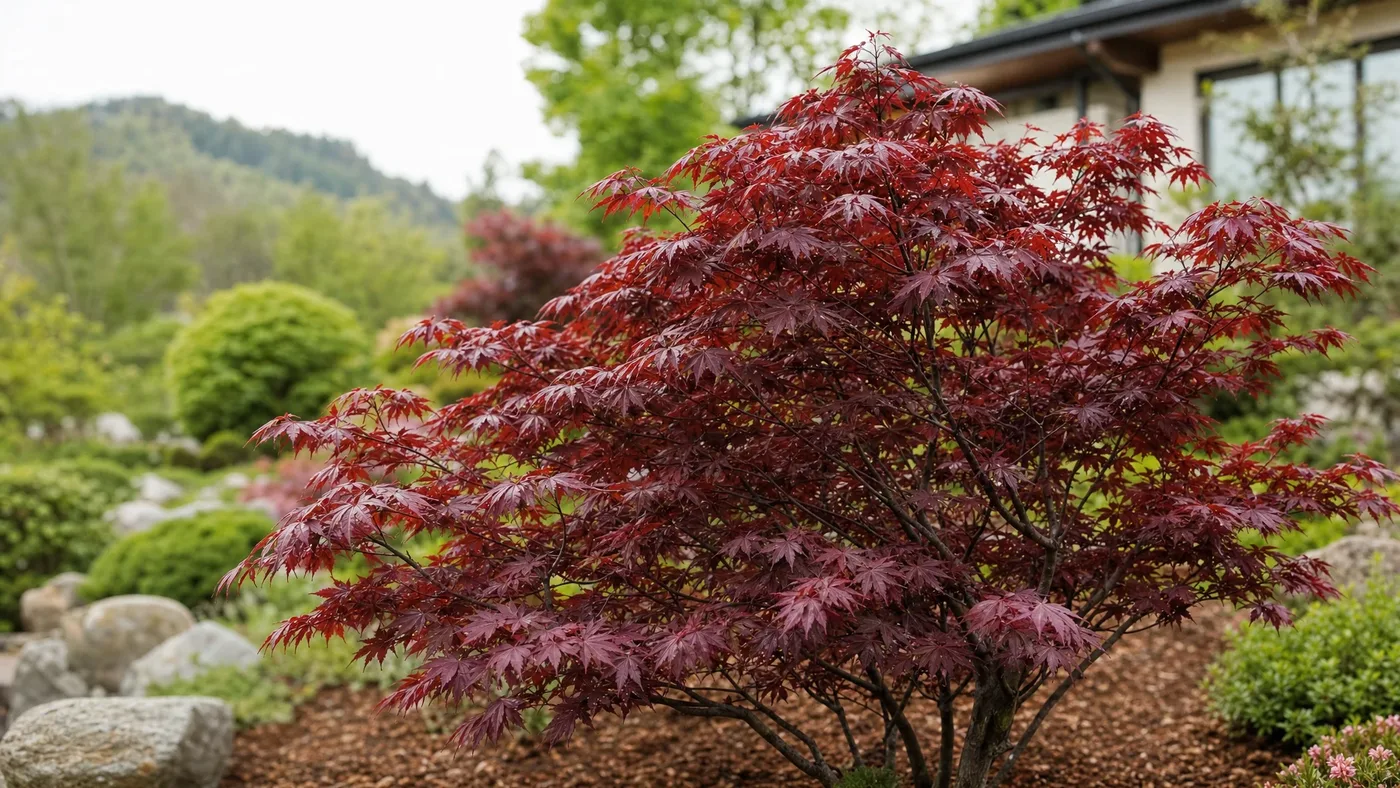
How to Restore an Overgrown Japanese Red Maple
An overgrown Japanese maple is one of two different problems, and only one of them can be fixed with a saw. If the tree is too dense (crowded twigs, dead interior, crossing branches), you can restore it over three winters. If the tree is simply too big for the spot, pruning will not shrink its genetics. This guide covers both cases and tells you which one you are dealing with. For the basic cuts and timing, our pruning guide for Japanese red maple is the companion to this one.
First, Decide Whether It Is Too Dense or Too Big
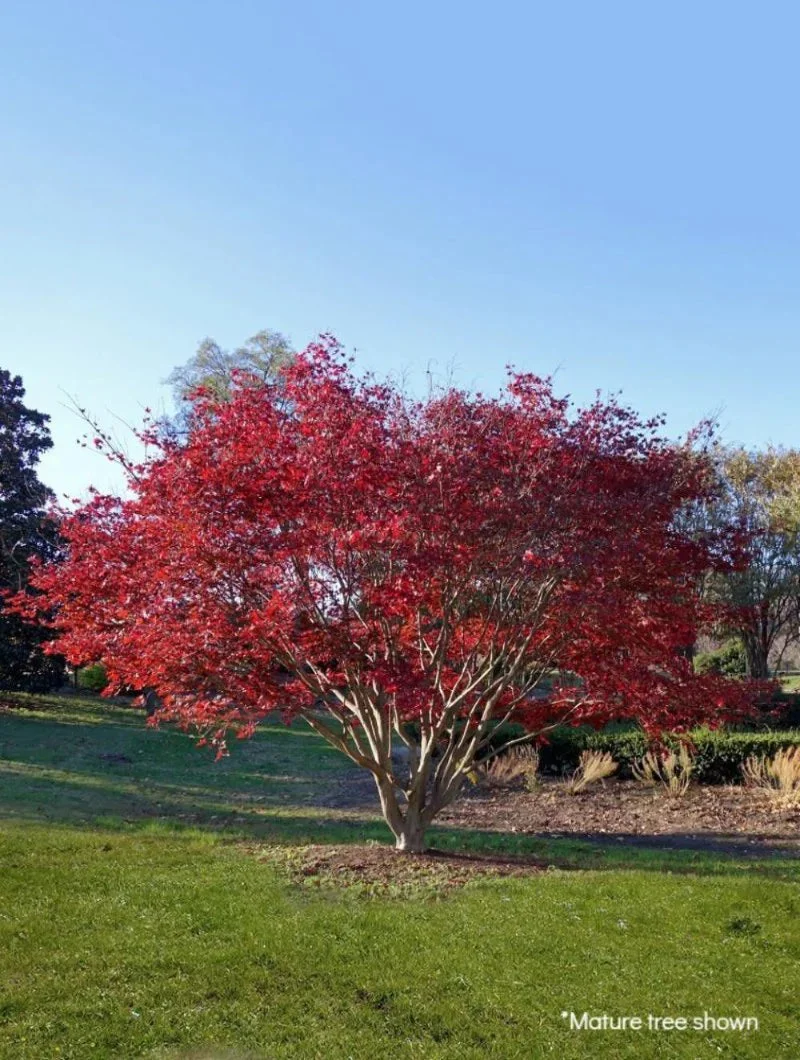
Walk around the tree and measure it. Standard upright red forms mature at 15-25 ft tall and 12-20 ft wide. Dwarf and cutleaf types often stay 6-10 ft. Growth is slow, roughly 6-12 in per year, so a tree that looks enormous has usually been in the ground a long time.
| What you see | Diagnosis | Can pruning fix it? |
|---|---|---|
| Thick tangle of thin twigs, bare inner branches, leaves only at the tips | Too dense | Yes, over 2-3 winters |
| Crossing or rubbing limbs, dead wood, suckers at the base | Neglected, not oversized | Yes, mostly in year 1 |
| Healthy, well-shaped tree that is 20 ft tall beside a 10-ft eave | Too big for the spot | No |
Be blunt with yourself here. A 20-ft cultivar will not become an 8-ft tree because you wish it would. You can trim it a little and keep it from getting bigger, but you are fighting the plant every year.
Materials You Need
- Bypass hand pruners (for cuts under 3/4 in)
- Bypass loppers (for cuts up to about 1.5 in)
- A curved pruning saw for anything larger
- Isopropyl alcohol or a household disinfectant to wipe blades between cuts
- Gloves, eye protection, and a stable stepladder (never a tilted one)
- Marking tape to flag branches before you cut
- A tarp for clippings
The Three-Year Plan
Do all structural cutting in late fall to midwinter, while the tree is dormant. Pruning then avoids heavy sap bleed and lets you see the branch structure. Flag your cuts on a clear day, step back, and sleep on it before cutting.
Year 1: Clean Up
- Remove dead wood. Scratch a twig with a thumbnail. Brown and dry means dead. Cut back to a live branch or the collar. If several limbs died in one season and the wood under the bark is streaked, have your local extension office look at it, since verticillium wilt is one cause of branch dieback.
- Cut suckers. Take off shoots coming from the base or rootstock flush with the trunk or root.
- Fix the worst crossing limbs. Where two branches rub, keep the better-placed one and remove the other at its origin. Pick the 3-5 worst offenders, not every imperfection.
- Stop. Resist the urge to keep going. Year 1 is a cleanup, not a makeover.
Year 2: Open the Interior and Start Reducing Height
- Thin the crowded interior. Remove small, weak branches that point inward or straight up through the canopy. The goal is to see sky through the tree, not to hollow it out.
- Reduce height at the leaders. Follow a tall branch down until you find a strong lateral (a side branch at least a third the diameter of the one you are removing) growing the direction you want. Cut just above it. This is how you reduce Japanese maple size without wrecking its shape.
- Cut at the collar, not flush. Leave the slightly swollen ring where the branch joins. Use the three-cut method on heavy limbs so the bark does not tear.
- Check your total. Step back. If you have removed more than about a quarter of the leafy growth, you have gone too far for one winter.
Year 3: Refine
- Remove any watersprouts (straight vertical shoots) that formed after earlier cuts. Cut them off at the base while they are still pencil-thin.
- Take a second, smaller round of height reduction if the tree still needs it, again back to laterals.
- Tidy the silhouette. A good renovation pruning of a maple leaves layered branching with gaps you can see through.
Why You Cannot Do It All in One Winter
Keep removal to roughly one-fifth to one-quarter of the live growth in any single year. This is a working rule of thumb, not a laboratory number, but the mechanism behind it is well understood. Roots keep supplying water and stored energy to a canopy that is suddenly much smaller. Dormant buds along the trunk and branches wake up and fire in spring. The result is a thicket of vertical watersprouts, often thicker and more crowded than the growth you removed. You are then back where you started, with weaker attachments on top.
Spreading the work over three winters lets the tree redistribute that energy into the branches you kept.
The One Unforgivable Cut: Topping
Do not top the tree. Topping means shearing the leaders flat at one height with no lateral to take over. It leaves stubs, triggers exactly the watersprout response described above, and gives a Japanese maple a permanently stiff, broom-like head. The natural layered form does not come back. A topped maple takes decades to recover, if it ever does, and the large wounds invite decay.
If the only way you can see to get the height down is a flat cut across the top, the tree is the wrong size for the spot. That is a siting problem, not a pruning problem.
When Replacing Is the Better Call
If the tree is healthy but simply too large, consider replacing it. Planting a correctly sized tree is usually cheaper and kinder than years of corrective cuts. Dwarf and cutleaf cultivars commonly stay 6-10 ft, and weeping types spread 8-12 ft. If you want to stay with a red-leaf form, our nursery-grown Japanese Red Maple in 3-, 5- and 7-gallon sizes gives you a young tree to place correctly from the start. Mind the spacing: standard forms want 10-15 ft from structures and other trees. Container-grown stock bought from any nursery may be seed-grown and variable, so check the tag for the mature size listed.
You should also skip the restoration route if the trunk has major decay, if more than a third of the canopy is dead, or if the tree sits within 5 ft of a foundation or utility line. In those cases, removal is the honest answer.
Common Mistakes
| Mistake | What happens | Do this instead |
|---|---|---|
| Removing half the canopy in one go | Watersprout thickets, weak growth | Stay near 1/5 to 1/4 per year |
| Pruning in summer heat | Scorched, newly exposed leaves and bark | Cut in dormancy |
| Heavy nitrogen feeding after pruning | Leggy growth and weaker color | Light, balanced, low-nitrogen feed in early spring |
| Leaving long stubs | Dieback and decay | Cut to the collar or a lateral |
| Opening the canopy too fast on a sunny trunk | Sunscald on thin bark | Open gradually over several winters |
What to Expect
After year 1, the tree may look only slightly different, and that is normal. After year 2, you may see more light reaching the interior and some bare branches starting to leaf out along their length. By year 3, a tree that was too dense may have a clearer branch structure and a more open, layered outline. Results vary with the cultivar, the age of the wood, and how severe the neglect was. Because growth runs roughly 6-12 in per year, expect to maintain the shape with a light trim each winter rather than finish the job once.
After pruning, keep watering evenly, mulch, and avoid piling on fertilizer. Our Japanese red maple care guide covers the sun, water and soil side. For region-specific timing, your local cooperative extension office can confirm when dormancy starts in your zone (the species grows in USDA zones 5-8).
Quick Reference
| Item | Guideline |
|---|---|
| Best cutting window | Late fall to midwinter, dormant tree |
| Max removal per year | About 1/5 to 1/4 of live growth |
| Year 1 | Deadwood, suckers, worst crossing limbs |
| Year 2 | Thin interior, cut leaders back to strong laterals |
| Year 3 | Remove watersprouts, refine shape |
| Never | Top the tree flat, or prune in summer heat |
| Standard size | 15-25 ft tall, 12-20 ft wide |
| Dwarf/cutleaf size | Often 6-10 ft tall |
| If it is just too big | Replace with a correctly sized cultivar |
Japanese Red Maple
Nursery-grown Japanese Red Maple in sizes from 3 Gallon 2-3 ft, shipped to your door.
From $118.33
Shop Now →