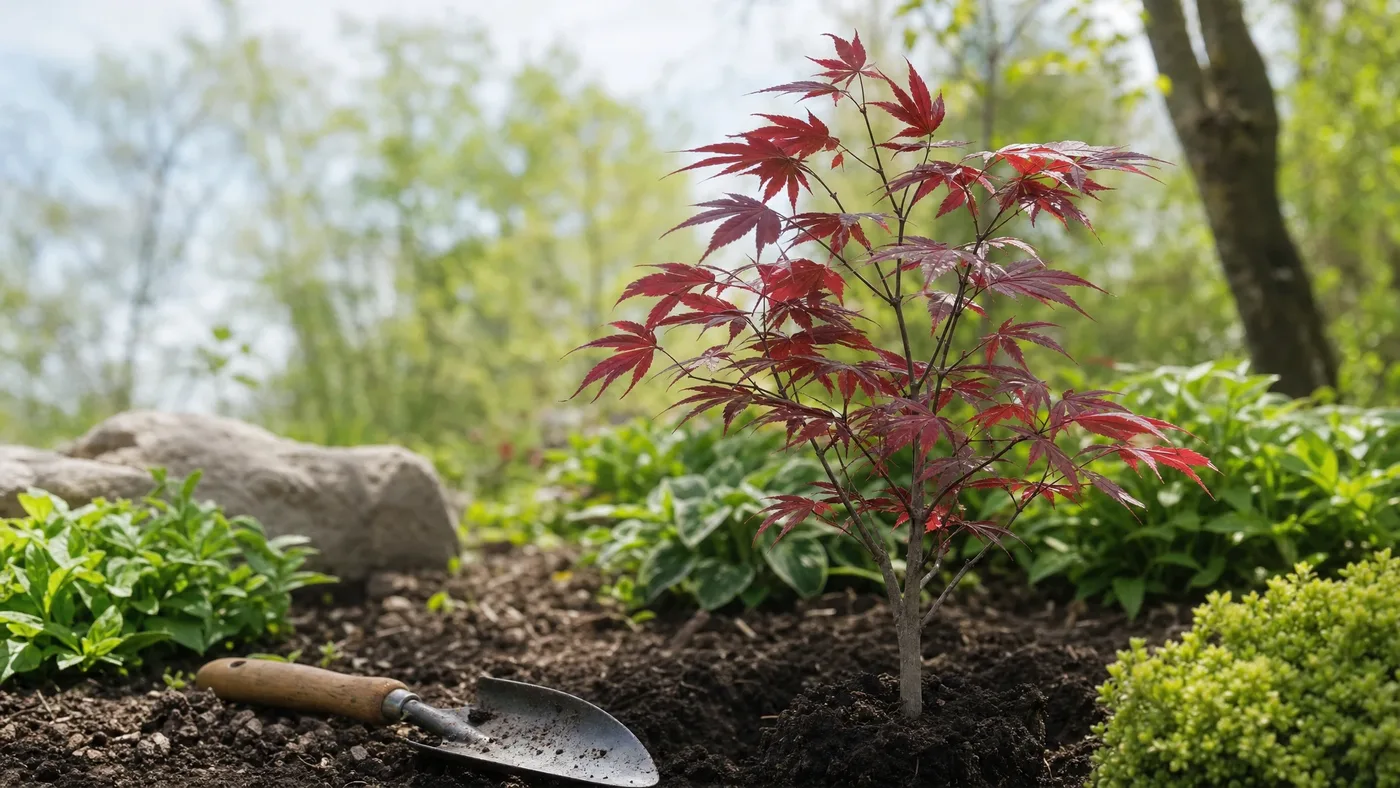
How Far to Plant a Japanese Red Maple From the House
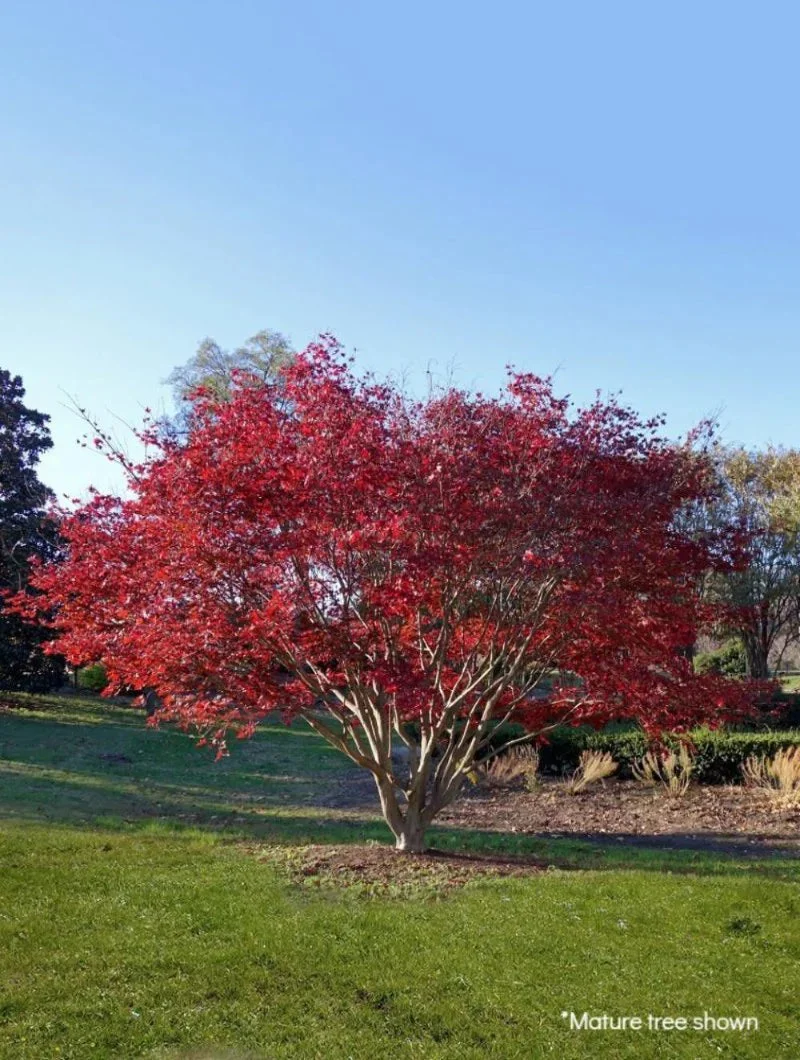
Plant an upright Japanese red maple 8 to 12 feet from the house and a dwarf or weeping form 4 to 6 feet out. The rule is half the mature spread plus a couple of feet. Roots are rarely the problem near a foundation. Canopy width is, so measure the tree you will have in 10 to 15 years.
Spacing is one step in the larger planting job, which our guide to how to plant a Japanese red maple the right way walks through from hole to mulch.
Distance by Tree Form
| Form | Mature spread | Distance from house |
|---|---|---|
| Standard upright red forms | 12 to 20 ft | 8 to 12 ft |
| Dwarf, cutleaf or weeping forms | 8 to 12 ft | 4 to 6 ft |
Uprights usually reach 15 to 25 ft tall. Dwarf and cutleaf cultivars often stay 6 to 10 ft. Those are species-level ranges, and the exact figures vary by cultivar.
Roots and Foundations
Will Japanese maple roots damage my foundation?
Unlikely. Japanese maple roots are shallow, fibrous and non-aggressive, which makes this one of the safer trees to put near a house. The real risk is wet soil: root rot develops in poorly drained ground, so keep downspouts from dumping at the root zone.
Is the fear about japanese maple roots at the foundation justified?
Mostly no. That worry belongs to large shade trees, and it gets attached to anything called a maple. The common mistake runs the other way: a 15-ft-wide tree planted 3 ft from the siding because it looks tiny in a container.
Can I plant a Japanese maple under the eaves?
Avoid it. A roof overhang blocks rain, and this tree wants even moisture, especially in its first 2 to 3 years. Plant beyond the drip line, or commit to regular watering.
Does the soil next to a foundation cause trouble?
It can. Backfill beside a house is often compacted and poor in organic matter, while the tree wants rich, well-drained loam at a pH of roughly 5.5 to 6.5. Loosen the planting area wide, not just deep.
Canopy Width and the Distance Rule
What is the rule of thumb for planting a Japanese maple near the house?
Take half the mature spread and add a couple of feet. A 12 ft spread gives about 8 ft, and a 20 ft spread gives about 12 ft. Measure from the trunk, not from the edge of the bed.
How far should an upright form sit from the wall?
8 to 12 feet. That keeps branch tips off the siding and leaves room to walk around the trunk. It also lets the tree hold its natural shape instead of leaning away from the wall.
How close can a dwarf or weeping form go?
4 to 6 feet. Use the upper end if the cultivar sits at the wide end of the 8 to 12 ft spread range. Check the specific cultivar's listed width before you dig.
Can I plant 3 feet from the siding for instant effect?
You can, but you will regret it. Growth is roughly 6 to 12 inches a year, so it looks fine for several seasons, then branches press the wall and trap moisture. Pruning is limited to dead, crossing or crowded wood in late fall to midwinter, so you cannot simply shear it back to fit.
What if my tree is an unnamed seedling?
Plan for the larger end of the range. Seed-grown red maples can vary in mature habit and color, while named cultivars are grafted and more predictable. Our guide on how big a Japanese red maple gets and how fast covers the variation in detail.
Walks, Drives, Other Trees and Utilities
How far from a walkway or driveway?
Apply the same half-spread rule to the pavement edge. Otherwise expect branches to overhang and brush car roofs and shoulders. Also keep the tree away from de-iced surfaces, since salt tolerance is poor.
How far from other trees?
10 to 15 feet for standard forms, and less for dwarf cultivars. Crowding gives you thin, one-sided growth and uneven color. A Japanese maple also gets lost under a larger neighbor's canopy.
What about buried utilities and overhead lines?
Call 811 before digging, every time. Avoid planting under power lines, since an upright can reach 15 to 25 ft. For septic lines or private irrigation, ask your local cooperative extension office or the installer.
Sun, Wind and Site Conditions
Is the south or west wall a bad spot?
In hot-summer climates, often yes. Reflected heat and wind cause leaf scorch, and afternoon shade preserves color. An east-facing exposure with morning sun is the easier site.
Will a young tree in full sun get sunscald?
It can. Trunk sunscald is a documented problem on young trees in full sun. Planting where the house shades the trunk in the afternoon helps.
Tight Spaces and Choosing a Tree
Who should not plant one near the house?
Anyone with a bed narrower than about 4 feet, or a spot outside USDA zones 5 to 8 (some cultivars tolerate zone 9 with afternoon shade). A narrow strip suits a dwarf form or a container better. Container trees need root protection in freezing winters.
Which size should I start with?
Start small and plant at the right distance. Nursery-grown trees come in 3-gallon, 5-gallon and 7-gallon sizes at our shop, and the smaller ones establish well. You get the mature canopy in 10 to 15 years either way.
What should I plant beneath it?
Hostas, ferns and hakone grass suit the shade and moisture. Treat the maple as a specimen set out from the wall, not as a foundation shrub tucked against it. The landscape ideas and companion plants guide shows layouts.
Quick Reference
| Situation | Distance or action |
|---|---|
| Upright form from house | 8 to 12 ft |
| Dwarf or weeping form from house | 4 to 6 ft |
| From other standard trees | 10 to 15 ft |
| Utilities | Call 811 before digging |
| Under eaves | Avoid; plant beyond the drip line |
| Hot south or west wall | Provide afternoon shade |
| Near de-iced pavement | Keep clear; salt tolerance is poor |
Japanese Red Maple
Nursery-grown Japanese Red Maple in sizes from 3 Gallon 2-3 ft, shipped to your door.
From $118.33
Shop Now →