Acer Palmatum vs Acer Japonicum: Red Maple vs Full Moon Maple
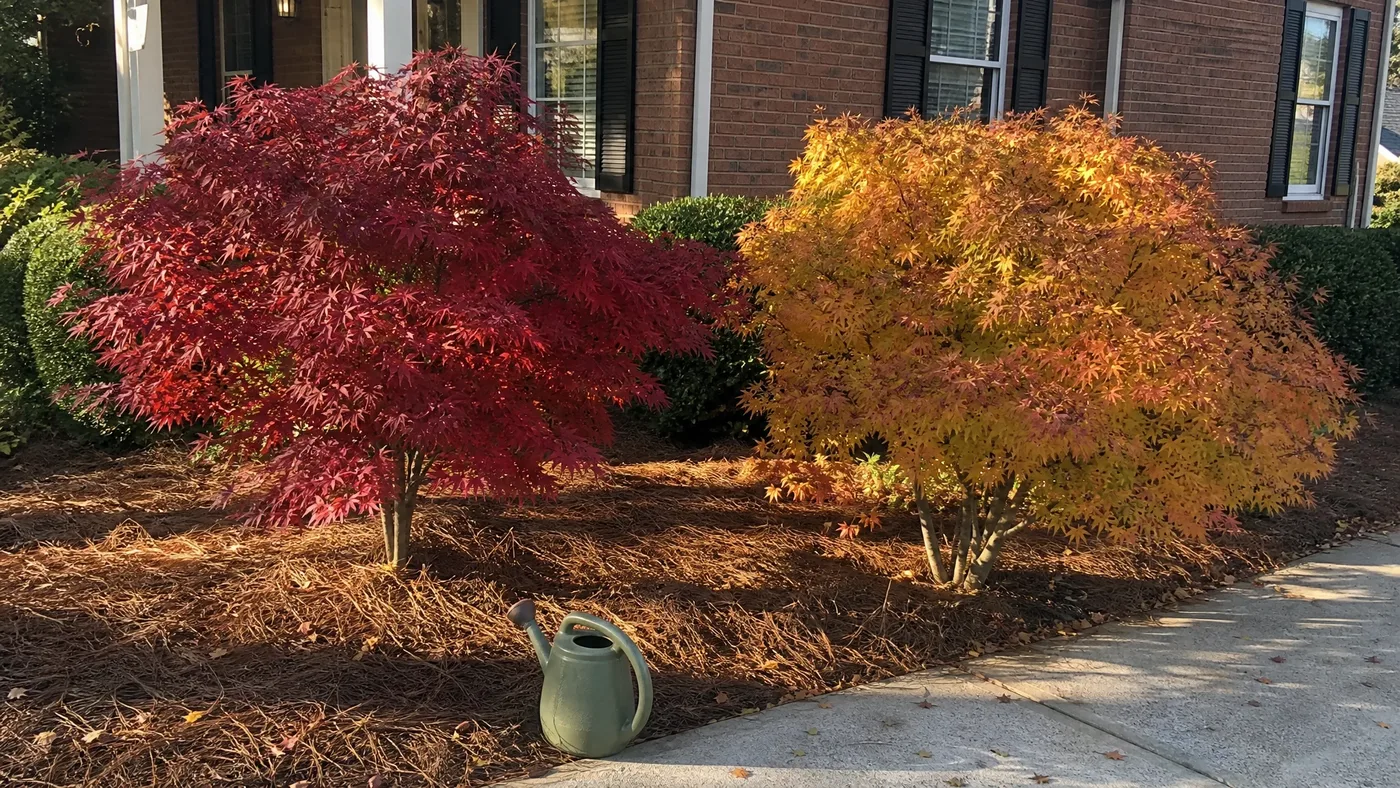
Picture a mixed woodland garden in October, with two maples in the same bed. One lights up in yellow and orange while the other holds a deeper red, and every visitor asks what you did differently. Usually the answer is that you planted two species and only knew about one. Mixing them up costs the plant, not you: a full moon maple set on a hot, windy slope scorches every July, and a red palmatum bought for gold simply never turns gold.
Buyers keep running into Acer japonicum listed next to the red Acer palmatum, and the two are not interchangeable. In this article, we'll go through where each tree sits in a landscape, how they handle cold and heat, how big they get, how their fall color compares, and how to tell them apart by counting lobes on a single leaf.
Japanese Red Maple and Full Moon Maple Across the Landscape
Stand at the far end of the yard and the first difference is not shape but season. A red-leaved Japanese maple opens with red to purple foliage in spring and carries it into summer, though it may fade toward green or bronze in real heat. A full moon maple is a green tree for most of the year, with soft green summer leaves, and it earns its place in the bed in autumn.
That changes what you plant it for. We treat the red palmatum as a focal point, the dark note you can read from across the lawn or from the road. The full moon maple is quieter. It works as a woodland tree that fills a shaded corner with soft green and then surprises you in October.
Where Each Tree Sits in the Bed
The red palmatum is the more flexible of the two on light. The red-leaf form takes anything from 2 to 6 hours of direct sun up to full sun, and the species can still scorch with excess sun, wind or drought. In practice that means morning sun and afternoon shade, with a windbreak if the spot is exposed.
The full moon maple asks for more shade. Partial to full shade is preferable at the southern limits of its range, and we would not argue with that. If your only open spot is a bright, hot, windy one, the palmatum is the tree that has a chance there, and even it will want some help.
How They Read From Across the Yard
Plant a red palmatum against a dark evergreen or a pale wall and the color does the work for you. Plant a full moon maple in front of the same backdrop in July and it nearly disappears, which is fine if you wanted a calm green layer. Plant it where the October light hits it and you will understand why people collect them.
Put the two in one bed only if you want that contrast on purpose. Otherwise pick the one that matches the job. A red-leaved buyer who wants color from May through September is shopping for the palmatum, not the full moon.
Hardiness and Heat for Japanese Red Maple by Region
The two trees overlap in the middle of the country and part ways at both ends. UF/IFAS lists Acer palmatum for zones 5B through 8B, and the red-leaf form is given as 5a through 8b. Acer japonicum grows in zones 4B through 7B. Shared ground is roughly zones 5B to 7B.
Think of it as the full moon sliding one step colder and the palmatum sliding one step warmer. If you garden in zone 4, the full moon maple is the one that belongs on your list. If you garden in zone 8, the red palmatum is, because the full moon maple stops at 7B in the sources we use.
Cold Hardiness and Late Frosts
Colder does not mean easier. The red-leaf form stays quite small in zone 5, and frost damage, especially from late frosts, can occur on the species. A palmatum pushed too far north is not killed so much as held back, with tips lost in spring and a lopsided shape to show for it.
We tell customers in zone 5 to choose the most sheltered corner they have, away from the low spot where cold air pools. Our hardiness zone guide goes through the map in more detail, and your local extension service knows your microclimate better than any zone number does.
Summer Heat and Leaf Scorch
Heat is where the full moon maple loses ground. Warm-region gardeners often hear that the full moon is simply a hardier Japanese maple, and that is true of cold but not of heat. Brown, crisped leaf edges are the same story on both trees, and the cure on both is shade, water and shelter from wind. If you are already seeing it, read about leaf scorch on a Japanese red maple.
The red palmatum has an extra heat symptom of its own. That red and purple spring foliage may fade to green or bronze in summer, so color holds best where nights cool off and afternoons are shaded. A full moon maple has no color to fade, but it does have less margin before the leaves burn.
Mature Size of a Japanese Red Maple Against Full Moon
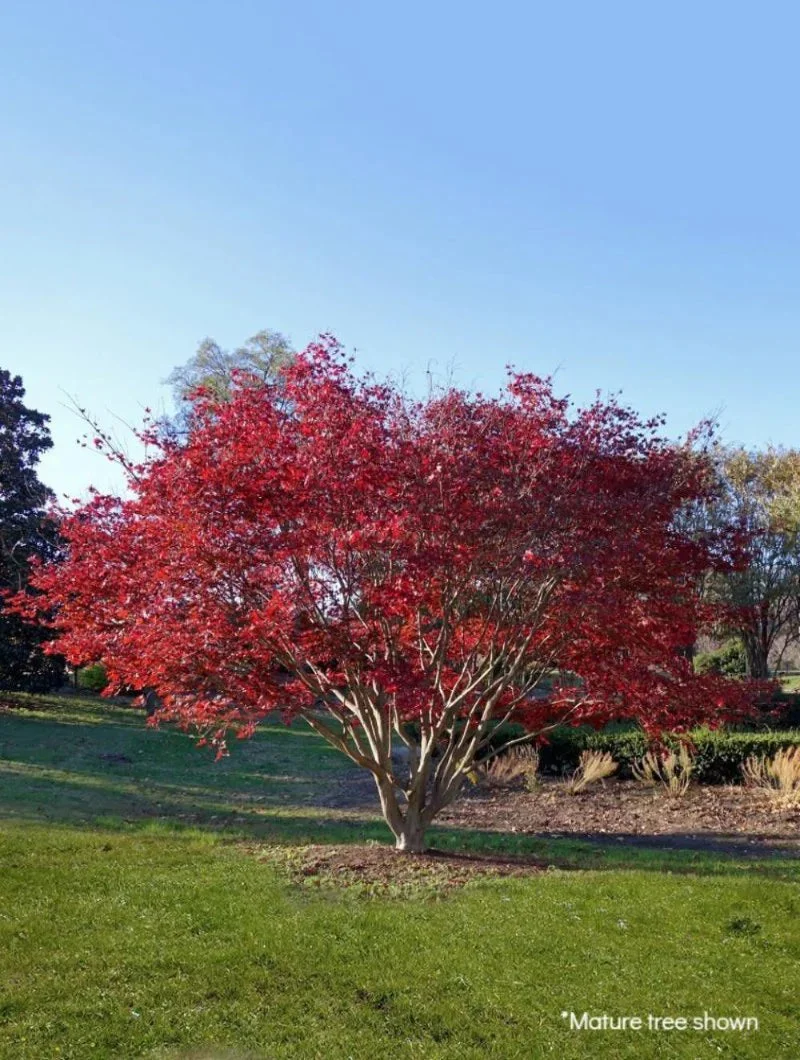
On paper the two trees are close. Acer palmatum has a mature height of 15 to 25 feet and a width of 10 to 25 feet, and the red-leaf form is described as a small tree of about 25 feet. The full moon maple reaches 10 to 30 feet in height and width, depending on cultivar.
The wide range on the full moon is the thing to notice. It comes from the cultivar you choose, and an unnamed tree gives you no way to guess where in that range it will land. A red palmatum is more predictable. Our guide on how big a Japanese red maple gets covers the year-by-year picture.
Height, Width and Pace in Numbers
The table below puts the figures from our sources next to each other. Growth rate is the one that surprises people, since the full moon is the slower of the two.
| Trait | Red Acer palmatum | Acer japonicum |
|---|---|---|
| Mature height | 15–25 feet | 10–30 feet, depending on cultivar |
| Mature width | 10–25 feet | 10–30 feet, depending on cultivar |
| Growth rate | Slow to moderate | Slower than Japanese maples |
| Summer leaf color | Red to purple, may fade to green or bronze | Soft green |
What the Slower Growth Means
Missouri State's guidance says the full moon maple has a slower growth rate than Japanese maples. At the nursery that shows up as a smaller tree after the same number of seasons. In the yard it means patience, and it means you should not buy a tiny one expecting it to fill a corner by the third summer.
For spacing, plan for the top of the range with either tree and then be pleasantly surprised. Both are small trees, and both are slow enough that crowding is a problem you will meet at year ten, not year two.
Japanese Red Maple Fall Color Against Gold
The full moon maple's reputation rests on fall. Its exceptional yellow to red fall color varies between cultivars, which is why people photograph it. A red-leaved palmatum is a different kind of tree, because its color is already doing its job in May, so autumn is an extra rather than the point.
Acer palmatum fall color runs through yellow, bronze, purple and red depending on the cultivar. The red-leaf form's leaves are typically red to purple in spring but may fade to a green or bronze in summer heat. So a red palmatum can look tired in August, then recover its color as nights cool.
Matching Expectations to the Tree
If what you want is a tree that is red from spring to fall, buy the red palmatum and do not expect the full moon to deliver it. The full moon will give you green for months, then color. Our fall color guide sets out what a red palmatum does in a normal year.
The reverse disappointment is just as common. People buy a red-leaved Japanese maple hoping for the glowing yellow they saw on a neighbor's tree, and get dark red or bronze instead. Species and cultivar decide this, and so does the weather that year.
Why Color Varies Between Years
Neither tree is guaranteed the same show each autumn. Both source pages say color depends on the cultivar, and a tree stressed by drought or scorch in summer rarely finishes well. We have found that the best fall color follows a summer when the tree never dried out and never fried.
Why Nurseries Push Japanese Red Maple Over Full Moon
Nurseries lean toward the palmatum for plain reasons. It has a wider zone range into the warm side, it holds red foliage all season, and it is the tree most buyers are picturing when they say "Japanese maple." The full moon maple is slower, and Missouri State notes it can be more demanding in its need for moist, well-drained, high-organic soil than Japanese maples.
A slower tree with fussier soil needs and a green summer is a harder sell on a sales bench. That is not a knock on the tree. It is a reason you will see far more red palmatum than full moon in the trade, and why labels get sloppy when both are in the same row.
Why the Label Is Not Always Enough
One of the most common questions we get is whether a full moon maple is just a green Japanese maple. It is not, and there is a wrinkle on the palmatum side: the name Atropurpureum refers to the red-purple leaf color and is used for many red-leaved seedlings. A red-leaved tag tells you about color, not about a specific named tree. Our piece on grafted versus seedling Japanese red maples explains what that means for you.
Our Verdict for a Red-Leaved Buyer
If you want red leaves, buy the palmatum. It is the right tree for most zones from 5 to 8, and it gives you the color in spring, when you want it. The red-leaved plants we grow are palmatum, and we would rather say so plainly than let a tag blur it.
Choose the full moon maple if you garden in zone 4, if you have a cool shaded spot that suits a soft green tree, and if you want yellow to red autumn above all else. In a hot, open site, we would pass on it.
Lobes and Leaf Shape on a Japanese Red Maple
When tags fail, the leaf does not. Acer palmatum leaves are 2 to 5 inches, opposite and simple, with five to nine lobes, most deeply lobed. The deeply divided, soft green leaves of the full moon maple have 9 to 11 lobes. The two ranges meet at nine, so you need to check more than one leaf.
Keep in mind that a red leaf is not proof of anything. A full moon maple can turn red in autumn, and a palmatum can fade to green in July. Color moves around with the season and the tree. Lobe count mostly does not.
How to Count in Hand
Take the leaf from the middle of a healthy shoot. Leaves at a shoot tip are often undersized and leaves on a sucker are often odd, so neither is a fair sample. The steps below take about a minute.
- Pick three mature leaves from different branches, fully expanded and not damaged by scorch.
- Count every lobe, including the smaller ones near the base, on each leaf.
- Five to seven lobes on all three points to palmatum, and nine to eleven on all three points to full moon.
- If the count sits at nine, look at the tree as a whole, including its summer color, and ask the nursery which species it is.
Where Counting Gets Harder
Cutleaf and laceleaf palmatum forms, such as 'Dissectum Atropurpureum', have leaves cut so finely that a clean count is difficult. For those, judge by the overall plant, which is a small, slow, mounded shrub of about 5 to 8 feet, not a tree. A full moon maple will not look like that.
Count the Lobes Before You Pay
Carry one leaf into the nursery, or pick one off the tree in front of you, and count the lobes. Five to seven is a palmatum, nine to eleven is a full moon, and nine is where you stop and ask. For a red-leaved buyer in zones 5 to 8, the palmatum is our choice. For zone 4 or a cool shady corner, the full moon earns its place.
Do not argue with the botany. If the tag says one thing and the leaf says another, the leaf is right.
Japanese Red Maple
Nursery-grown Japanese Red Maple in sizes from 3 Gallon 2-3 ft, shipped to your door.
From $118.33
Shop Now →Before we recommend a Japanese Red Maple, we raise it ourselves in soil that drains freely yet stays evenly moist, with shade to break the hot afternoon sun. Each one we send out was grown in our own fields, so the tag on the pot matches the tree inside it. If you have settled the palmatum versus full moon question, come see our Japanese Red Maples and choose the one for your yard.