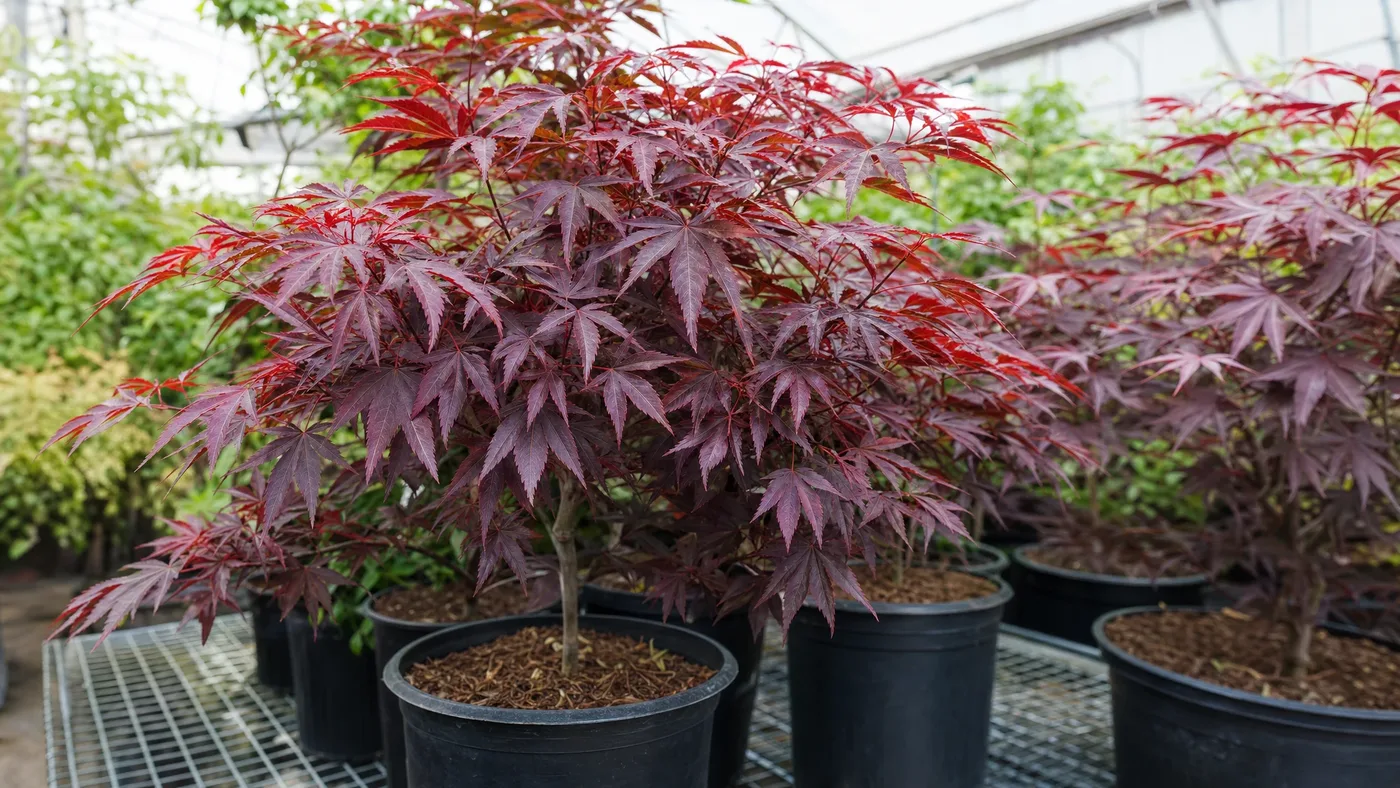
Grafted vs Seedling Japanese Red Maple: What You're Buying
A grafted Japanese red maple is a named clone, so its size, form and summer color are predictable. A seed-grown one is a genetic individual: usually attractive, occasionally outstanding, sometimes green by July. Neither is a bad tree. Grafted is the better buy for one showpiece; seed-grown suits hedges, groupings and experimenters.
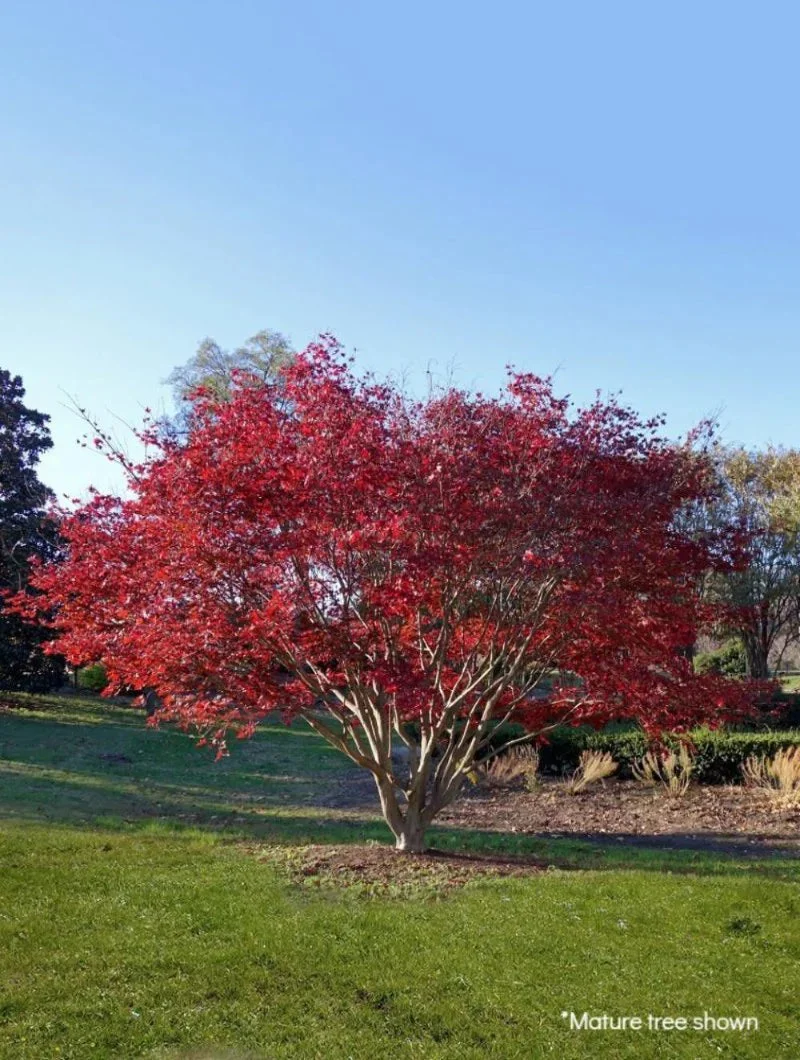
This post is a companion to our Japanese red maple buying guide, which covers container sizes and what to check at delivery. Here we focus on the single distinction that explains much of the price spread in the market: how the tree was propagated.
The short version: grafted vs seedling at a glance
| Attribute | Grafted named cultivar | Seed-grown red |
|---|---|---|
| What it is | A clone of one chosen parent tree, joined onto seedling roots | A genetic individual grown from seed |
| Trueness to type | High. Every tree matches the named cultivar | Variable. Siblings can differ |
| Summer color hold | Predictable for that cultivar | Usually red to reddish-purple, but some drift greener in heat |
| Mature size | Predictable range for the cultivar | Falls somewhere in the species range |
| Price pattern | Higher per size, because grafting adds labor and time | Lower per size |
| Main failure mode | Rootstock suckers below the union | Color and size lottery |
| Typical listing wording | A cultivar name in quotes, such as 'Bloodgood' | "Red Japanese maple," "Japanese Red Maple," or Atropurpureum Group |
How to see which one you're buying
Start with the listing. A cultivar name such as 'Bloodgood', 'Emperor I', 'Fireglow' or 'Crimson Queen' signals a grafted tree, because named cultivars are propagated by grafting. A generic name like "red Japanese maple" is probably seedling stock. If the listing says Atropurpureum Group, that is a seed-grown red form, not one specific tree.
Then look at the trunk. A grafted tree usually shows a union low on the stem: a slight bulge, a change in bark texture, or a small dogleg where the scion meets the rootstock. A seedling tapers straight out of the soil with no join. On very small plants the union can be subtle, so do not treat a smooth trunk as proof. Ask the seller.
One planting note for grafted trees: set the root ball so the union stays visible above the soil line. Burying it makes it harder to spot and prune rootstock growth later.
Grafted Japanese maple: pros and cons
Pros
- You know what you are getting. A clone repeats the parent's leaf color, habit and general size. That matters if you are matching a second tree to the first.
- Summer color is less of a gamble. Some seedlings turn greener in heat or deep shade. A selected cultivar was chosen partly because it holds color.
- Size planning works. The species runs 15-25 ft tall for standard upright reds and 6-10 ft for dwarf or cutleaf types. A named cultivar lets you plan inside one range instead of the whole span.
Cons
- Cost. You pay for the extra propagation step and the years it takes.
- Rootstock suckers. Shoots can emerge from below the union, usually with green leaves. They are manageable, but you have to catch them. Our post on rootstock suckers and green branches explains how to tell them apart and remove them.
- A weak point at the union. It needs protection from damage while the tree is young.
Seed-grown Japanese maple: pros and cons
Pros
- Lower cost per size. That lets you buy more trees, or a larger one, for the same budget.
- No graft union. A seed-grown tree grows on its own roots, so there are no rootstock suckers to chase.
- Natural variation can pay off. Plenty of seedling reds are handsome, and a few turn out better than expected.
Cons
- Color is not guaranteed. Seedlings do not reliably come true from seed. Some end up reddish-purple all summer, others fade toward green by midsummer. Our propagation guide explains the genetics behind this.
- Size and habit vary. You may get a taller or looser tree than you pictured.
- Zone and heat tolerance can shift. The hardiness range is zones 5-8, but the exact limits can move by a full zone depending on the genetic line. A seedling's line is unknown.
Our position: seed-grown is not a scam
Online forums sometimes treat any unnamed red maple as a bait-and-switch. That is unfair. A seed-grown red is a different product, honestly priced for what it is. The problem only arises when a buyer expects a clone and receives an individual. The fix is clear labeling and the right match between tree and job, not avoiding seedlings altogether.
Best for: matching the tree to the job
| Your use case | Better fit | Why |
|---|---|---|
| One front-yard specimen chosen for exact color and size | Grafted | You need a known result, and the tree is the focal point |
| A hedge, screen or mass planting | Seed-grown | Small differences between trees blend in, and cost multiplies with count |
| A grove or naturalistic grouping | Seed-grown | Slight variation looks natural |
| A matched pair flanking an entry | Grafted | Clones match each other in form and color |
| A tight patio or courtyard with a size limit | Grafted (dwarf type) | Dwarf cultivars stay 6-10 ft, and a seedling could outgrow the space |
| You like experimenting and can wait for results | Seed-grown | Low cost, and a good chance of a pleasant surprise |
Who should not choose which
Skip seed-grown if a specific shade, a size cap or a matched pair is a requirement. Skip grafted if you will not check the base for suckers, or if the budget forces you to buy fewer trees than the planting needs. Neither type fixes a poor site. Both want afternoon shade in hot-summer climates, consistent moisture and well-drained, slightly acidic soil (roughly pH 5.5-6.5).
Questions to ask any seller, including us
- Is this tree grafted or grown from seed? A direct answer is a good sign. Vagueness is not.
- Is there a cultivar name? If not, treat the tree as seed-grown, with variable color and habit.
- Can I see the base of the trunk? Ask for a photo of the union if the tree is grafted.
- What is the expected mature size range? For an unnamed seedling, an honest answer is a wide range.
- What container size and height does it ship at? Size tells you how many seasons of growth you are paying for. The species grows roughly 6-12 in per year.
- What is the zone range? Compare it with your USDA zone, and check with your local cooperative extension office if you are at the edge of zone 5 or 9.
If you want nursery-grown trees to compare, our 3-gallon (2-3 ft), 5-gallon (2-3 ft, more developed) and 7-gallon (3-4 ft) trees are at our shop. Check each listing for whether it names a cultivar, and ask us if it does not. A tree sold only as "Japanese Red Maple" should be assumed seed-grown and variable. For a side-by-side of named cultivars, see our varieties and cultivars comparison.
The verdict
Buy grafted when the tree has to perform one specific job: a single specimen where color, form and final size are part of the design. Buy seed-grown when numbers matter more than exactness: a screen, a grove, or a first experiment with the species. The wrong move is paying cultivar-level expectations on a seedling, or paying cultivar-level prices for a tree nobody can name. Slow growth means either choice takes 10-15 years to reach real landscape size, so choose the one you will still be happy with then.
Quick reference
| Check | Grafted | Seed-grown |
|---|---|---|
| Listing name | Cultivar in quotes | Generic or Atropurpureum Group |
| Trunk base | Union bulge or dogleg | Smooth taper |
| Color expectation | Matches the cultivar | Usually red, may fade to green |
| Watch for | Green suckers below the union | Size and color surprises |
| Best use | Specimens, pairs, tight spaces | Hedges, groves, experiments |
| Hardiness | Zones 5-8 (cultivar may vary) | Zones 5-8 (line unknown, may shift a zone) |
| Before buying | Ask for a union photo | Ask what size range to expect |
Japanese Red Maple
Nursery-grown Japanese Red Maple in sizes from 3 Gallon 2-3 ft, shipped to your door.
From $118.33
Shop Now →