Japanese Red Maple vs Bloodgood: Is the Seedling the Same Tree?
You were handed a pot with a tag that reads only "red Japanese maple," and the price looks low next to the Bloodgood across the aisle. What is actually in that pot, and how would you find out before you pay?
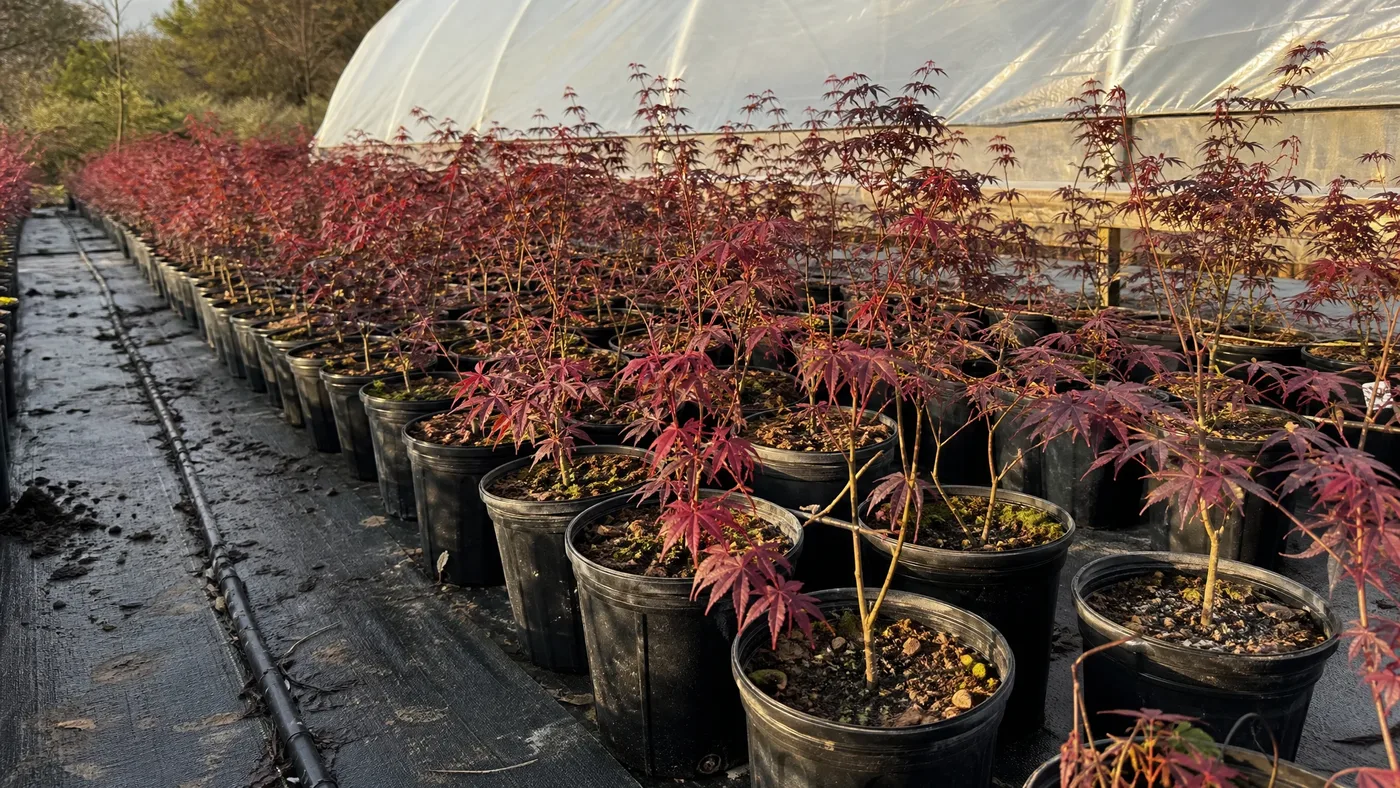
Most people assume the two are the same tree, with the cheaper one just younger or smaller. What we see instead is two different kinds of plant. Bloodgood is a named cultivar, a clone. An unnamed red is usually a seedling, and no two seedlings are guaranteed to match.
We'll walk you through reading the tag and what seed-grown variation looks like, then how to judge leaf color in the first summer and growth through year five, and finally hardiness, the price gap and a clear way to choose.
Start With What the Tag Actually Says
Look for single quotes. A named cultivar is written 'Bloodgood', and the name is the promise that the tree was propagated from one parent plant. A tag with only a common name makes no such promise. The Atropurpureum name is used for many red-leaved seedlings, so even that word on a tag does not point to one specific tree.
Use this table as a decoder when you are standing at the bench.
| What the tag says | What is probably in the pot | What to do |
|---|---|---|
| 'Bloodgood' | A grafted or cutting-grown clone | Ask which, and look for a graft union |
| Atropurpureum or Atropurpureum Group | A red-leaved seedling or a loose group of them | Treat it as a seedling |
| "Red Japanese maple" only | A seedling of unrecorded parentage | Ask the seller how it was grown |
| 'Dissectum Atropurpureum' | A weeping cutleaf, 5–8 feet tall and wide | Wrong tree if you want an upright 15-footer |
The quickest physical test is the trunk. Grafted trees show a bump or seam low on the stem where the red top meets the rootstock, and seedlings run straight into the roots with no seam. Our grafted vs seedling guide shows what that union looks like.
One of the most common questions we get is whether the cheaper tree is just a Bloodgood nobody bothered to label. Plan on it not being one. A grower with a true Bloodgood has every reason to say so.
If Your Japanese Red Maple Is Seed-Grown, Expect Variation
A seed carries genes from two parents, and only one of them is the red tree you can see. That is why a flat of seedlings from the same lot is a family and not a set of copies. Every one of them is a real Japanese maple, and none is a defective Bloodgood. Our cultivar comparison makes the same point from the other side.
What Varies Between Siblings
The differences you can see are depth of red or purple, how early the leaves open, leaf shape and vigor. Branching habit differs too, so one seedling may be upright and tidy while its neighbor sprawls. At quart size most of this is not yet visible, which is the whole risk of buying small.
What to Do With an Off-Type Tree
Sort the tree into one of these cases before you decide anything.
- If the leaves open green and stay green, you do not have a red tree. Return it or swap it while the seller will still take it back, and do not wait a year hoping it changes.
- If the red is duller than you hoped but even and healthy, keep it. It is inside normal variation, and a quiet burgundy often looks better beside green shrubs than a loud one.
- If the color is good but the shape is awkward, you can shape it with careful structural pruning, and a seedling takes that as well as any other maple.
- If the tree is red in spring and bronzed by July, hold your verdict until you have checked the site, as the next section explains.
Reading Leaf Color in the First Summer
Bloodgood is red through summer except in hot dry areas, where it may turn greenish red. For the generic red-leaf form the claim is more cautious: red or purple in spring, possibly fading to green or bronze in summer heat. So a faded leaf does not prove a tree is a seedling. It tells you to look at the site.
Run the check in this order.
- Note the color of the new leaves as they open in spring. Red or purple here is what you paid for.
- Look again once the leaves are full size. Compare the sunniest side of the crown with the shaded interior.
- Check after the first long hot spell. A color shift that follows heat and dry soil points to the site.
- Check again when cooler weather returns. A tree that recovers some red was stressed, and a tree that stays green was never going to hold.
- Take a dated photo each time, from the same spot.
If the fade is limited to the sun-facing leaves, give the tree afternoon shade and even moisture and look again next year. Our guide to red Japanese maples turning green works through the causes in detail.
If every leaf on the tree is green-bronze all summer, in a spot where a neighboring tree stays red, you have your answer about the seedling. Moving it will not fix a color that the genes never held. Do not read a late fall change as a problem either, since Japanese maples are often one of the last trees to change color.
Japanese Red Maple Growth and Size by Year Five
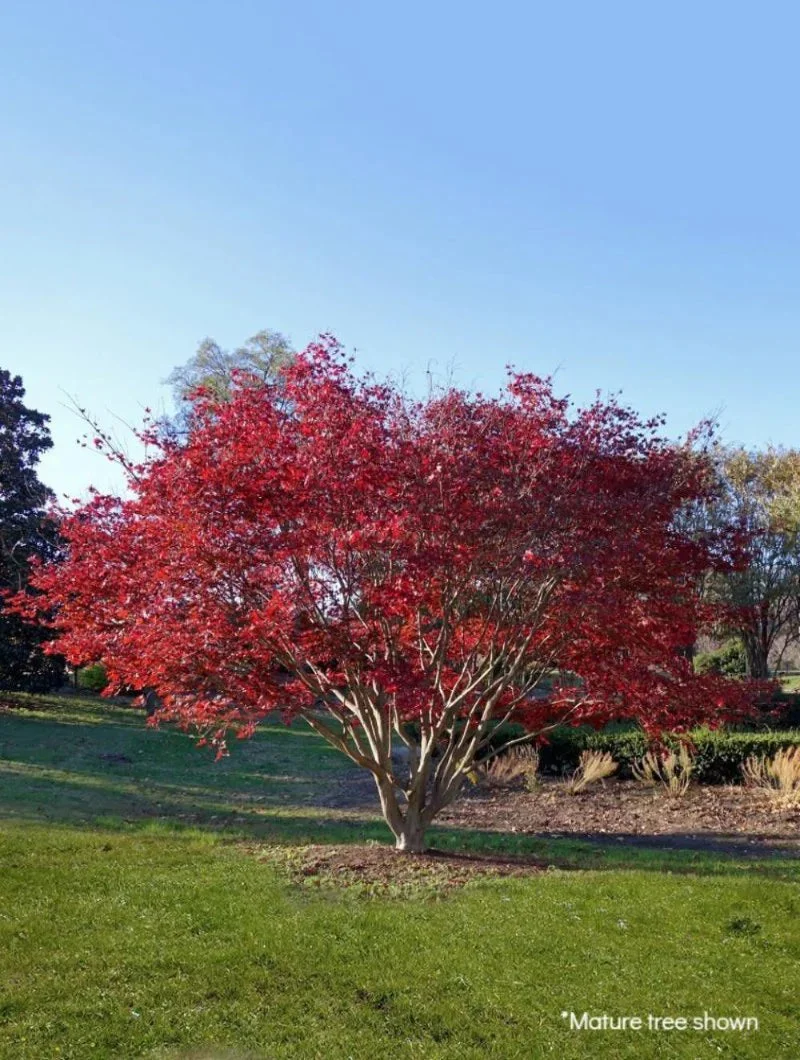
Neither tree is a fast grower, and that is useful to know before you give up on a small one. The species' growth is slow to moderate at 15 to 25 feet tall, and Bloodgood gets the same rate. The red-leaf form is a tree of about 25 feet, and it stays quite small in zone 5.
The gap is in the ceiling. Bloodgood is a small round-headed tree 15 to 20 feet tall, and up to 20 feet tall and wide is given as well. A seedling has no such cap on paper. We found no source with measured heights at year five for either tree, so ask your local extension office what to expect in your region.
Reading Your Tree Against Its Neighbors
Plant two or three seedlings of the same age side by side and the differences show up early. Use that as your guide.
- If one seedling is clearly outgrowing the others, plan for the 25-foot end and leave it room to spread.
- If a seedling stays compact and slow, you have a smaller tree than average and can place it closer to a patio or a window.
- If growth is slow in a cold zone, do not assume something is wrong. Slow is the normal pace in zone 5.
- If a Bloodgood in your row looks bigger than its siblings, remember that more than one clone is sold under that name, which we come back to below.
In our rows, seedlings from one lot rarely look alike by the third year, while clones of one parent keep much the same shape.
Cold Hardiness: Where Each Tree Holds Up
On paper the two are the same. The red-leaf form and Bloodgood are both rated for zones 5a through 8b, and the species is rated 5B through 8B. No source we checked takes either tree to zone 9. The practical difference is not the range itself but how much you can trust it at the edge.
A named clone is a single genetic individual, so if it survives your zone 5 winter once, the next one is likely to as well. A seedling is one draw from a family. Most will behave, and a few will be less tough, which matters only near the cold limit.
If Your Site Is Borderline
Winter cold is rarely the first problem. Late frost on newly opened leaves is. Frost damage, especially from late frosts, is among the issues for the species. So avoid low spots where cold air pools and open ground that gets winter wind. Deer also occasionally or frequently browse tender new growth, so protect young trees where they roam.
If you garden in zone 5, put either tree on a sheltered side, mulch the root zone and buy it in a size you can protect. Our zone 5 guide covers the options. At the warm end, 8b, the risk flips to hot dry summers, and Bloodgood's greenish red in hot dry areas is the same warning.
Why Bloodgood Costs More Than a Japanese Red Maple Seedling
The price gap is mostly labor and time. Bloodgood is propagated through grafting and stem cutting. Grafting means growing a rootstock, joining a cutting of the named tree to it by hand, and then waiting for the union to knit. A seedling skips all of that. Someone sows seed and grows the plant on.
There are three real costs behind the higher price.
- Skilled hand work, since each graft is made one at a time and some fail.
- Extra nursery time, because the plant needs to heal and then grow before it can be sold.
- The name itself, which is a record that the plant came from a chosen parent.
What the extra money buys is consistency, not perfection. More than one clone is sold as Bloodgood, so two named trees can still differ a little. They will differ far less than two seedlings.
The other side of the bill is that a graft is two plants in one. The rootstock can send up green shoots that are not the red tree and have to be removed. A seedling has only its own roots and nothing to sort out. For current numbers, see our cost guide.
Choosing Between a Japanese Red Maple and Bloodgood for Your Yard
Start with how many trees you need and how much alike they must look. Everything else is secondary.
Pay for Bloodgood When
Choose Bloodgood if you are planting a pair, a row or a screen, or matching a tree to one you already own. It is also the better pick if a specific, known color matters to the design, or if you are in a hot, dry area and want the tree with the better documented record for holding red. You are paying for predictability.
Buy the Seedling When
Choose the seedling if you need one good red tree in one spot, you are working to a tighter budget and you can wait and see. Buy it in leaf, in summer, so you can judge the color before it comes home. A seedling you picked by eye is no more of a gamble than a name on a tag.
What to Ask the Seller
Before you pay, ask these questions and weigh the answers.
- Is this a named cultivar, and if so which one?
- Was it grafted, grown from a cutting or grown from seed?
- Can I see the leaf color on this exact tree today?
- If it comes in green, what is your return policy?
A seller who answers all four plainly is a seller to trust, whichever tree you buy.
Paying for Sameness or Keeping One Good Red
The two trees share a zone range, a slow pace and a general shape. They differ in how much they vary. Bloodgood is a clone with a narrower size cap and a better record for holding red. A seedling is a one-of-a-kind tree whose color and size you confirm by looking at it. If you need identical trees in a row, pay for Bloodgood. If one good red tree will do, a seedling bought in leaf is fine.
Japanese Red Maple
Nursery-grown Japanese Red Maple in sizes from 3 Gallon 2-3 ft, shipped to your door.
From $118.33
Shop Now →Here is how we raise Japanese Red Maple: the beds drain well, the soil stays evenly moist, and each tree gets shade for part of the day. Any tree we send out is one we would set in our own ground, the seedling you may be weighing against a Bloodgood included. Browse our Japanese Red Maples and pick one out while it is in leaf.