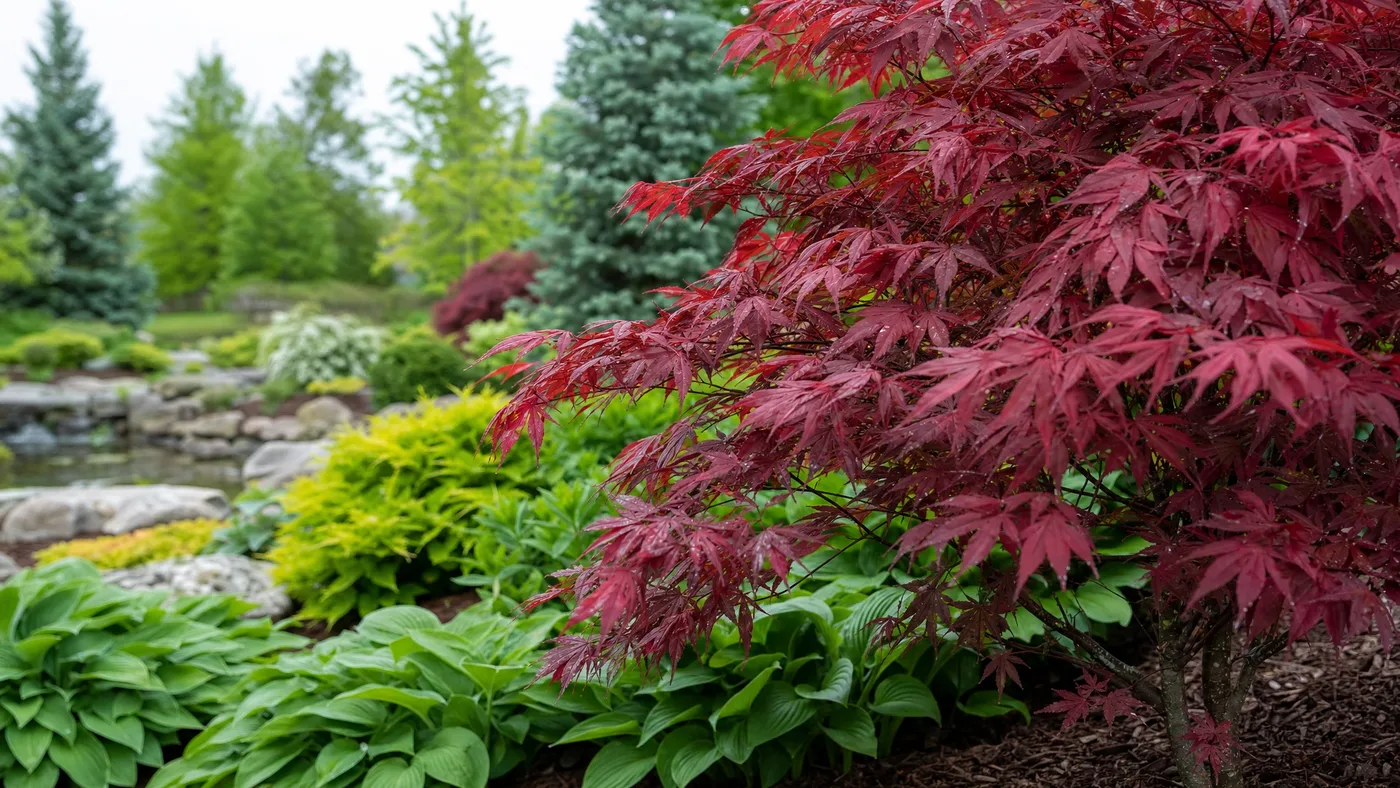
Red Japanese Maple Turning Green? Causes and Fixes
A red Japanese maple turns green for one of five reasons: normal summer bronzing, too much shade, too much nitrogen, heat stress, or rootstock shoots taking over a grafted tree. Bronzing and heat stress usually fix themselves. Shade and nitrogen fixes show next season. Rootstock takeover never corrects itself.
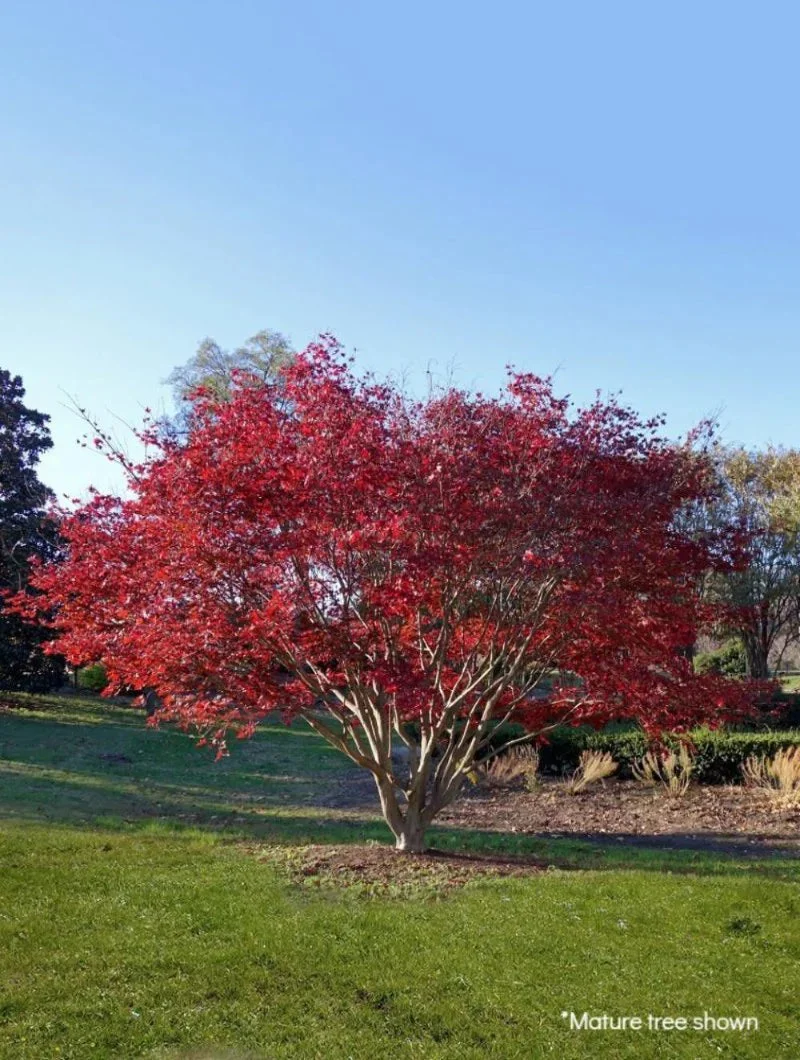
If you are asking why is my red maple green, treat it like a triage call: rule out the harmless causes first, then the fixable ones, then the urgent one. This is the most common cosmetic complaint we hear, and it is a different question from a tree that is actually declining. If the leaves are crisp, dropping early or the branches are dying back, you have a health problem, not a color problem, and that needs a separate diagnosis.
Symptom-to-Cause Table
Start here. Match what you see to the likely cause, then jump to the step that covers it.
| What you see | Likely cause | Will it turn red again? |
|---|---|---|
| Whole canopy slowly dulls in July or August | Normal summer bronzing | Usually yes, in fall |
| Only the side facing the house or a taller tree is green | Too much shade | Next season, after you change the light |
| Oversized, lush leaves plus a green shift | Too much nitrogen | Next season, after you stop the feeding |
| Green or scorched leaves after a hot, dry, windy spell | Heat stress | Usually yes, once conditions ease |
| A few branches clearly green and growing about twice as fast, from low on the trunk | Rootstock takeover | No. Never self-corrects |
What You Need
- A phone camera, to photograph the tree from the same spot each week
- A tape measure, for checking distance from walls and canopy edges
- Brightly colored ribbon or flagging tape, to mark suspect branches
- Clean, sharp hand pruners
- The bag from whatever fertilizer you have used, plus your lawn fertilizer schedule
- A soil pH test kit (optional, but useful if you are unsure of your soil)
Step 1: Check the Calendar and the Pattern (Normal Bronzing)
Look at the whole tree. Is the change gradual, even across the entire canopy, and happening in July or August? Red-leaved forms of Acer palmatum can shift greener in summer depending on the cultivar. Anthocyanin, the red pigment, fades as the season warms and chlorophyll takes a larger share of the leaf.
The tell is that nothing else is wrong. Leaves are the normal size, edges are clean, and new growth is not the issue. This is the harmless cause, and the tree typically moves to vivid red, orange or crimson in fall, though intensity varies by cultivar and season.
If your tree does this every summer and you want one that holds its color, that comes down to choosing the right selection. Our guide on which Japanese red maples stay red all summer covers that.
A genetics note: straight-species or seed-grown reds, the kind often sold as an unnamed quart-size plant, can show variable color and habit. If a seed-grown tree greens up in summer despite good care, that is its genetics, not something you did wrong. Named cultivars are grafted and tend to be more true to type. Nothing you change in the soil will turn a seedling into a different tree.
Step 2: Measure the Light (Too Much Shade)
Anthocyanins need light. In deep shade, the leaves shift greener, and the facts are consistent on this: color can fade in deep shade as well as in intense summer heat. That is why the tree needs a middle path.
- Walk around the tree on a sunny morning and again in late afternoon.
- Note which side is greenest. If it is the side facing the house, a fence or a neighboring tree, shade is your answer.
- Check whether a nearby tree has leafed out larger than it used to, or whether a hedge has crept toward the maple.
The target is full sun to part shade, with afternoon shade in hot-summer climates. If the tree sits in dense shade all day, trim back the competing branches (or the neighbor's, with permission) before you consider moving the maple. Our guide to Japanese red maple sun requirements lays out how much light is enough.
Moving a tree is a bigger job than it sounds. Plan it for early spring or fall, never peak summer heat.
Step 3: Audit the Fertilizer (High Nitrogen)
Too much nitrogen pushes soft, lush, oversized leaves, and the foliage often looks greener and growth can turn leggy. Overfeeding also weakens color. The tell is leaf size: if the new leaves are noticeably bigger than last year's and the shoots are long and floppy, suspect nitrogen.
Do not forget the sneaky source. Lawn fertilizer counts. A tree planted in or beside turf has roots reaching well beyond the canopy, and high-nitrogen lawn feed spread across the grass reaches that root zone. Pull out your lawn schedule and compare it with where the tree stands.
The fix:
- Stop all fertilizer on and around the tree for the rest of this season.
- Next spring, feed lightly, once, with a balanced, low-nitrogen fertilizer in early spring. That is usually sufficient.
- Keep lawn fertilizer spreaders off the root zone.
Rates and product choices are in our guide to fertilizing a Japanese red maple. If your soil pH is outside the roughly 5.5 to 6.5 slightly acidic range, a soil test is worth doing before you add anything else.
Step 4: Look for Heat and Water Stress
Heat stress overlaps with normal bronzing, so check what else is going on. Leaf scorch from hot sun, wind or drought stress shows as brown, crisped edges along with the color shift. Young trees in full sun can also develop trunk sunscald.
- Check the soil 3 to 4 inches down. It should be evenly moist, not soggy and not dry.
- Water deeply and regularly, especially in the first 2 to 3 years. Drought tolerance is low to moderate even once established.
- Give afternoon shade if you can, using a taller structure or a shade cloth on the hottest days.
- Do not overcorrect with extra water. Standing water causes root rot, which is its own problem.
Once the weather eases and the roots have what they need, color often recovers. Scorched leaf edges will not heal, but new growth should be unaffected.
Step 5: Check for Rootstock Takeover (The Urgent One)
This is the cause that does not wait. Grafted trees are a named red cultivar joined onto a different rootstock. If a shoot grows from below the graft union, it carries the rootstock's genetics, and those shoots are green.
The tell is a pattern rather than a general dulling. Only some branches are green. They grow about twice as fast as the rest of the tree. They come from low on the trunk, near the graft or the base. Everything else on the tree is still its normal red.
- Tie ribbon on each green shoot so you can find it again.
- Trace each one back to where it starts. If it starts below the graft union, it is rootstock.
- Cut it out at its origin with clean pruners. Leave no stub.
- Check again every few weeks. These shoots return if the base is left in place.
On timing, structural pruning is best done in late fall to midwinter dormancy to avoid heavy sap bleed. If you want to remove a shoot sooner, ask your local cooperative extension office. Our guide on when to prune a Japanese red maple explains the dormant window. Either way, do not leave green shoots for a second season. They grow faster than the red wood and can eventually crowd it out.
Tips and Common Mistakes
- Do not fertilize a green tree to "fix" it. Feeding makes high nitrogen worse.
- Do not judge in July. Wait until fall before calling a summer color shift a failure.
- Do not prune red wood to remove green. Cut only the shoots you traced to the rootstock.
- Do not water more as a reflex. Evenly moist is the goal. Wet feet cause root rot.
- Do not assume one cause. A shaded, overfed tree can have both problems at once.
Who This Tree Is Wrong For
If you want a red that stays red through every hot summer with no seasonal change, be honest with yourself: red-leaved Acer palmatum forms can shift in heat, and that behavior varies by cultivar. A deep-shade yard will also never give you strong red. Match the tree to the light before you plant. If you are choosing a tree now, our nursery-grown Japanese Red Maple at /shop/ comes in 3-gallon, 5-gallon and 7-gallon sizes, shipped to the door.
What to Expect
Results depend on the cause, so treat these as likely outcomes, not guarantees. Summer bronzing and heat stress may resolve on their own, with color often returning in fall. Fixes for shade and nitrogen may show up the following season, since leaves already formed will not recolor. Rootstock shoots will not turn red, and removing them protects the red growth you want to keep.
Quick Reference
| Cause | Tell | Action | Timeline |
|---|---|---|---|
| Summer bronzing | Whole canopy, gradual, July to August | Wait; consider a different cultivar later | Often red again in fall |
| Too much shade | Greenest on the shaded side | Open up light; afternoon shade only in hot climates | Next season |
| High nitrogen | Big, lush leaves; lawn feed reaches roots | Stop feeding; use low-nitrogen balanced feed in early spring | Next season |
| Heat stress | Scorched edges after hot, dry or windy weather | Even moisture; afternoon shade; protect trunk | Often recovers when conditions ease |
| Rootstock takeover | Some branches green, twice as fast, low on trunk | Trace to origin and remove at the base | Never self-fixes; act this season |
Japanese Red Maple
Nursery-grown Japanese Red Maple in sizes from 3 Gallon 2-3 ft, shipped to your door.
From $118.33
Shop Now →