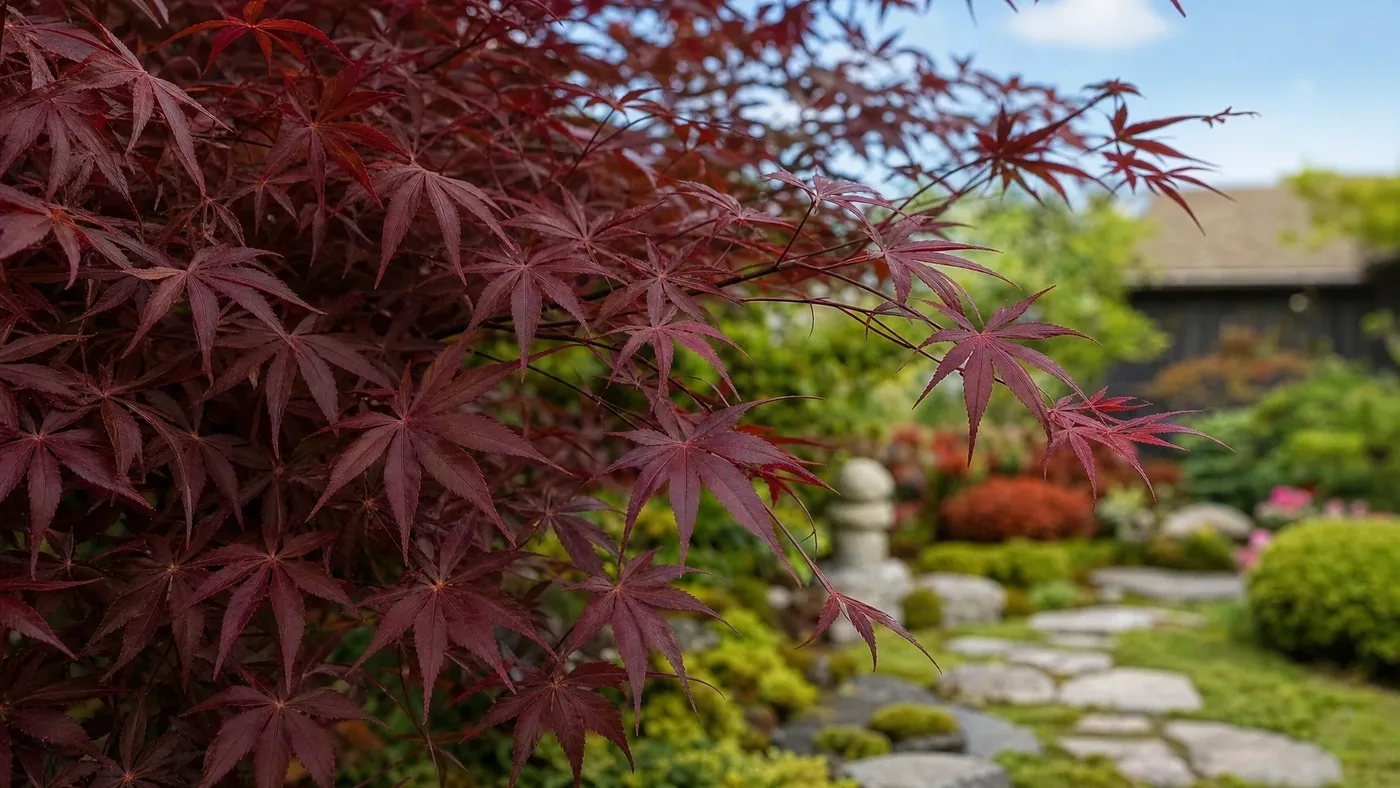
Which Japanese Red Maples Stay Red All Summer?
Among upright red Japanese maples, 'Bloodgood' and 'Emperor I' are consistently described by growers as the best at holding red through summer. Among weeping dissectums, 'Crimson Queen' and 'Red Dragon' earn the same reputation. Seed-grown reds are the least reliable. Before blaming the cultivar, though, rule out shade, heavy nitrogen and heat stress.
This is a sourced comparison, not a photo study. We have not run color trials, so the rankings below reflect how growers and extension sources commonly describe each type, and we say so where it matters. If you are still deciding between forms, our Japanese red maple varieties and cultivars comparison covers size, habit and hardiness in full. This post answers one narrower question: which ones keep their color when July turns hot.
Quick Diagnosis: What a Fading Leaf Is Telling You
A Japanese maple color fade in summer usually has one of four causes. Match what you see to the likely source before spending money on a new tree.
| What you see | Most likely cause | Cost to fix |
|---|---|---|
| Inner leaves green, outer sun-facing leaves still red | Too much shade on the canopy interior | Free (prune crowding branches in dormancy, or accept it) |
| Lush, fast shoots that look greener than older growth | Too much nitrogen | Free (stop feeding, switch to a low-nitrogen product) |
| Bronze or dull leaves with crisp brown edges | Heat, wind or drought stress (leaf scorch) | Low (water deeper, mulch, add afternoon shade) |
| Whole tree greens by August, every year, in good conditions | Genetics, often a seed-grown plant | Replace with a grafted named cultivar |
Why Red Leaves Turn Green or Bronze in Summer
Red-leaf Japanese maples carry red-purple pigments (anthocyanins) that sit over the green chlorophyll in the leaf. Summer color depends on how well those pigments hold up against heat and how much green chlorophyll the leaf is making in competition. Several things tip that balance toward green:
- Low light. Leaves in deep shade make more chlorophyll to compensate, and the red recedes. Our plant reference notes that red forms can shift greener in deep shade.
- Excess nitrogen. Heavy feeding pushes soft, green growth at the expense of color and can cause leggy shoots.
- Heat. In hot-summer climates, color fades under intense heat, and afternoon shade is the usual remedy.
- Genetics. Some forms simply bronze or green by August no matter how well you care for them.
That last point is why this comparison exists, but it is the last thing to blame, not the first.
Rule Out the Three Care Causes First
Here is the position we would take at a nursery counter: most people who write in about a green Japanese maple have a care problem, not a bad cultivar. All three causes below cost nothing to correct, and they should be checked in this order.
1. Shade that is too deep
Red forms do best in full sun to part shade. Deep shade turns leaves greener. The catch is that in hot-summer climates full afternoon sun scorches and fades the same leaves. The target is bright morning light with some afternoon relief. Our guide to Japanese red maple sun requirements walks through how to read your own yard.
2. Too much nitrogen
A light feeding of balanced, low-nitrogen fertilizer in early spring is usually enough. Overfeeding causes leggy growth and weaker color. If you fertilize the maple along with a lawn that gets high-nitrogen feed, runoff alone may be enough to matter. See fertilizing Japanese red maple: what, when and how much before you reach for the bag.
3. Heat and water stress
Young trees need regular, even moisture, and this tree has only low to moderate drought tolerance even once established. Leaf scorch from hot sun, wind or drought is environmental, not a disease, and it dulls color fast. Deep, consistent watering for the first 2 to 3 years is the single best protection.
If you have fixed all three and a tree still greens up, then it is time to look at the cultivar.
Cultivar by Cultivar: Typical Summer Behavior
The table below summarizes how growers and extension-style plant profiles commonly describe these types. Treat it as a reputation ranking, not a measured result. Behavior shifts with climate, and our plant facts note that heat tolerance can move by a full zone depending on the genetic line.
| Type | Form | Summer color, as commonly described | Propagation | Reliability |
|---|---|---|---|---|
| 'Bloodgood' | Upright tree | Holds deep red-purple longer than most uprights | Grafted, true to type | High |
| 'Emperor I' | Upright tree | Consistently described by growers as holding red well into summer | Grafted, true to type | High |
| 'Crimson Queen' | Weeping dissectum | Retains red among laceleaf types, but fine foliage scorches easily in wind and sun | Grafted, true to type | High, if sheltered |
| 'Red Dragon' | Dissectum | Commonly listed among the better red-holding dissectums | Grafted, true to type | High, if sheltered |
| Atropurpureum Group seedling reds | Variable | Ranges from deep red to bronze-green by August | Seed-grown | Least predictable |
Pros and Cons of Each Option
'Bloodgood'
- Pros: One of the most widely grown upright reds, which means plenty of grower experience to draw on. Grafted, so the color you see is the color you get.
- Cons: It is still a standard upright, so plan for the 15 to 25 ft mature height range given for upright red forms, and expect color to dull in a hot, exposed site.
'Emperor I'
- Pros: Growers commonly describe it as a strong summer color holder among uprights, a good pick for warmer summers.
- Cons: Slow growth, roughly 6 to 12 inches a year, means you pay for patience. Similar size to other uprights, so it needs the same 10 to 15 ft of clearance.
'Crimson Queen'
- Pros: Weeping dissectum form that suits patios and courtyards. Dwarf and cutleaf types often stay 6 to 10 ft.
- Cons: The finely cut leaves are the first to scorch in wind or reflected heat. Color holds only if the site is sheltered.
'Red Dragon'
- Pros: Another dissectum with a reputation for keeping red, and compact enough for containers.
- Cons: Same exposure sensitivity as other laceleaf types. Container trees also need root protection in freezing winters.
Seed-grown red seedlings
- Pros: Typically the most affordable entry point, and a perfectly good tree if you care more about form than a guaranteed shade of red.
- Cons: Seedlings do not clone their parents. Seed-grown plants can show variable mature color and habit, so one tree may stay red while its sibling bronzes. The grafted-versus-seedling difference is the single biggest genetic factor in color reliability.
Best For: Matching the Tree to Your Situation
| Your situation | Best choice | Why |
|---|---|---|
| Hot summers, zone 7 or 8, need maximum color hold | 'Bloodgood' or 'Emperor I' with afternoon shade | Upright grafted forms with the strongest reputation for staying red |
| Small courtyard, patio or container | 'Crimson Queen' or 'Red Dragon' | Dwarf and weeping habit, usually 6 to 10 ft |
| Windy or fully exposed site | An upright form, not a dissectum | Fine laceleaf foliage scorches first |
| Zone 9 garden | Any red form, only with afternoon shade | Zones 5 to 8 are standard; some cultivars tolerate 9 with shade |
| Tight budget, color is a bonus not a requirement | Seed-grown red | Accepts variability in exchange for lower cost |
The Verdict
For a Japanese maple that stays red all summer, buy a grafted named cultivar. 'Bloodgood' and 'Emperor I' are the safest uprights, and 'Crimson Queen' and 'Red Dragon' are the safest dissectums, provided the dissectums get shelter from wind and hot afternoon sun. The reasoning is simple: clonal genetics remove the biggest unknown. A seedling can be lovely, but you will not know whether it holds color until it has survived a few summers.
Just as important, do not expect any red maple to look identical in every climate. Even the best performers fade somewhat in intense heat. If you want a nursery-grown tree to start with, our Japanese red maple options are sold in 3-gallon, 5-gallon and 7-gallon sizes. Check which form you are getting, since the stock may be seed-grown with variable color. For how color changes later in the year, see what to expect from Japanese red maple fall color each year.
Who Should Not Choose a Red Maple for Summer Color
- Gardeners with deep, all-day shade, where red will turn green no matter the cultivar.
- Gardeners in hot, windy, exposed sites with no way to add afternoon shade.
- Anyone who needs guaranteed identical color across several trees, because seedlings will not deliver that.
- Coastal sites with salt spray, since salt tolerance is poor.
If you live somewhere with extreme summer heat, ask your local cooperative extension office which Japanese maples perform in your area. Local advice beats any general ranking.
Quick Reference
| Check | Target |
|---|---|
| Light | Full sun to part shade; afternoon shade in hot climates |
| Fertilizer | Balanced, low-nitrogen, light, early spring only |
| Water | Consistent, even moisture; no standing water; deep watering for the first 2 to 3 years |
| Hardiness | Zones 5 to 8; zone 9 only with afternoon shade for some cultivars |
| Best upright color holders | 'Bloodgood', 'Emperor I' |
| Best dissectum color holders | 'Crimson Queen', 'Red Dragon' (sheltered site) |
| Least reliable | Seed-grown reds |
| Pruning | Late fall to midwinter, dead, crossing or crowded branches only |
Japanese Red Maple
Nursery-grown Japanese Red Maple in sizes from 3 Gallon 2-3 ft, shipped to your door.
From $118.33
Shop Now →