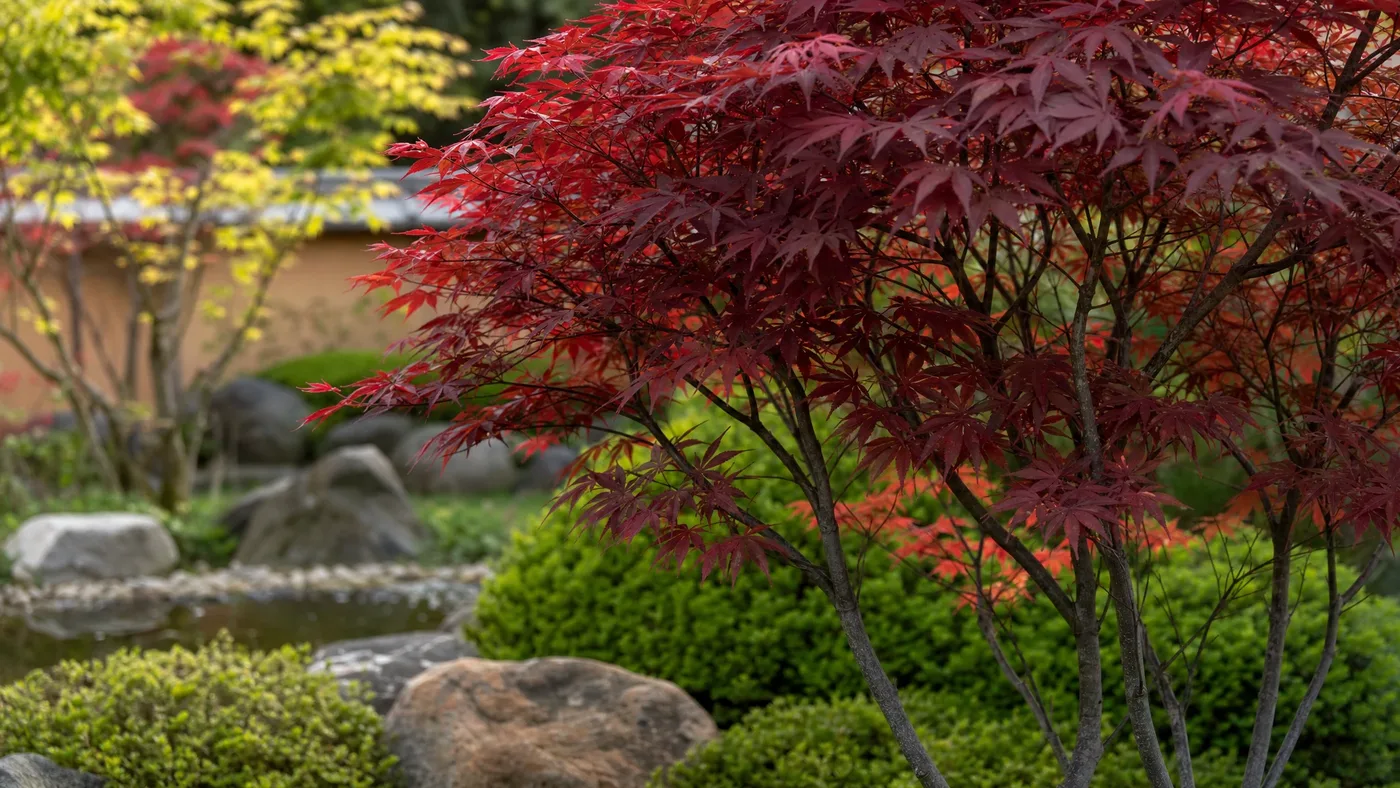
The Best Weeping Red Japanese Maples, Compared
Shopping for the best weeping red Japanese maple means choosing among four names that come up again and again: Crimson Queen, Tamukeyama, Inaba Shidare and Red Dragon. They look similar in a nursery row. They behave differently in a hot July or a windy February. This post sorts them by the question that actually decides the purchase, which is where you live. For the wider picture across upright, laceleaf and dwarf forms, start with our Japanese red maple varieties and cultivars comparison.
A note on sourcing before we begin. We have not run field trials on these trees. What follows reasons from the Missouri Botanical Garden (MBG) plant profiles, university extension guidance and the general consensus among growers, and where a cultivar detail is a description rather than a measurement, we say so.
The Four Weeping Reds at a Glance
All four are dissectum types (laceleaf), meaning the leaves are cut into fine, feathery segments and the branches cascade into a mound. For dwarf and weeping Japanese maples as a group, the reference sheet puts mature height at roughly 6-10 ft and width at roughly 8-12 ft, growing slowly at about 6-12 in per year. Exact numbers vary by cultivar and by whether the plant is grafted onto a rootstock at a given height, so treat the table as relative, not absolute.
| Cultivar | Habit (commonly described) | Color hold in summer | Heat tolerance | Best use |
|---|---|---|---|---|
| Crimson Queen | Tight, cascading mound, fine lace | Refined deep red, but can bronze or fade in hard heat | Moderate; wants afternoon shade in hot summers | Mild-summer gardens, focal points |
| Tamukeyama | Broad, weeping mound, slightly coarser lace | Dark red-purple, commonly described as holding well | Best of the four by grower consensus | Hot-summer climates, general landscape |
| Inaba Shidare | Weeping mound, often described as a bit more upright and bold | Deep crimson, commonly described as holding well | Good; similar tier to Tamukeyama | Gardens wanting stronger color contrast |
| Red Dragon | Compact, finely cut, smaller overall | Bright red in spring, can shift in heat | Moderate; shade the afternoon sun | Containers, courtyards, small spaces |
Where You Live Decides Most of It
Common advice says to pick the one with the prettiest leaf. We would push back on that. Leaf refinement is the last thing to optimize. Climate comes first, because the most common failure with a weeping red is leaf scorch, which is environmental rather than a disease, and the second most common is color fading in intense heat or deep shade. MBG lists afternoon shade as the standard fix for hot-summer sites, and the reference zone range for red Japanese maples is USDA zones 5-8, with some selections tolerating zone 9 only with afternoon shade.
Our position, stated as a sourced judgment and not a measured result: in hot-summer climates the default pick should be Tamukeyama, not Crimson Queen. Southern growers and extension sources point to Tamukeyama as the red laceleaf that handles heat best. Crimson Queen wins in milder zones on color refinement, and we cover its details in our Crimson Queen size, color and care guide.
Cultivar Profiles
Crimson Queen
Crimson Queen is commonly listed as the benchmark weeping red laceleaf, and it is the name most buyers type into a search box. The leaf is finely cut, the cascade is tidy, and in spring and fall the color is hard to fault. Weeping laceleaf red types like this one hold color best where summers are mild.
- Pros: the most refined texture of the four, widely available, well documented.
- Cons: commonly described as prone to bronzing or scorching in hot sun and wind; needs afternoon shade where summers are hot.
- Skip it if: your site gets reflected heat from pavement or a west wall.
Tamukeyama
Tamukeyama is commonly described as a broad, weeping mound with deep red-purple foliage. Its reputation is practical: it keeps its color through summer better than most reds, which is why it turns up in Southern nursery recommendations. The lace is a touch coarser than Crimson Queen, and most people never notice.
- Pros: the strongest heat reputation, reliable color retention, forgiving of a few hours of afternoon sun if watered consistently.
- Cons: less delicate texture; still needs wind protection and even moisture.
- Skip it if: you want the finest possible leaf and live in a cool, mild-summer area.
Inaba Shidare
Inaba Shidare is commonly described as a bolder weeper with deep crimson leaves and a slightly more assertive habit. Gardeners comparing Tamukeyama vs Inaba Shidare are usually choosing between two heat-capable reds, so the decision comes down to form and color tone. Tamukeyama reads as a darker, softer mound. Inaba Shidare reads as more crimson and a little more architectural.
- Pros: strong color, good presence as a specimen, in the same heat-tolerance conversation as Tamukeyama.
- Cons: less widely stocked than Crimson Queen; sources vary on exact size, so ask the grower for the grafted height and expected spread.
- Skip it if: you want the quietest, most uniform mound.
Red Dragon
Red Dragon is the small-space answer. It is commonly described as a compact, finely cut weeper, and the red Dragon Japanese maple earns the container slot because its size suits a large pot, a courtyard or a patio corner. The reference sheet confirms that smaller and dwarf-growing selections suit containers, with one caveat: container trees need root protection in freezing winters.
- Pros: manageable scale, good for pots and tight beds, easy to place near an entry.
- Cons: the color can shift in summer heat, and pots dry out fast, which is exactly what scorches laceleaf foliage.
- Skip it if: you cannot water a container every few days in summer.
Best For: Matching the Tree to the Job
| Your situation | Pick | Why |
|---|---|---|
| Hot summers, zones 7-8 (zone 9 with afternoon shade) | Tamukeyama | Strongest heat reputation among growers and extension sources |
| Mild summers, focal point | Crimson Queen | Finest texture and color refinement |
| Want bolder crimson tone | Inaba Shidare | Strong color with a more assertive habit |
| Pot, patio or courtyard | Red Dragon | Compact scale suits containers |
| Windy site in zone 5 | An upright red instead | Laceleafs struggle here (see below) |
Who Should Not Buy a Weeping Laceleaf
Here is the honest limit. In zone 5, on a wind-exposed site, all laceleafs struggle. The fine foliage dries out and burns in winter and spring wind, and the grafted weeping structure is hard to repair once branches die back. If that is your yard, an upright red form is the safer buy. Our guide to choosing between upright and laceleaf forms walks through that decision, and the reference sheet lists the upright standard reds at 15-25 ft, so plan the space.
Also skip a weeping red if you have standing water or heavy clay. Root rot in poorly drained soil is a documented problem, and the target soil is rich, well-drained loam at roughly pH 5.5-6.5. Poor salt tolerance rules out road-salt splash zones too.
Heat Is the Real Test
If you garden where summers are long, read our guide to sun-tolerant red Japanese maples for hot climates before you commit. A few habits matter more than the cultivar name:
- Give morning sun and afternoon shade, even for the heat-tolerant picks.
- Keep moisture even for the first 2-3 years. Young trees have low drought tolerance.
- Avoid planting against a hot wall or over pavement.
- Plant in early spring or fall, not at peak summer heat.
- Go light on fertilizer. A balanced, low-nitrogen feeding in early spring is plenty, and overfeeding weakens color.
A Word on Buying Named Cultivars
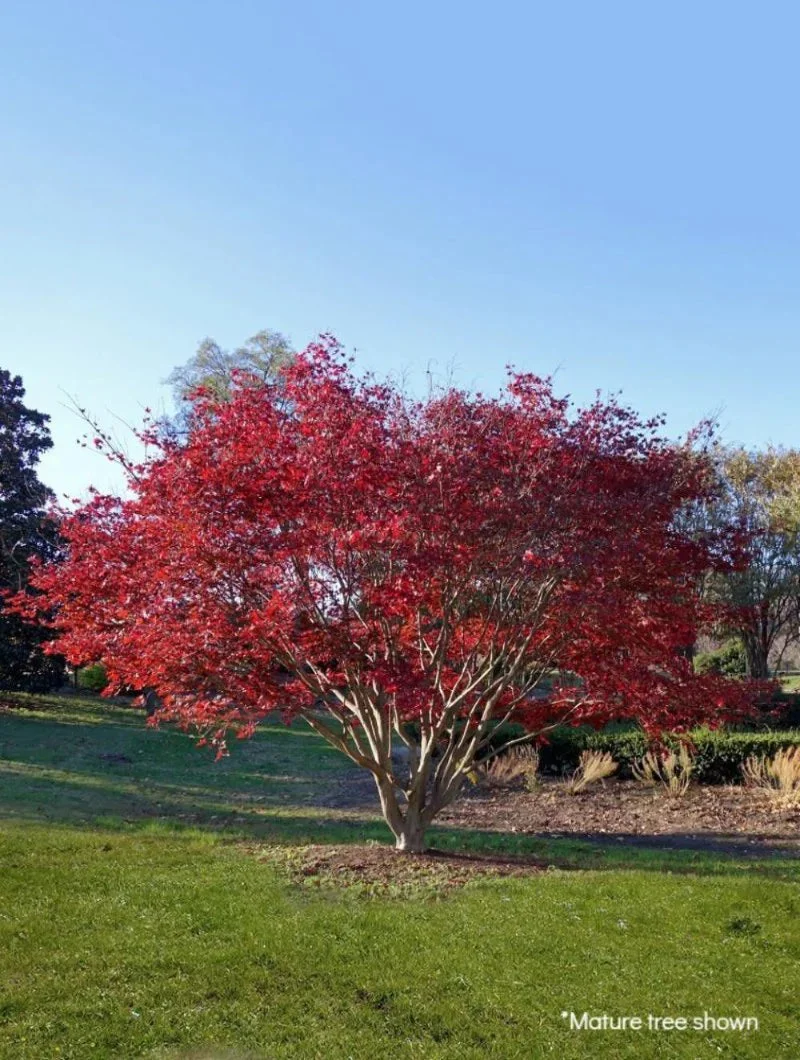
Named cultivars like these four are grafted, which is how they stay true to type. Our Japanese Red Maple trees are nursery-grown and sold in 3-gallon (2-3 ft), 5-gallon (2-3 ft, more developed) and 7-gallon (3-4 ft) sizes, but they are sold as Japanese Red Maple, not as a named weeping cultivar. Seed-grown red stock can vary in mature color and habit, so if you specifically want Tamukeyama or Crimson Queen, buy that exact cultivar name from a grower who labels it, and confirm it is grafted. If you would rather have a good-sized red-leaf tree and accept some variation, the shop sizes are a reasonable fit.
The Verdict
For most gardeners in hot-summer regions, Tamukeyama is the default best weeping red Japanese maple, because heat is what kills the look of the others. In mild summers, Crimson Queen is worth the extra attention to shade. Choose Inaba Shidare when you want a more crimson, architectural tone. Choose Red Dragon for a pot or tight courtyard. For region-specific calls on microclimate and hardiness, ask your local cooperative extension office, since zone limits can shift by a full zone depending on the genetic line.
Quick Reference
| Question | Answer |
|---|---|
| Hardiness (species level) | USDA zones 5-8, zone 9 only with afternoon shade |
| Hot summers | Tamukeyama first, then Inaba Shidare |
| Mild summers, refined look | Crimson Queen |
| Containers and small spaces | Red Dragon, with root protection in freezing winters |
| Zone 5, windy site | Choose an upright red instead |
| Dwarf/weeping size (species level) | Roughly 6-10 ft tall, 8-12 ft wide |
| Soil and pH | Rich, well-drained loam, pH about 5.5-6.5 |
| Planting window | Early spring or fall |
| Pruning | Late fall to midwinter, dead or crossing wood only |
Japanese Red Maple
Nursery-grown Japanese Red Maple in sizes from 3 Gallon 2-3 ft, shipped to your door.
From $118.33
Shop Now →