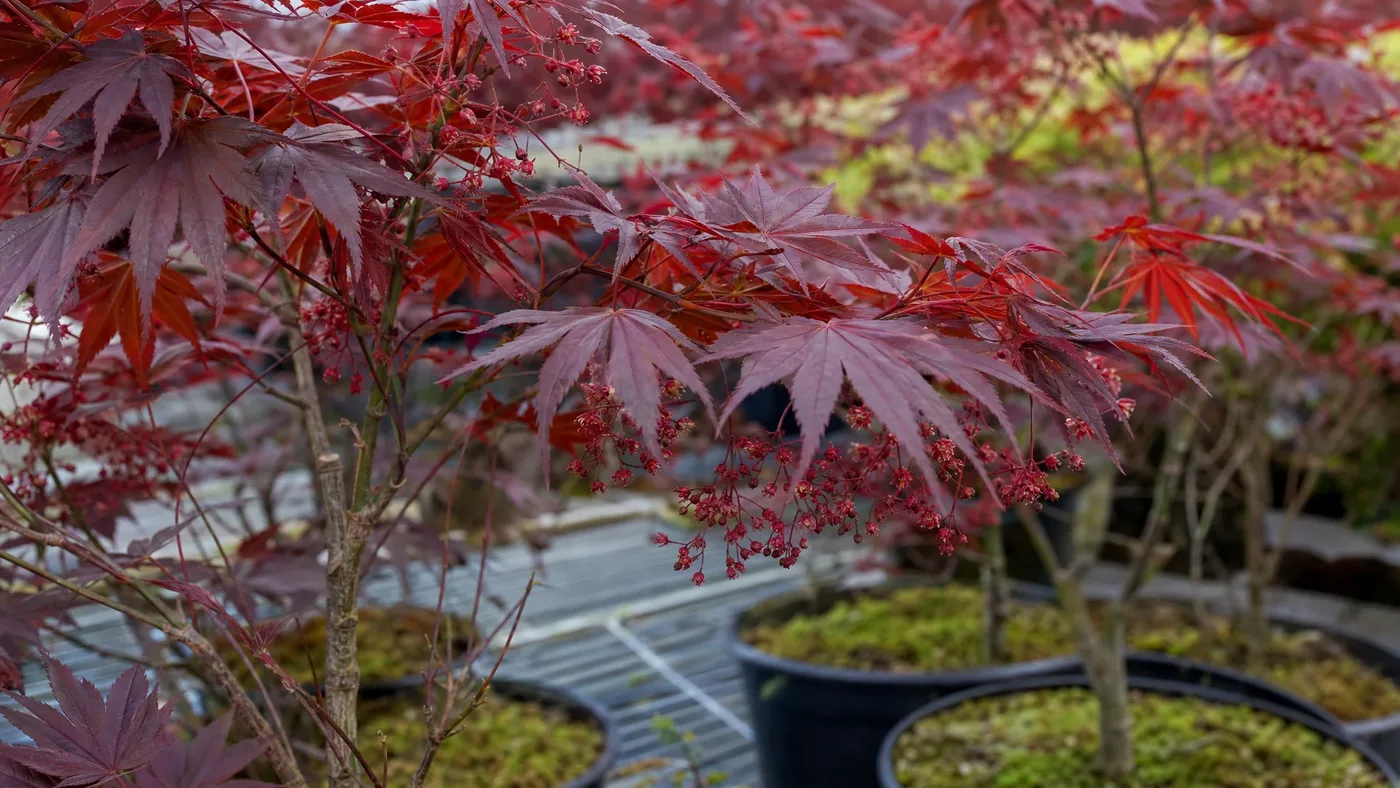
Crimson Queen Japanese Maple: Size, Color and Care
The Crimson Queen Japanese maple is the tree most people picture when they search for a red laceleaf Japanese maple: a mounded, cascading dome of finely cut crimson leaves that nearly touches the ground. It is also one of the most misjudged trees at purchase time. Buyers fall for the foliage and overlook the footprint. This guide covers Crimson Queen size, color, siting and care, in the order we would walk you through the decision. For the wider field of red maples, start with our comparison of Japanese red maple varieties and cultivars.
What a Crimson Queen actually is
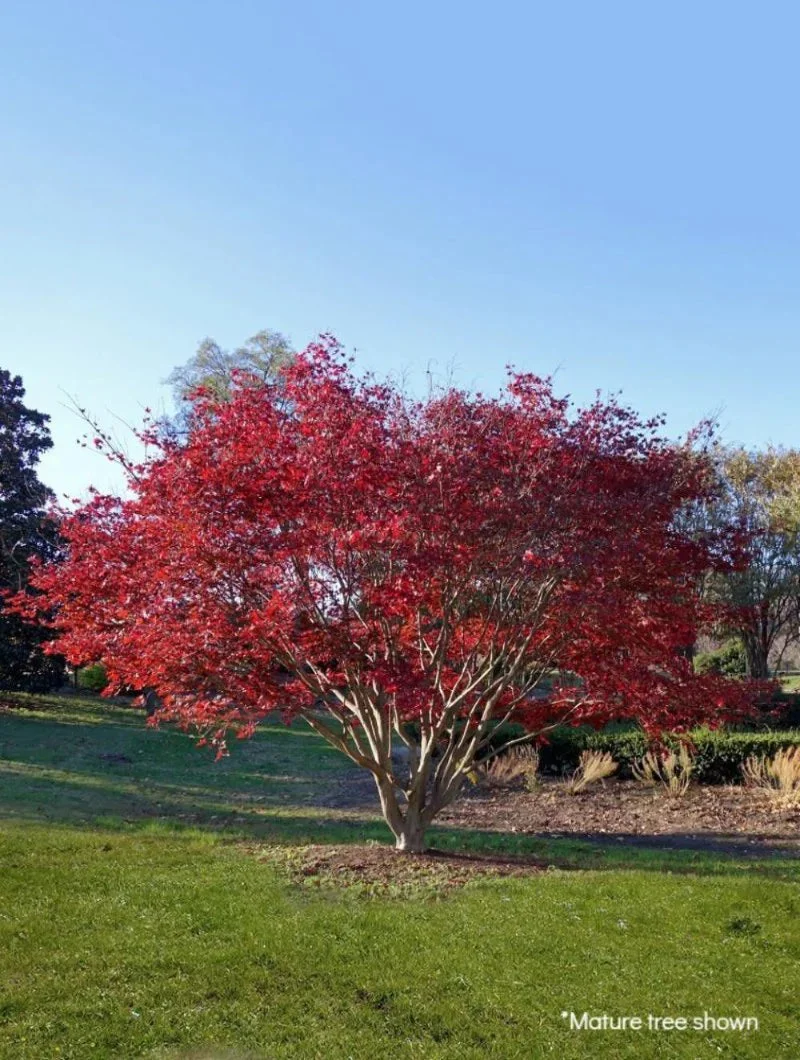
'Crimson Queen' is a named cultivar of Acer palmatum in the dissectum group. Dissectum means the leaves are cut nearly to the stem into narrow, lacy segments. Instead of 5-7 broad lobes, you get a feathery texture. The branches arch downward, so the tree grows as a mound, not an upright vase.
It is not the same thing as an unnamed seedling-grown red Japanese maple, and it is not the same as the upright reds such as 'Bloodgood' or 'Emperor I'. Named cultivars like this one are grafted, which is how the leaf shape and weeping habit stay true. Seed-grown stock can vary in color and habit.
Crimson Queen size: plan for the width
Missouri Botanical Garden (MBG) profiles commonly list Crimson Queen at 8-10 ft tall by 10-12 ft wide. Read that again: it is wider than it is tall. That is the number that causes trouble.
Growth is slow to moderate for the species, roughly 6-12 inches a year, and a Crimson Queen typically takes 10-15 years to reach significant landscape size. That slow pace lulls buyers. A 3-ft plant in a 4-ft bed looks fine for several seasons. Then the branches reach the lawn, the walkway and the foundation, and from then on the tree is a pruning project for life.
Our position: people buy laceleafs for the leaf and underestimate the width. Measure the planting site for a 10-12 ft spread before you choose this cultivar. If the space is smaller, choose a smaller one (see the table below).
| Cultivar (form) | Commonly listed size |
|---|---|
| 'Crimson Queen' (weeping dissectum) | 8-10 ft tall by 10-12 ft wide |
| 'Tamukeyama' (weeping dissectum) | 6-8 ft tall by 8-12 ft wide |
| 'Inaba Shidare' (dissectum, more upright-arching) | commonly 5-7 ft |
| 'Red Dragon' (compact dissectum) | commonly 7-8 ft |
| 'Shaina' (dwarf upright, dense) | commonly 4-6 ft |
| 'Bloodgood' (upright) | 15-20 ft tall and wide |
Cultivar figures come from MBG and extension profiles and vary by site and by source. Treat them as ranges.
Color: what to expect through the seasons
Crimson Queen is commonly described as holding its summer red better than most laceleafs. Many red dissectums fade toward bronze-green by August. This one tends to stay redder, though no red maple is immune to fading in deep shade or intense summer heat.
- Spring: new foliage emerges bright red, along with small, inconspicuous red-purple flowers.
- Summer: crimson to reddish-purple, with the best color generally coming from morning sun and afternoon shade.
- Fall: red, orange or crimson. Intensity varies by season and site.
- Winter: after leaf drop, the cascading branch structure becomes the show.
Where it shines, and where it does not
A weeping laceleaf works best as a single focal point. It suits entries, the edge of a gravel or stone path, a slope where the branches can cascade over a retaining wall, and Japanese or Zen-style plantings. Companions that handle similar acidic, humus-rich soil include azaleas, rhododendrons, hostas, ferns and hakone grass.
Its main weakness is the leaf itself. Fine foliage dries out faster than broad leaves, so leaf scorch from hot wind, hot sun or drought stress hits laceleafs harder than it hits upright reds. Afternoon shade and even moisture matter more here than for a 'Bloodgood'.
Who should not buy a Crimson Queen
- Small-bed gardeners. If the site is narrower than about 10 ft, you will be fighting the spread.
- Exposed, windy, full-sun sites with no shade. Scorch will be a yearly event.
- Anyone who wants a hands-off tree in hot, dry conditions. Drought tolerance is low to moderate even once established.
- Coastal gardeners with salt spray. Salt tolerance is poor.
- Zone 4 or colder. The species is rated for zones 5-8, and some cultivars tolerate 9 with afternoon shade. Check with your local cooperative extension office for how your microclimate performs.
If you want a red leaf in a tight space or a hotter site, look at the compact or heat-tolerant options. 'Tamukeyama' is widely regarded by Southern growers and extension sources as the most heat-tolerant red dissectum. Our comparison of weeping red Japanese maples sets them side by side.
Materials you need
- A grafted, labeled Crimson Queen (more on this below)
- A shovel and a tape measure
- Compost or leaf mold to improve heavy or lean soil
- 2-3 inches of shredded bark or leaf mulch
- A balanced, low-nitrogen fertilizer for early spring
- Clean, sharp hand pruners (for corrective work only)
Step by step: siting, planting and early care
- Measure first. Mark a 10-12 ft wide circle on the ground. The trunk should sit at least 5-6 ft from walls, fences and walkways so that the full spread has room. Keep it clear of other trees as well.
- Choose the light. Full sun to part shade works in cooler climates. In hot-summer climates, pick a spot with afternoon shade and shelter from drying wind. Young trees in full sun can also develop trunk sunscald.
- Check the soil. The tree wants rich, well-drained loam with plenty of organic matter and a slightly acidic pH of roughly 5.5-6.5. Standing water invites root rot, so if the site holds water after rain, plant on a gentle mound or choose another spot.
- Plant in early spring or fall. Avoid peak summer heat. Dig the hole wide, not deep, and set the root flare level with or just above the surrounding soil. Backfill with native soil, mixing in a modest amount of compost.
- Water in, then keep it even. Soak the root zone at planting. Through the first 2-3 years the tree needs regular watering. Aim for consistent, even moisture, never soggy and never bone dry.
- Mulch. Spread 2-3 inches over the root zone, kept a few inches off the trunk. Mulch evens out soil moisture and cools the roots.
- Feed lightly. A balanced, low-nitrogen fertilizer in early spring is usually enough. Overfeeding can cause leggy growth and weaker color.
- Prune by thinning, not shearing. See the next section.
Pruning a weeping laceleaf
Pruning needs are minimal. Do any structural or corrective work in late fall to midwinter dormancy, which avoids heavy sap bleed. Remove only dead, crossing or crowded branches, and thin from inside the canopy so the weeping outline stays intact. Never shear it like a hedge, because shearing leaves a dense outer shell of leaves and bare interior wood. Our guide to pruning a weeping Japanese red maple walks through the cuts.
Growing a Crimson Queen in a container
A large container is a legitimate way to grow a weeping laceleaf, particularly on a patio or courtyard where the ground spread is not available. Pots are more forgiving of the width problem but less forgiving of drying out and cold. Container-grown trees need root protection in freezing winters, and the soil dries out faster than in the ground. Read our guide to growing Japanese red maple in pots and containers for pot sizes and winter protection.
Common mistakes to avoid
| Mistake | What happens | Fix |
|---|---|---|
| Planting in a bed under 10 ft wide | Constant cutting back, lost weeping form | Size the site to a 10-12 ft spread, or pick a smaller cultivar |
| Hot, windy site with no afternoon shade | Crispy, browned leaf edges (scorch) | Move to a sheltered spot, or add shade and a windbreak |
| Inconsistent watering | Scorch and twig dieback | Deep, regular watering for 2-3 years, plus mulch |
| Heavy feeding | Leggy growth, weaker color | One light, low-nitrogen feeding in early spring |
| Shearing the canopy | Dense shell, bare interior | Thin from inside in dormancy |
| Poorly drained soil | Root rot | Raise the planting area or relocate |
Watch for aphids, scale, borers and Japanese beetles. Start with integrated pest management: inspect often, rinse aphids off with water, and hand-pick beetles. If you do reach for a pesticide, always read and follow the pesticide label; the label is the law. Verticillium wilt and anthracnose are the main diseases, and your local cooperative extension office can confirm a diagnosis.
Expected results
With good siting and care, a Crimson Queen may fill out its mounded form gradually over 10-15 years and can live 80-100+ years. Color generally holds best with afternoon shade and even moisture, though results will vary by climate and season. Fall color may range from red to orange or crimson. Leaf scorch is not a pathogen, but it can occur in a hot, dry, windy summer even on a well-sited tree.
Buying one: ask for grafted, named stock
Because the true Crimson Queen is a grafted cultivar, ask any seller whether the plant is grafted and labeled by cultivar name. An unlabeled red maple may be seed-grown, which can vary in leaf shape, color and habit. We offer nursery-grown red-leaved Japanese maples in 3-gallon, 5-gallon and 7-gallon sizes at our shop. Those are sold as Japanese Red Maple, not as named cultivars, so they suit buyers who want a red-leaved Acer palmatum and can accept some variation. If your heart is set on the weeping laceleaf form, confirm the cultivar with whoever you buy from.
Quick reference
| Factor | Crimson Queen |
|---|---|
| Form | Weeping dissectum (red laceleaf), mounded |
| Size (commonly listed) | 8-10 ft tall by 10-12 ft wide |
| Hardiness (species) | Zones 5-8; some cultivars tolerate 9 with afternoon shade |
| Light | Full sun to part shade; afternoon shade in hot climates |
| Soil | Rich, well-drained, pH roughly 5.5-6.5 |
| Water | Even moisture; regular watering for the first 2-3 years |
| Planting time | Early spring or fall |
| Feeding | Light, low-nitrogen, early spring |
| Pruning | Thin from inside, late fall to midwinter |
| Weak points | Leaf scorch, wind, drought, salt, poor drainage |
Japanese Red Maple
Nursery-grown Japanese Red Maple in sizes from 3 Gallon 2-3 ft, shipped to your door.
From $118.33
Shop Now →