Red Laceleaf Japanese Maples: Size, Care and Color Hold
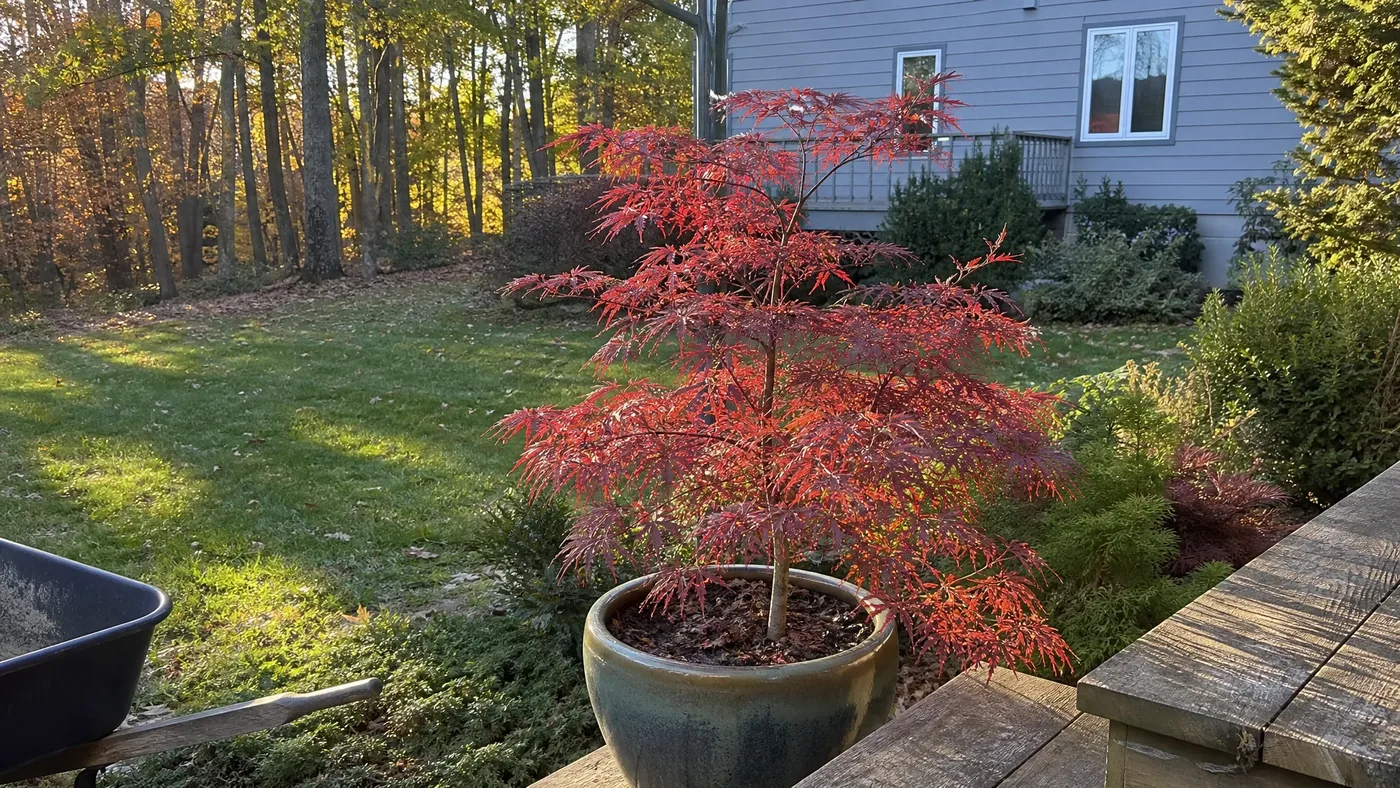
Picture the corner of an east-facing patio at eight in the morning. The sun is low and soft, and it passes through the fine, lacy red leaves of one small tree so the whole mound glows like stained glass. Laceleaf is the common name for the dissectum form of Japanese maple, whose leaves are cut so deeply they look like threads rather than hands.
The same fine leaves that glow in morning light also burn quickly in wind and hot sun. A red laceleaf in the wrong corner browns at the edges or fades to bronze long before fall. Read on for what the name means, the size a red laceleaf reaches, how light and wind change through the day, and how well the red holds in August. We follow one tree on one patio all the way through.
What Laceleaf Means for a Japanese Red Maple
Hold a leaf from an upright red Japanese maple next to a laceleaf leaf, and you can tell the difference before reading a tag. The upright leaf is a broad hand with lobes you could trace with a pencil. The laceleaf leaf is cut almost to the stem, so each lobe becomes a narrow strand. Botanists call this form dissectum, and most people say laceleaf or cutleaf.
The cutting changes the whole tree, not only the leaf. Branches arch and weep instead of climbing, so the plant builds a cascading mound that is often wider than tall. Growth is slow, and a laceleaf spends years filling out before it gains any real height. If you are still choosing between the two shapes, our guide to upright versus laceleaf Japanese maples covers that decision.
The red forms are sold under names such as 'Dissectum Atropurpureum' or simply as a red laceleaf. The Atropurpureum name refers to the red/purple leaf color and is used for many red-leaved seedlings, so on a tag it tells you color more than it tells you a specific selection. Hardiness runs from zone 5B through 8B for the species.
Our example is a three-gallon red laceleaf planted at the outer corner of an east-facing patio. Morning sun arrives over the paving, the house shades most of the afternoon, and a gap along the side wall lets late light and wind slip through.
One Three-Gallon Tree on Planting Day
The owner of our example tree spent an evening standing in the corner before buying anything. The question was not whether the tree would fit now, since a three-gallon plant fits almost anywhere. The question was where its branches would be in ten years, and whether that spot would still make sense. This is the thinking behind every good placement for a plant that spreads wider than it grows tall.
Choosing the Corner
The trunk went well back from the paving edge, so the mound can eventually spill over the stones instead of being cut back to stay off them. The soil there drains freely, which matters because the species wants evenly moist, well-drained ground, and the red-leaf form prefers acid soil. One of the most common questions we get is whether a small tree will look lost in a corner this size. It will for a few years, and that is the price of a plant that never outgrows a small yard or patio.
Setting the Tree
Planting follows the same sequence for any laceleaf. Here is what the owner did.
- Dug the hole as wide as the space allowed but no deeper than the root ball.
- Found the root flare and set it level with, or just above, the surrounding soil, keeping the graft union well above ground.
- Backfilled with the soil that came out of the hole, breaking up clods and skipping heavy amendments.
- Watered slowly until the whole root zone was soaked, then added mulch, leaving a gap at the trunk.
The First Summer
We tell customers to skip fertilizer in year one and put the effort into watering. The owner checked the soil under the mulch with a finger and watered deeply whenever it felt barely damp, rather than sprinkling on a schedule. Fine leaves lose water fast, and a young root system cannot keep up if the patio stones are radiating heat in July.
Year Five Brings a Low Mound
By year five the tree no longer looks like a plant that came out of a pot. The main branches have started to arch, the outer shoots reach sideways, and the trunk is mostly hidden beneath a layer of red. Width has usually caught up with height, and the shape is closer to a low dome than a tree. Growth stays slow, and the red-leaf form remains quite small in colder climates around zone 5.
We will not pin an inch count to each year, because growth swings with climate, water and light, and a figure from another region would mislead you. What you can plan around is the mature range, which is wide because red laceleaf selections differ so much.
Mature Size by Form
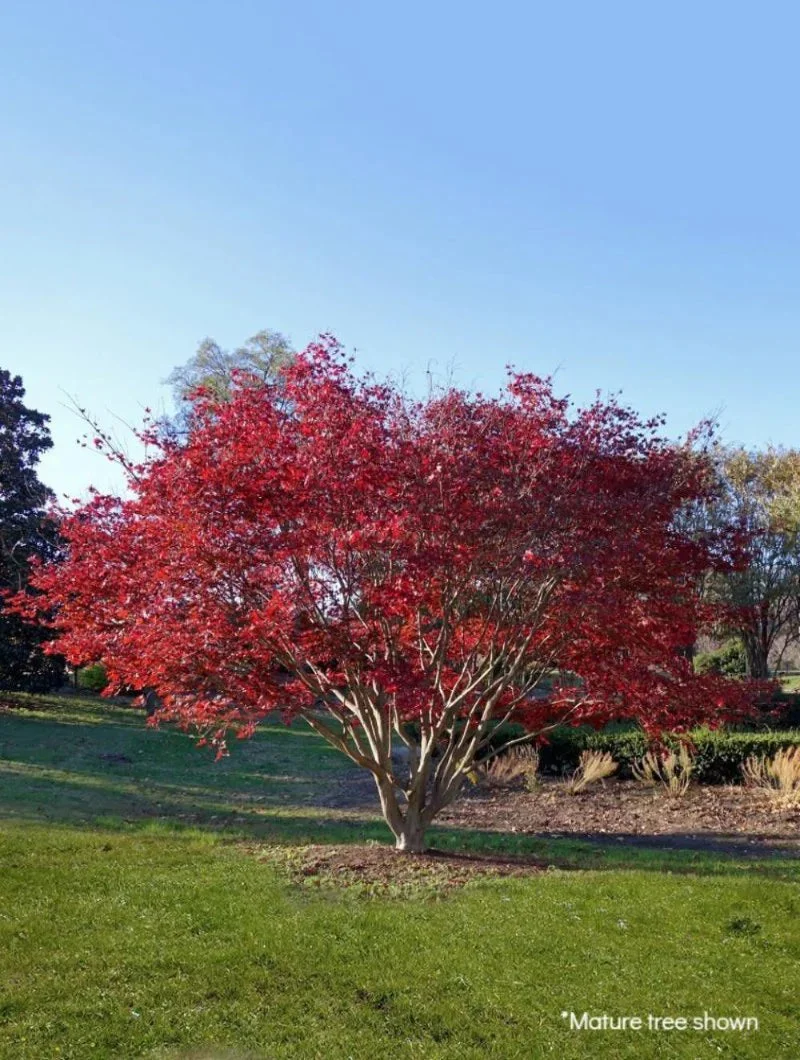
The table sets three published figures side by side. 'Dissectum Atropurpureum' reaches 1.5–2.5 meters, about 5–8 feet, tall and wide, while UF/IFAS gives a plain laceleaf 'Dissectum' a mounded shape of about 15 feet tall and 20 feet wide.
| Form | Height | Spread |
|---|---|---|
| 'Dissectum Atropurpureum' | about 5–8 ft | about 5–8 ft |
| Laceleaf 'Dissectum' | about 15 ft | about 20 ft |
| Upright species | 15–25 ft | 10–25 ft |
The gap between the first two rows is the reason to ask what you are buying. If the tag does not name a selection, plan for the larger number and be pleasantly surprised. For individual names and their sizes, see our comparison of weeping reds.
Afternoon Light on a Laceleaf Japanese Red Maple
At eight in the morning the corner is the best seat on the patio. The low sun comes in nearly sideways, lights the red from behind, and does little harm because the air is still cool. By late afternoon the same corner is another place entirely, with warm stone underfoot and light that has had hours to heat the air. A laceleaf notices the difference long before you do.
The red-leaf form grows with anything from 2 to 6 hours of direct sun, in full sun or partial shade. A laceleaf wants the low end of that range, taken early. More direct sun can be tolerated in the northern part of the range, but leaves can scorch in hot weather unless they get some shade or irrigation. You will read that every red maple needs full sun for color. That is fair for an upright in a cool climate and poor advice for a laceleaf in the South.
Tracking the Hours
This is how the light moves across our example corner in midsummer, and what each stretch does to the tree.
| Time of day | Light on the tree | Effect on the leaves |
|---|---|---|
| Early morning | Low, direct, cool | Best for color, no scorch risk |
| Late morning | Stronger direct sun | Fine, if the soil is moist |
| Midday | Bright but shaded by the house | Safe, and the tree can rest |
| Late afternoon | Hot sun around the house corner | Tips brown first |
The owner solved the last row with a taller shrub on the south side of the tree, planted to cast shade from midafternoon on. In our rows, the laceleafs that look best in August are almost always the ones that lose the sun by midafternoon.
Wind on the Fine Leaves of a Japanese Red Maple
In our example, the gap along the side wall turns out to be a wind tunnel. On breezy July afternoons the air runs along the house and bends around the corner straight into the tree. The fine leaves have a lot of edge for their size, and each strand dries quickly, so the browning starts at the tips and creeps inward over a few days.
Why Laceleafs Suffer Most
Cultivars with heavily dissected foliage are particularly prone to scorch, and drying winds, hot sun, drought, waterlogging, frost and even salt-laden coastal wind are all causes. Put simply, scorch happens when high temperatures arrive with wind. That means wind is not a separate problem from heat. It makes heat worse, and a tree in a still, warm corner will often come through a spell that ruins one standing in a draft.
The Screen the Owner Built
The owner placed a lattice panel on the windward side of the tree and planted the shrub behind it. A screen with gaps works better than a solid wall, because a wall throws turbulence over the top and drops it on the plant behind. The screen sits far enough back that its shade does not fall on the maple in the morning, when the tree needs the sun. We often see owners put a panel right against the trunk, which blocks the good light along with the bad wind.
Red Hold Through a Hot August
By August the example tree has had three months of warmth, and the color tells the story. The outer leaves that got morning sun and midday shade are still a deep red-purple. The few at the tip of the sunniest branch have faded toward bronze. The red-leaf form follows the same pattern: the leaves turn red/purple in spring but may fade to green/bronze in summer heat.
Laceleaf Against Upright Red
An upright red stands in the open with its crown in full sun for hours, so heat reaches every leaf and it has more height to catch wind. A laceleaf sits low and can be tucked into a protected corner, which gives it a real advantage if you choose the spot well. In a hot, exposed site the advantage disappears, and the fine leaves fade and scorch sooner than the broad ones. For reds that hold up better in heat, see which Japanese red maples stay red all summer.
What Keeps the Red in the Leaves
The habits that kept our example tree red through August were simple.
- Deep, infrequent watering in dry spells, so the roots stay moist without sitting wet.
- A layer of mulch over the root zone to keep the soil cooler under the patio's reflected heat.
- Afternoon shade and a wind screen in place before summer arrives, not after the first brown tips.
- No heavy nitrogen feeding in midsummer, since pushing soft new growth into heat invites more scorch.
Year Ten for a Laceleaf Japanese Red Maple
At year ten the tree is not finished growing, since a slow laceleaf takes many years to approach its mature range. It is a full, layered mound that now covers the corner it was planted for. The care has barely changed: morning sun, afternoon shade, a wind screen, steady water and mulch. The only pruning needed is the removal of dead twigs and crossing branches, and our guide to pruning a weeping Japanese red maple covers how to do that without ruining the cascade.
Walk onto the patio at dusk and the finished mound is a low shape of red, its layered branches falling like a skirt over the patio stones, the last light catching the thread-fine leaves one tier at a time.
Japanese Red Maple
Nursery-grown Japanese Red Maple in sizes from 3 Gallon 2-3 ft, shipped to your door.
From $118.33
Shop Now →Our growers raise Japanese Red Maple on our own farms and watch each tree through the year, from late frost on new leaves to scorch at the tips in summer. We are a small team of growers with top-quality trees, and you are welcome to pick out a plant for your own garden.