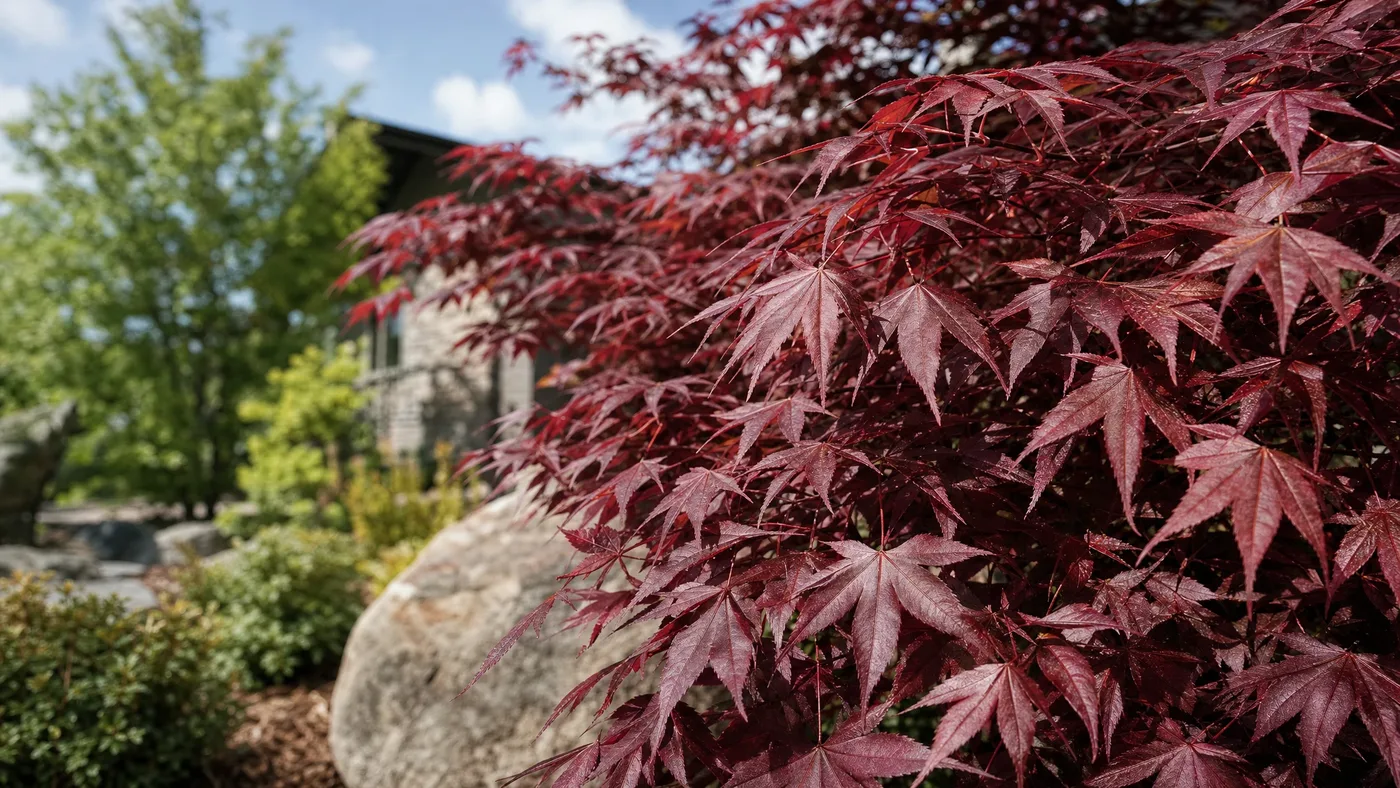
Japanese Red Maples for Small Yards and Patios
A Japanese maple small yard planting goes wrong in one predictable way. Someone buys a tree labeled "Japanese maple" because it looks tidy in a 3-gallon pot, plants it four feet from the house, and spends year eight fighting the gutters. The fix is made before you dig: measure the space, then choose the right kind of tree for it. This guide walks through that order. For the wider design picture, see our Japanese red maple landscape ideas and companion plants guide.
What you need before you start
- A tape measure and a few stakes or a garden hose to outline the canopy
- A note of which direction the spot faces and when it gets afternoon sun
- Your USDA zone (Japanese red maple is rated for zones 5-8, and some forms tolerate zone 9 with afternoon shade)
- Either a planting hole location or a container with drainage holes
- Compost, mulch, and a few shade-tolerant companions such as hostas, ferns or hakone grass
Step 1: Measure width at maturity, not height
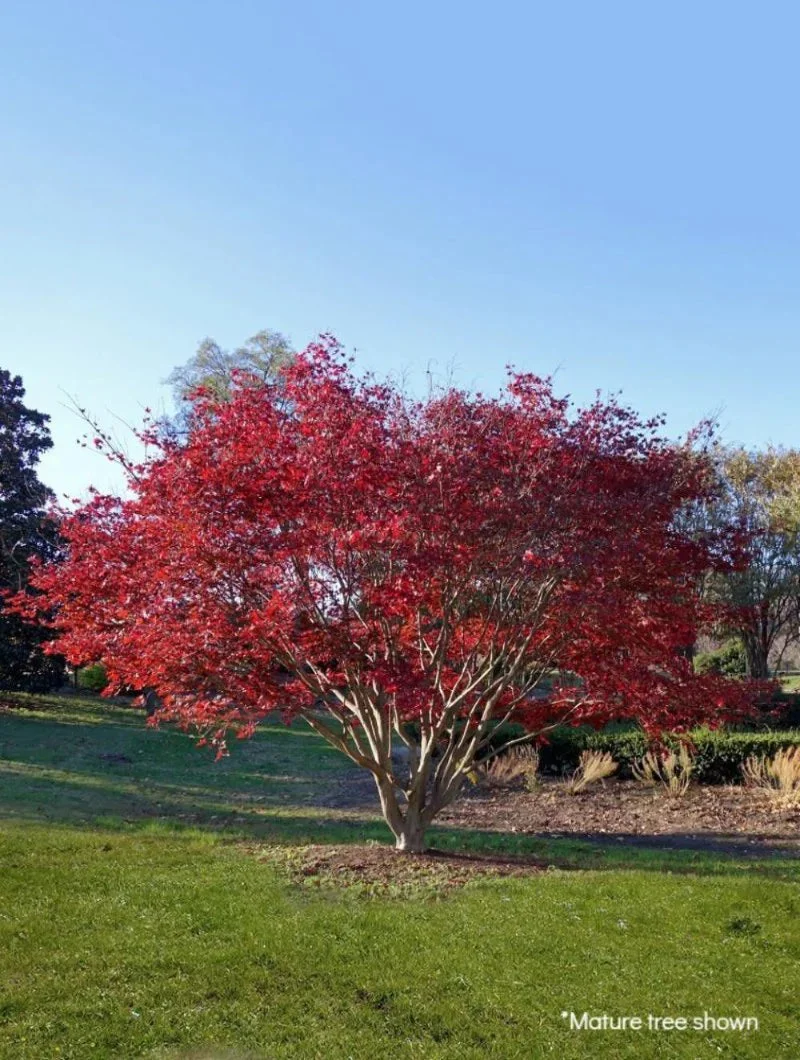
Most people ask how tall the tree gets. In a small yard, the better question is how wide. Standard upright red forms reach 15-25 ft tall and 12-20 ft wide. Dwarf and weeping types are much smaller, usually 6-10 ft tall and 8-12 ft wide, though this varies significantly by cultivar.
Spread is what blocks a walkway, scrapes siding and crowds a neighbor's fence. Standard forms want 10-15 ft of clearance from structures and other trees. Dwarf forms need less. Our distance-from-house spread table gives the numbers by tree type, so check it against your tape measure.
- Stand where you plan to plant and measure to the nearest wall, fence, walkway and neighboring tree in every direction.
- Halve the mature width you expect, then add a buffer. A 10-ft-wide tree needs about 5 ft of clear radius, plus extra so branches do not touch siding.
- If the clear radius is under 5 ft in any direction, you are in dwarf or container territory. A standard upright is the wrong tree.
Step 2: Choose your strategy
Once you know the real space, three approaches work. Pick one. Do not blend them and hope.
Strategy A: a dwarf cultivar in the ground
If you have a bed at least 12 ft wide, a dwarf red cultivar is the most satisfying option. Names that come up often for compact red forms include 'Shaina' and 'Red Dragon'. We do not have field data on either, so check the current Missouri Botanical Garden (MBG) profile or your supplier's tag for mature size before you commit. Expect growth of roughly 6-12 in per year, so the tree will fill its space slowly.
Strategy B: a laceleaf as eye-level sculpture
Where an upright tree would hit the eaves, use a weeping laceleaf (dissectum) form such as 'Crimson Queen'. It builds a mounded, cascading shape rather than a tall one. Plant it where you will see it at eye level: beside a front step, at a path bend, or next to a patio chair. Weeping forms stay roughly 8-12 ft wide at maturity, so they need floor space even if they do not need headroom.
Strategy C: container culture to cap size
A pot limits root volume, and root volume limits the tree. This is the only sensible option for a balcony. It also suits a patio where there is no soil at all. Container-grown trees need consistent moisture and root protection in freezing winters. Our guide to growing Japanese red maple in pots and containers covers the pot sizes, soil mix and winter protection, and the roundup of best Japanese red maples for containers helps you pick a form.
Decision table: space, strategy and example
| Your space | Best strategy | Example form | Watch for |
|---|---|---|---|
| Bed 12 ft or wider, open overhead | Dwarf in the ground | 'Shaina' or 'Red Dragon' (verify size on the tag) | Allow 8-12 ft of spread |
| Under eaves or near a window | Laceleaf, weeping habit | 'Crimson Queen' | Needs floor space, not headroom |
| Courtyard or townhome strip | One tree plus underplanting | Dwarf or weeping form | Reflected heat from walls and paving |
| Patio with no soil | Large container | Smaller or dwarf selection | Freezing winters, drying out |
| Balcony | Container only | Dwarf selection | Wind and afternoon sun |
Step 3: Use one tree and an underplanting, not three shrubs
In a 12-ft bed, three shrubs read as a hedge of sameness. One maple with a ground layer reads as a composed picture, and it uses less water and less pruning time. The maple gives you height and a branching silhouette that shows well in winter. The ground layer fills the gaps.
- Set the tree off-center, not in the middle, so the bed feels intentional.
- Plant hostas, ferns or hakone grass in drifts under and around the canopy. Azaleas and rhododendrons share the same slightly acidic soil preference (roughly pH 5.5-6.5).
- Keep companions a hand's width back from the trunk so the root flare stays dry.
In a courtyard or townhome strip, paving and walls hold heat. Leaf scorch from hot sun, wind and drought stress is the most common problem in these spots. Choose a site with afternoon shade if you can. In hot-summer climates, afternoon shade helps preserve leaf color and prevents scorch.
Step 4: Plant it correctly
- Time it. Plant in early spring or fall, and avoid peak summer heat.
- Dig wide, not deep. Make the hole about two to three times the width of the root ball and no deeper than the ball itself.
- Check drainage. Fill the hole with water. If it is still standing there after several hours, choose another spot or plant in a container. Root rot in poorly drained soil is a leading cause of loss.
- Set the height. The top of the root ball should sit level with or slightly above the surrounding soil.
- Backfill and water. Use the native soil, mixed with some compost if it is thin. Water slowly and thoroughly.
- Mulch. Spread mulch 2-3 in deep, pulled back from the trunk.
The small-yard trap: "I'll just prune it smaller"
This is the most common bad plan we hear, and we will say it plainly: you cannot hold a 20-ft cultivar at 8 ft by pruning. Extension guidance for Japanese maples is to prune lightly, removing only dead, crossing or crowded branches in late fall to midwinter dormancy. Heavy cuts to force a small size take away the layered branching that makes the tree worth growing. They also invite sap bleed and sprouting of weak, upright shoots. You spend every winter cutting and the tree looks worse each year.
Buy the right genetics for the space instead. If you already inherited an oversized tree, our guide on restoring an overgrown Japanese red maple covers the careful way to reduce it over several seasons.
Where to get one
Be honest about what you are buying. Unnamed, seedling-grown Japanese red maples can vary in mature color and habit, and exact size is uncertain without a named cultivar. That makes a seedling-grown tree a good match for a roomy small yard (12 ft or more of bed) or a large container, and a poor match for a very tight strip where every foot matters. In that case, buy a named dwarf from a specialist. If a container or modest bed is your plan, the 3-gallon size (2-3 ft tall) in our Japanese red maple shop is easy to handle and suits small spaces and pots.
Tips and common mistakes
- Planting too close to the house. Judge by mature width, not by the nursery pot.
- Overfeeding. A light, balanced, low-nitrogen feeding in early spring is usually enough. Too much nitrogen causes leggy growth and weaker color.
- Letting a pot dry out. Young trees and container trees need regular watering. Drought tolerance is low to moderate even once established.
- Salt exposure. Salt tolerance is poor, so keep trees away from de-icing runoff along driveways and walks.
- Full sun on a young trunk. Young trees can get trunk sunscald in full sun.
What to expect
Growth is slow to moderate, so a small tree may take 10-15 years to reach significant landscape size. With good siting and care, trees may live 80-100 years or more. Fall color is typically red, orange or crimson, but intensity varies by cultivar and season. In deep shade or intense summer heat, some red forms can shift greener. Results depend on your climate, soil and the specific tree.
Quick reference
| Item | Guideline |
|---|---|
| Hardiness | USDA zones 5-8 (zone 9 with afternoon shade for some forms) |
| Standard upright size | 15-25 ft tall, 12-20 ft wide |
| Dwarf or weeping size | About 6-10 ft tall, 8-12 ft wide (varies by cultivar) |
| Clearance from structures | 10-15 ft for standard forms, less for dwarfs |
| Soil | Rich, well-drained, pH about 5.5-6.5 |
| Light | Full sun to part shade, afternoon shade in hot climates |
| Best planting time | Early spring or fall |
| Pruning window | Late fall to midwinter, light only |
| Balcony or no-soil patio | Container only, with winter root protection |
Japanese Red Maple
Nursery-grown Japanese Red Maple in sizes from 3 Gallon 2-3 ft, shipped to your door.
From $118.33
Shop Now →