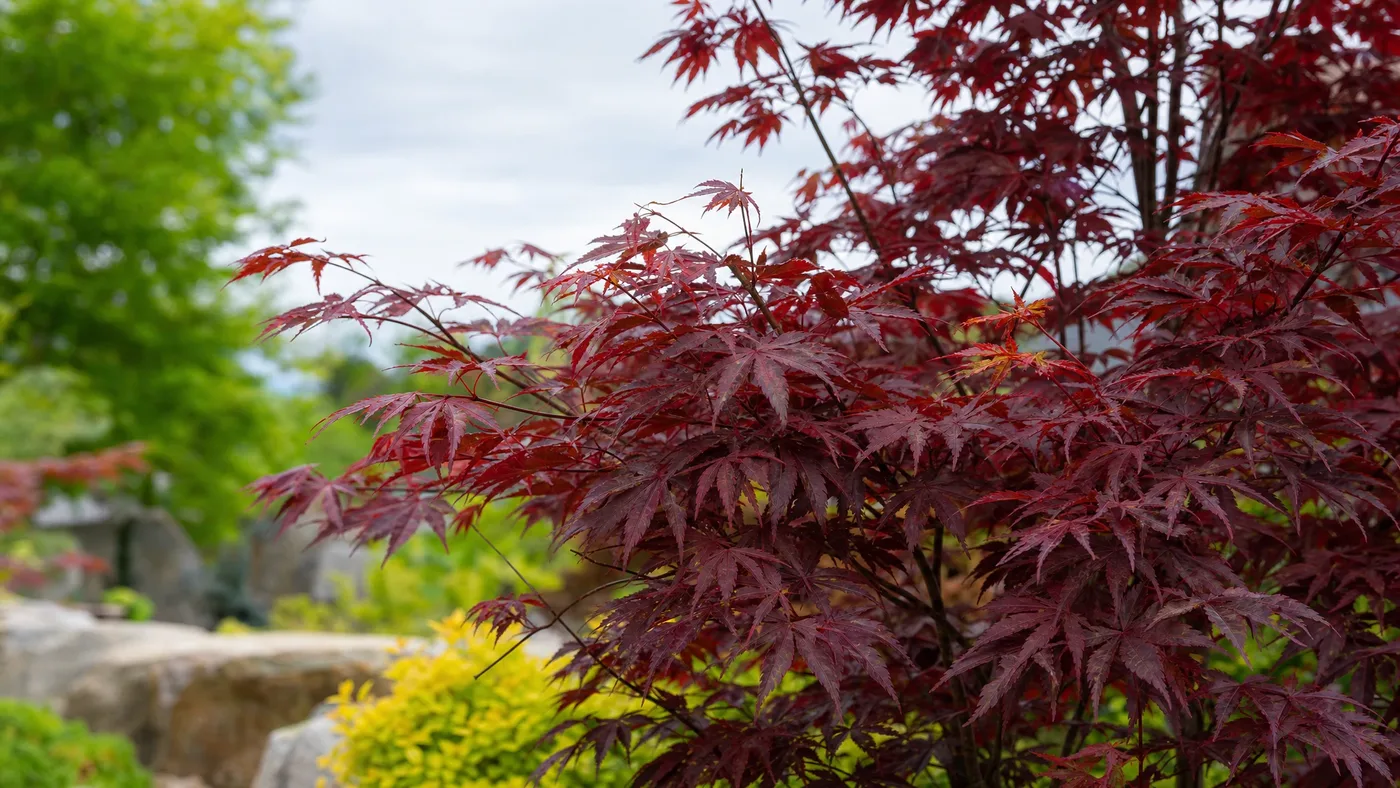
Pruning a Weeping Japanese Red Maple
Pruning a weeping Japanese maple is mostly a job of restraint. A well-grown laceleaf may need about 30 minutes of work a year, and the rest of the time the best tool is your eyes. If you are looking for the general rules on timing and tools for the whole species, start with our guide on how and when to prune a Japanese red maple tree. This article covers the specific method for weeping and dissected forms, which are pruned very differently from an upright tree.
Think in layers, not in shapes
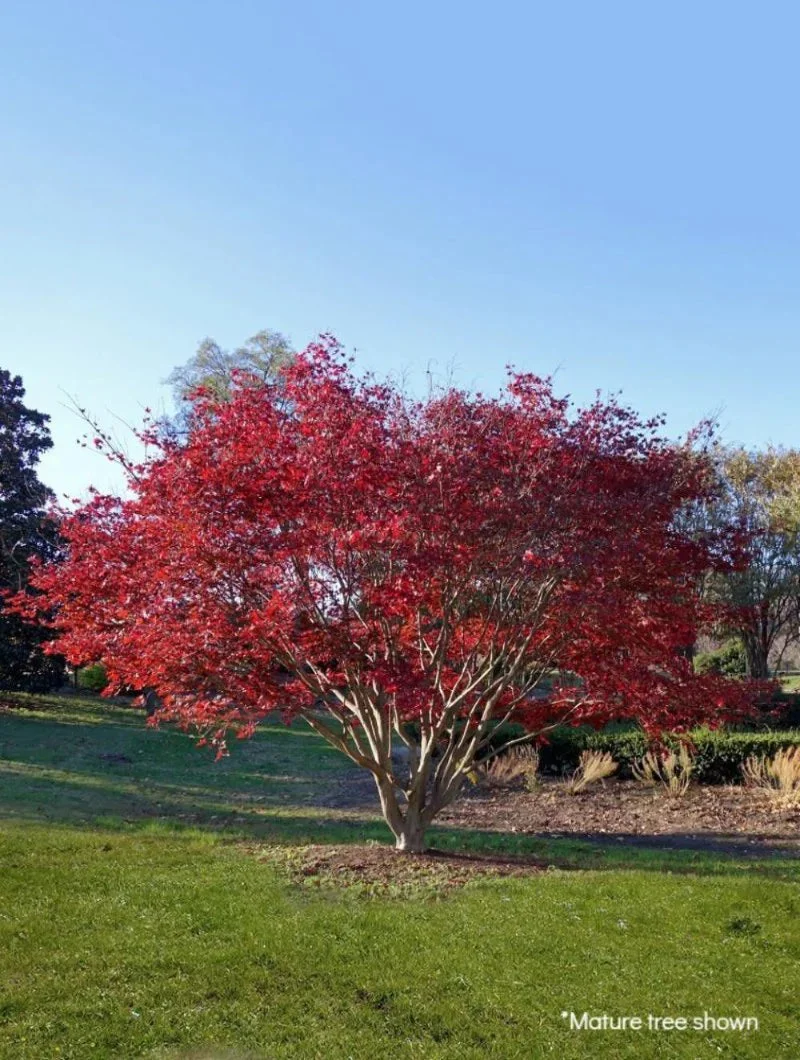
A healthy weeping maple reads as stacked cloud forms: an outer shell of fine foliage, with layers cascading below it. Pruning maintains those layers. It does not carve them. Once you see the tree that way, most decisions get easy. You are removing what does not belong inside the clouds, not drawing a new outline around them.
This is the working method for how to prune a laceleaf Japanese maple, in the order we would walk a customer through it:
- Deadwood first, from the inside.
- Open a few windows so light reaches the interior.
- Shorten tips selectively, underneath the outer layer.
- Stop. Do not touch the shell.
The one thing not to do: the hedge-trimmer dome
Here is the position we will take plainly. The single worst thing done to a laceleaf is shearing it into a dome with a hedge trimmer. It turns a sculpture into a meatball.
The mechanism is simple. Shearing cuts hundreds of branch tips at the same level, and each cut tip sprouts a cluster of new shoots. The outer shell thickens into a dense mat. Light stops reaching the interior, and the inner branches respond the way shaded wood always does: they go twiggy and die back. You end up with a green crust over a hollow, brittle core.
Undoing it is slow. Expect 2 to 3 years of interior thinning, done gradually in dormant seasons, to restore a natural structure. Better never to start.
When to prune
Do structural and corrective work in late fall to midwinter, while the tree is dormant. Heavy sap bleed is the reason to avoid spring and summer cuts on maples. Dormancy also gives you the best view you will ever get of a laceleaf: with the leaves off, every crossing branch and every dead twig is visible. The full timing reasoning is in the pruning timing guide.
Materials needed
- Bypass hand pruners (sharp, for small twigs and tip work)
- Narrow-bladed folding saw or small pruning saw (only for occasional larger deadwood)
- Long-handled loppers, optional, for reaching into the canopy
- Rubbing alcohol or a disinfectant wipe to clean blades between cuts on suspect wood
- A tarp to lay under the skirt and a pair of gloves
- A stool or low stepladder, so you can look at the tree from inside its height
Anvil pruners crush stems. Skip them here.
Step-by-step: how to prune a laceleaf
Step 1: Look before you cut
Walk all the way around the tree. Then crouch and look up into it from below the skirt. Decide what the tree should look like in 3 years, not what you can fix today. If you cannot name a reason for a cut, do not make it.
Step 2: Clear the deadwood under the skirt
Laceleafs hold a surprising amount of deadwood beneath the outer layer. Lift the skirt and work inward. Dead twigs are brittle, grey or tan, and snap cleanly with no green under the bark. Cut each one back to the branch it came from. Lay the tarp first, because this step produces a lot of debris.
If entire branches fail to leaf out in spring, or leaves wilt on one side of the tree, do not guess. Verticillium wilt is a documented disease of maples, and your local cooperative extension office can help you confirm it.
Step 3: Remove crossing and rubbing branches
Where two branches rub, take out the weaker one. Where a branch grows straight back into the center, remove it at its base. These cuts also relieve crowding, which is the main cause of interior dieback.
Step 4: Open windows
A window is a small gap in the canopy, made by removing one or two crowded interior branches so daylight reaches the inside. Make a few, spaced around the tree and at different heights. They should be invisible from outside, because the outer layer drapes over them. If you can see a hole from 10 feet away, you took too much.
Step 5: Shorten tips selectively, under the outer layer
If a branch is growing past the shape you want, trace it back and cut it to a side shoot that sits under the outer layer. The cut then hides beneath the foliage above it. Work one branch at a time. Never cut every tip to a single height, because that is shearing under a politer name.
Step 6: Step back, then stop
Walk away, come back, and look again. Then put the pruners down. Resist the urge to tidy the shell.
Common mistakes
| Mistake | What happens | Better move |
|---|---|---|
| Shearing the outer shell | Dense crust, shaded interior, twiggy dieback | Thin from inside; cut tips only under the outer layer |
| Pruning in spring or summer | Heavy sap bleed, harder to see structure | Wait for late fall to midwinter |
| Cutting to hit a size target | Chopped branches, ragged regrowth | Choose a form that fits the space |
| Removing too much at once | Stressed tree, sunburned interior wood | Spread heavy corrections over 2 to 3 seasons |
| Inventing work every year | Over-pruned tree with weak structure | If it looks right, leave it |
Scale: dwarf types and the size trap
Dwarf and cutleaf cultivars often stay 6 to 10 ft tall, with widths of 8 to 12 ft for dwarf or weeping types. Crimson Queen is the example most people know, and our comparison of weeping red Japanese maples lays out how the forms differ. Matching the plant to the space is the real fix for an oversized tree. Growth is slow, roughly 6 to 12 inches a year, so a tree planted too close to a path will not respond well to repeated cutting back. Move the plan, not the maple.
If you are still choosing a tree, our nursery-grown Japanese red maples are available in 3-gallon, 5-gallon and 7-gallon sizes at our shop. One honest caution: a seedling-grown red selection can vary in habit, so a true weeping laceleaf is usually a named, grafted cultivar. Check the plant label before you buy.
Tips from the pruning bench
- Prune on a dry day. Wet stems are slippery, and clean cuts matter more than speed.
- Cut just outside the branch collar, the slight swelling where a branch meets its parent. Do not leave stubs.
- Do not use wound paint. Extension guidance generally does not recommend it for trees.
- Feed lightly if at all. Overfeeding with nitrogen causes leggy growth that makes pruning harder.
- Protect young trees from sunscald, and give hot-summer sites afternoon shade, because pruning does not fix scorch.
What to expect
After a thinning session, a laceleaf may show better light penetration into its interior, and the cascading layers can look more defined. Results depend on the cultivar, the tree's age and how much correction was needed. A tree that was previously sheared can take 2 to 3 years to recover its natural form. Pruning does not change mature size, so do not count on it to shrink a tree.
Quick reference
| Item | Guideline |
|---|---|
| Best timing | Late fall to midwinter, while dormant |
| Annual effort | About 30 minutes for a well-grown laceleaf |
| Order of work | Deadwood, crossing branches, windows, tips under the layer |
| Never | Shear the outer shell or hedge-trim a dome |
| Recovering a sheared tree | 2 to 3 years of interior thinning |
| Dwarf and cutleaf size | Often 6 to 10 ft tall, 8 to 12 ft wide |
| Growth rate | Roughly 6 to 12 in per year |
| Suspected disease | Contact your local cooperative extension office |
Japanese Red Maple
Nursery-grown Japanese Red Maple in sizes from 3 Gallon 2-3 ft, shipped to your door.
From $118.33
Shop Now →