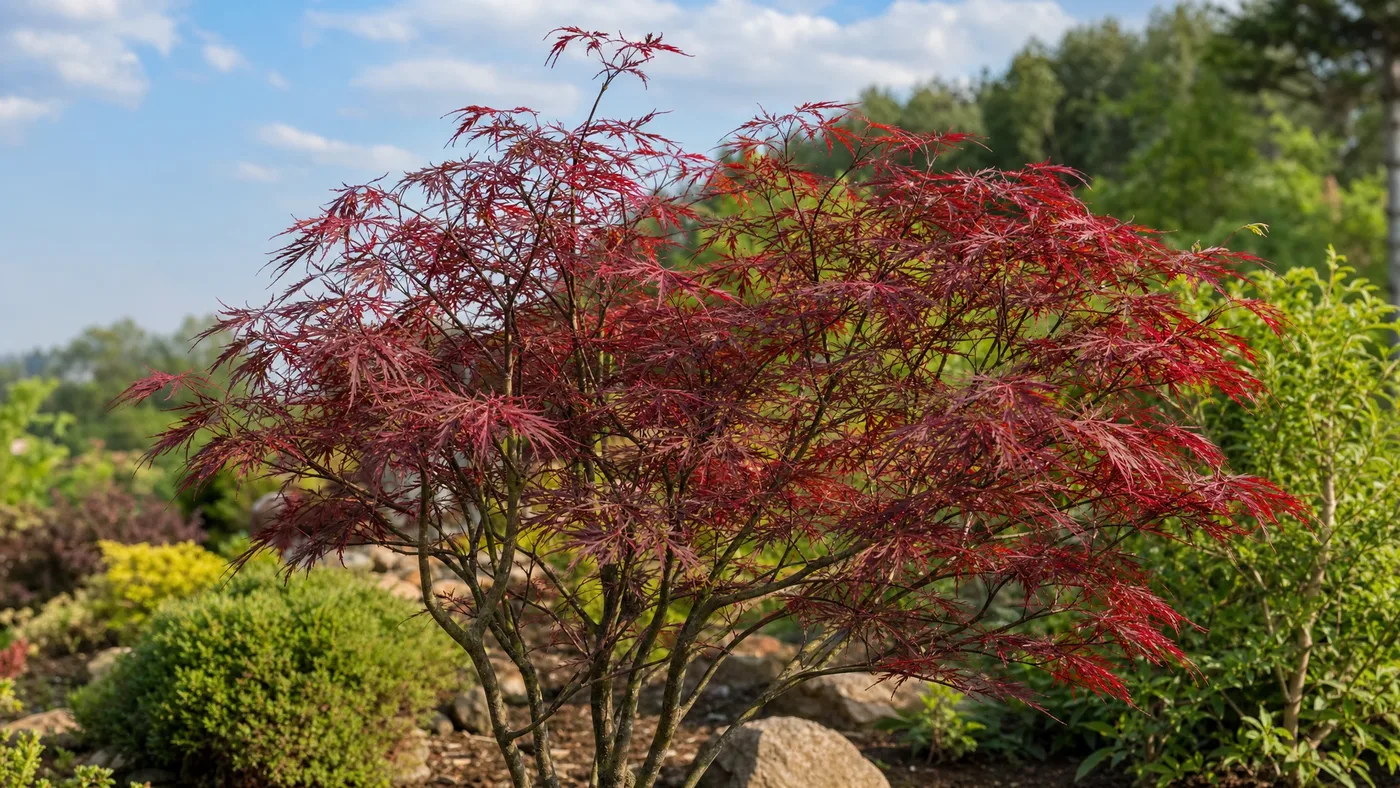
Upright vs Laceleaf Japanese Maple: Which Form to Choose
Most buyers compare these two trees by looks. One has a fine, feathery leaf and a cascading habit. The other has a broader leaf and a tree-shaped frame. That is the wrong starting point. The better question is what job the tree has to do in your yard, because the two forms do very different jobs.
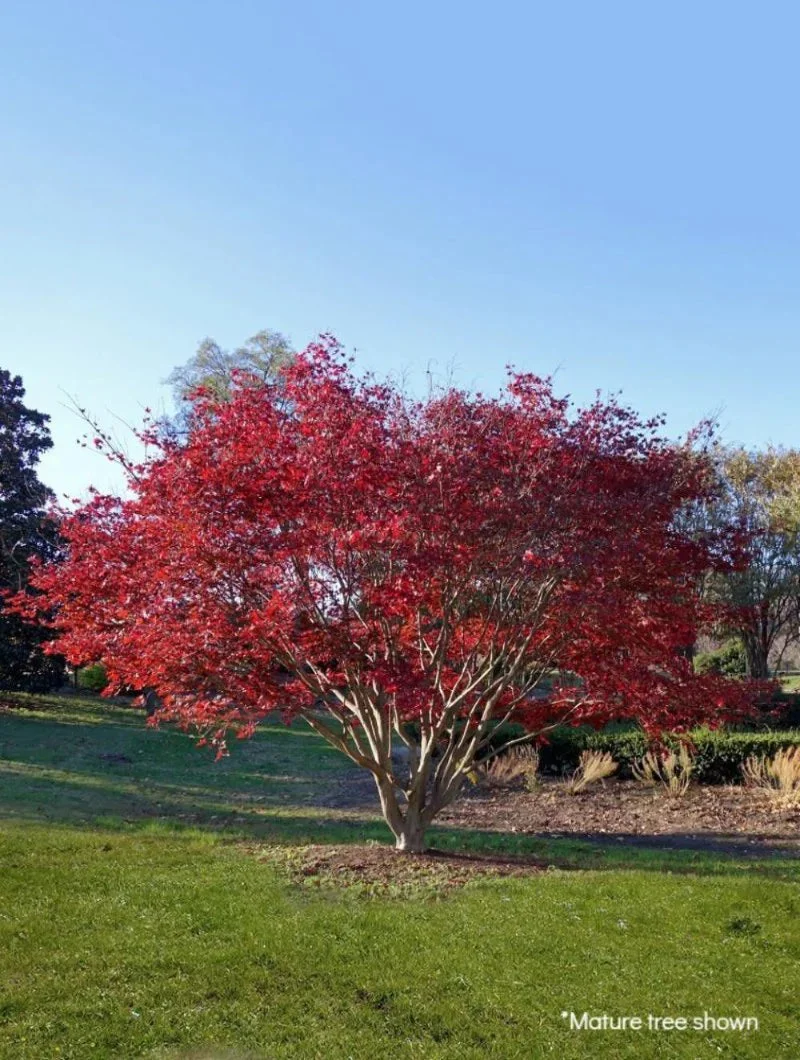
This guide covers the upright vs laceleaf Japanese maple decision for red-leaved forms, including the dissectum vs palmatum naming question. If you want to see named cultivars of each form side by side, our Japanese red maple varieties and cultivars comparison goes deeper than we will here.
The short answer: choose by the job, not the catalog photo
Here is the position we will defend for the rest of this post.
- Need shade, height, or a tree you can walk under? Choose the upright.
- Need a living sculpture at eye level, near a path, pond, or doorway? Choose the laceleaf.
- Need both? You need two trees. Neither form stretches to do the other's job, and that is the honest answer.
A laceleaf will never shade a patio chair. An upright will never sit politely beside a front step for 30 years without pruning. People who buy the wrong form usually bought on appearance and then spent a decade fighting the tree's natural shape.
What the two forms actually are
The upright is the standard red-leaved Acer palmatum. Typical upright red forms reach 15-25 ft tall and 12-20 ft wide. The leaf is palmate and deeply lobed, usually with 5-7 lobes. It grows slowly to moderately, roughly 6-12 in per year, so reaching real landscape size takes 10-15 years.
The laceleaf is the dissectum type, sold as a weeping Japanese maple. The leaf is cut so finely that each lobe looks like a strand. The habit is mounding and cascading, usually wider than tall. Dwarf and cutleaf forms commonly stay 6-10 ft tall with a spread of 8-12 ft. 'Crimson Queen' is the red dissectum example most people know.
A note on naming
| Name | What it means |
|---|---|
| Acer palmatum | The species. Missouri Botanical Garden (MBG) taxonomy treats the upright, broad-leaved forms as the standard type. |
| Acer palmatum var. dissectum | A variety of that same species. MBG lists the laceleaf, weeping forms here. Same species, so the two share the same basic hardiness and soil needs. |
| Atropurpureum Group | A grouping for red or reddish-purple seedling-grown forms. Seedlings vary in color and habit. |
One more naming trap: "weeping Japanese maple" is a habit, not a botanical term. Most laceleafs weep, but not every weeper is a laceleaf. Also, none of this has anything to do with Acer rubrum, the native North American red maple, which is a much larger and unrelated shade tree.
Upright vs laceleaf at a glance
| Attribute | Upright (palmatum type) | Laceleaf (var. dissectum) |
|---|---|---|
| Height and width pattern | 15-25 ft tall, 12-20 ft wide; taller than wide or close to equal | 6-10 ft tall; mounding and wider than tall, 8-12 ft wide for weeping types |
| Leaf | Palmate, 5-7 lobes, broader surface | Finely dissected, thread-like lobes |
| Landscape role | Specimen tree, shade, framing entryways, canopy you can walk near | Eye-level focal point, courtyard, Zen-style garden, container |
| Pruning approach | Minimal; remove dead, crossing, or crowded wood in dormancy | Minimal but fussier; dense, tangled interior wood needs thinning, and cuts show on a small tree |
| Scorch sensitivity | Moderate; afternoon shade helps in hot summers | Higher; finer leaf means less margin in sun, wind, and heat |
| Price pattern | Lower per foot of tree | Higher per foot; usually grafted low, which adds grower time (qualitative only) |
The upright: pros and cons
Pros
- It is a real tree. At 15-25 ft it gives dappled shade and a canopy you can stand beside.
- Better winter structure. The branching silhouette shows well once the leaves drop.
- More forgiving leaf. A broader leaf tolerates a rough summer day better than lace does, though it is not scorch-proof.
- Easier to leave alone. Pruning stays minimal.
Cons
- Needs room. Plan 10-15 ft from structures and other trees. In a small courtyard it becomes a problem by year 12.
- Slow to impress. At 6-12 in a year, a small tree does not look like a shade tree for a long while.
- Seedling variability. If the stock is seed-grown rather than a grafted named cultivar, mature color and habit can vary.
The laceleaf: pros and cons
Pros
- Scale. It fits where a 20 ft tree never could: beside a front step, over a low wall, near a pond.
- Eye-level drama. The cascading habit is the point. You see the whole plant up close.
- Container friendly. Smaller and dwarf selections suit pots and patios.
Cons
- Scorch margin is thin. The finer the leaf, the faster it dries out in hot sun, wind, or a missed watering. Afternoon shade matters more here than with the upright.
- No shade, no height. It will not solve a bare, sunny lot.
- Costs more per foot. Laceleafs are typically grafted low, and that grower time shows up in the price.
- Maintenance in the interior. Dense weeping growth can trap dead twigs that need clearing in dormancy.
- Container roots need winter protection in freezing climates.
Best for: matching the form to the job
| Your situation | Better fit | Why |
|---|---|---|
| Bare yard, want shade in 10-15 years | Upright | Only the upright reaches 15-25 ft |
| Framing a front entry at 6-8 ft from the door | Laceleaf | Stays 6-10 ft and will not crowd the house |
| Zen-style or Japanese garden bed | Either; laceleaf for ground-level sculpture | Depends on whether you want a canopy or a mound |
| Patio or courtyard container | Laceleaf or a dwarf selection | Smaller forms suit pots |
| Hot, windy, exposed site | Upright, with afternoon shade | Broader leaf has more scorch margin |
| Shade tree plus a focal point | Both | Two jobs, two trees |
Who should not choose each one
Skip the laceleaf if your only planting spot gets blasting afternoon sun with wind, or if you travel in July and nobody will water. Skip it too if you were hoping for shade.
Skip the upright if your planting space is under about 10 ft from a wall or fence, since the spacing guidance for standard forms is 10-15 ft. Pruning to hold a 20 ft tree at 8 ft is a losing job and spoils the natural shape.
Either form struggles in poorly drained soil, where root rot sets in. Both need rich, well-drained, slightly acidic soil (roughly pH 5.5-6.5) and consistent moisture for the first 2-3 years. Salt tolerance is poor for both. The same zones apply: 5-8, with some cultivars tolerating zone 9 with afternoon shade. For your exact heat and cold limits, check with your local cooperative extension office, since limits can shift by a full zone depending on the genetic line.
Shared care, briefly
Both forms want light low-nitrogen feeding in early spring, since overfeeding causes leggy growth and weaker color. Prune only in late fall to midwinter, to avoid heavy sap bleed. Our Japanese red maple care guide covers sun, water, soil, and pruning in full. Young trees in full sun can also get trunk sunscald, which affects both forms.
Our verdict
Choose the upright if the tree has to do something: shade a bench, anchor a corner, or grow into the yard over 10-15 years. Choose the laceleaf if the tree is the art: close, low, and seen every day. If your yard needs both jobs done, plant both and stop trying to find one tree that does it all.
If an upright red form is what you need, you can browse the nursery-grown Japanese Red Maple trees at our shop. They are sold in 3-gallon, 5-gallon, and 7-gallon sizes. Check each listing for what the plant is and is not before you order.
Quick reference
| Question | If yes, choose |
|---|---|
| Need shade or height? | Upright |
| Have 10-15 ft of clear space? | Upright |
| Want a weeping Japanese maple at eye level? | Laceleaf (var. dissectum) |
| Small courtyard or container? | Laceleaf or dwarf selection |
| Hot, windy site? | Upright, with afternoon shade |
| Need both shade and a focal point? | One of each |
Japanese Red Maple
Nursery-grown Japanese Red Maple in sizes from 3 Gallon 2-3 ft, shipped to your door.
From $118.33
Shop Now →