Can You Tap a Japanese Red Maple for Syrup? What to Know
One late-winter morning in a sugarbush stays with us: boots in old snow, buckets ringing as the first drops hit, and a boiling house so full of sweet steam that we smelled it before we saw the door. Later that week a neighbor asked whether the little red maple in the front yard could do the same.
It is one of the most common questions we get, and the honest answer is a qualified no. The tree will not die of curiosity, but the syrup and the tree both suffer for it.
This article talks about sap sweetness, trunk size, tap wounds and the red maple mix-up, and answers the questions customers ask us most. Read on to learn why sugar maple is the syrup tree, what a Japanese Red Maple would give you, and where your syrup effort belongs instead.
The Belief That Every Maple Makes Syrup
Many people reason that a maple is a maple, so any tree with five-lobed leaves and a spring flush of sap should fill a bucket. The sap part is true. Nearly every maple moves sugary water through its wood when nights freeze and days thaw. Whether that water is worth boiling is a separate matter.
Syrup makers settled on sugar maple long ago for a plain reason. Penn State Extension says the sugar maple has the highest sugar content of all the maple species, and it still takes approximately 43 gallons of sap to make 1 gallon of syrup. That is the best case. Every tree below it on the sweetness ladder asks for more sap, more fuel and more hours at the evaporator.
A Japanese Red Maple is Acer palmatum, a small Asian species grown for its leaves, its branching and its color. It was never bred, selected or managed for sap. Our red-leaved trees are sold under the name Atropurpureum, which is used for many red-leaved seedlings, so what you plant is chosen for leaf color and form, not for anything that happens inside the trunk in March.
The common advice to "tap what you have" gets this backward. Syrup making is a numbers game that rewards the one tree with the best numbers, and sugar maple has them. A red-leaved ornamental is a fine tree for a front yard and a poor choice for a sugarbush.
Does a Japanese Red Maple Have Sweet Enough Sap?
The belief here is that sap is sap, and a little less sugar just means a little more boiling. Japanese maple sap contains less sugar than sugar maple sap, but Japanese maples have been tapped to make maple syrup. Both halves are true, and the second does not cancel the first.
Think about the ratio. If the sweetest maple needs about 43 gallons of sap for one gallon of syrup, a tree with less sugar needs more than that. The sources we rely on give no sap sugar figure for Japanese maple, so we will not invent one. If you want a measured number, ask your local extension service, which can point you to a hydrometer or refractometer test.
The table below sets out what the sources say about the trees most often compared.
| Tree | What the sources say | What it means at the stove |
|---|---|---|
| Sugar maple | Highest sugar content of all maples, about 43 gallons of sap per gallon of syrup | The benchmark, and the fewest hours of boiling |
| Red, silver and Norway maples | Sap has less sugar, and red and silver break bud sooner | More sap per batch and a shorter collecting season |
| Japanese maple (Acer palmatum) | Less sugar than sugar maple, though it has been tapped | Possible, but you would boil more than the best case |
| Red-leaved Japanese Red Maple | No syrup data in the sources | Treat it as an ornamental, not a crop |
So the sap is sweet enough to be technically syrup. It is not sweet enough to be worth the effort, especially because the sap volume, which we turn to next, is the bigger obstacle.
There is also the long evening at the stove to weigh. Every extra gallon of sap is more fuel, more steam and more watching of the pan, and the ratio only grows worse as the sugar falls. We tell customers to ask whether the jar at the end justifies the weekend, and with this tree it rarely does.
The Notion That a Small Japanese Red Maple Runs Plenty
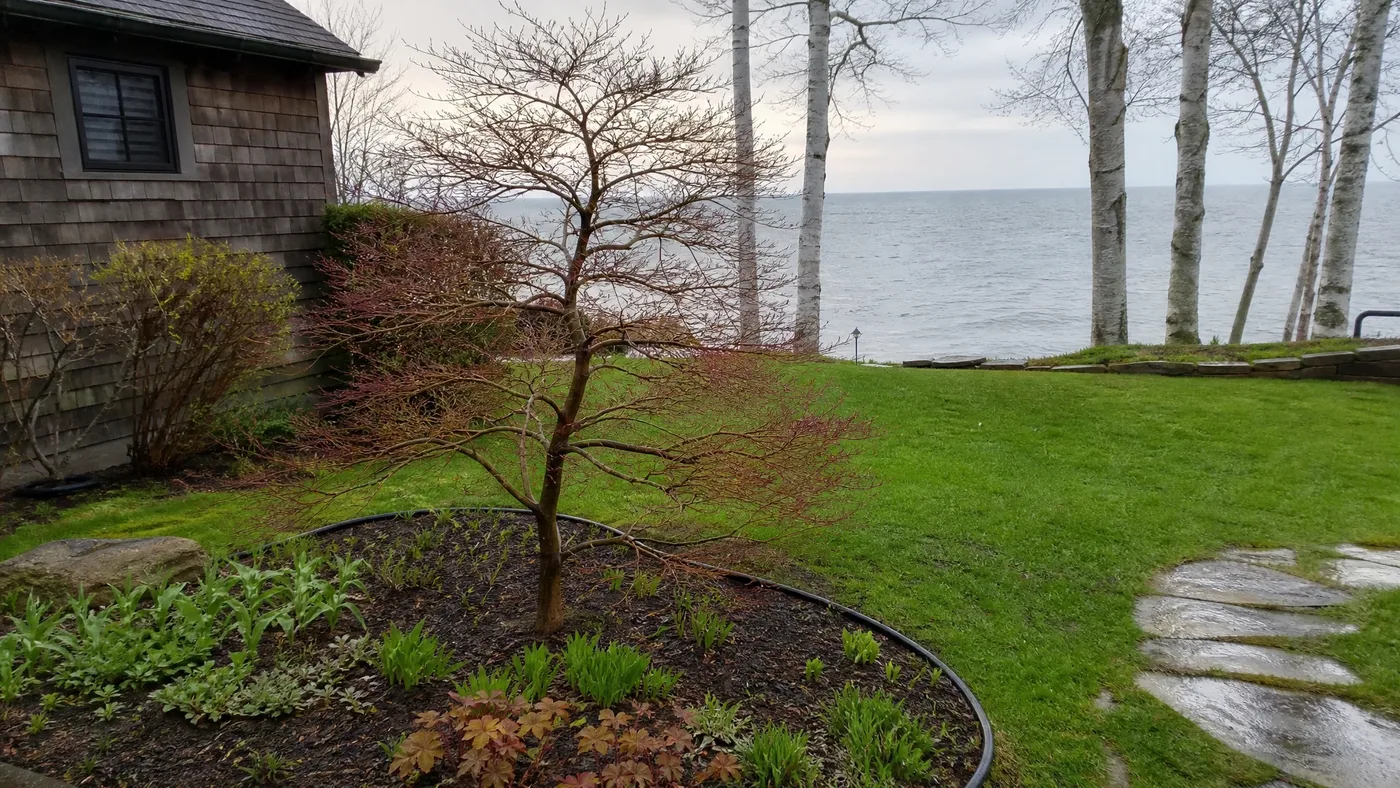
Some customers tell us that a small tree will still give "enough" if they only want a jar. Size decides that. Acer palmatum grows 15 to 25 feet tall, and the red-leaf form is a small, 25-foot-tall tree that grows slowly and stays quite small in zone 5.
That is the tall end. The weeping cutleaf form 'Dissectum Atropurpureum' reaches only about 5 to 8 feet, or 1.5 to 2.5 meters tall and wide. A young tree of any of these forms may stand shoulder high with a trunk you can circle with one hand.
A trunk that thin cannot supply a run worth boiling, for reasons that follow from how a tree is built:
- Sap moves through the outer wood of the trunk, so a thin stem simply holds less of it than a broad one.
- A small crown carries fewer buds and branches that pull sap upward on a thaw, so the flow is weaker.
- Slow growth means the tree adds wood and reserves gradually, and the sources describe growth as slow to moderate.
- Even one tap hole on a small stem is a large share of the wood available, so you cannot add taps to make up the volume.
Put thin sap and a small flow together and the arithmetic fails on both ends. You would gather very little liquid that already needs more than the usual boiling, and the finished syrup would amount to a spoonful or two. Our guide to how big a Japanese Red Maple gets shows how slowly the trunk thickens, which is the real limit here.
Slow growth cuts the other way too. A tree that adds wood so gradually cannot quickly make up for what a wound takes, so a mistake in year one is still showing in year ten.
Tapping Is Harmless to a Japanese Red Maple
People tell us a tap hole is tiny and heals on its own. On a large forest maple that is closer to true, because the tree is big enough to wall off a small wound. On a small ornamental the same wound matters far more.
The Wound Itself
A tap is a drilled hole through the bark into the living wood. The tree does not regrow that tissue. It seals the damage inside and grows new wood around it, and a small trunk has little spare wood to give up. If you are tempted anyway, ask your local extension service what trunk size they consider safe to tap, because we would not guess at a number.
Disease Entry and Stress
An open hole is also a doorway for fungi and other pathogens, and sap running from it feeds them. Anthracnose, leaf scorch, and frost damage are among the problems Japanese maples can face, and a tree already coping with those has less to spare. Our guide to verticillium wilt in a Japanese Red Maple shows how fast a stressed tree can slide.
The tap also comes at the worst moment. Early spring is when the tree is pushing out its flowers, which are small and red to purple, and its first leaves.
A Grafted Tree Has Less to Spare
Many red Japanese maples are grafted, which adds a union where the top meets the rootstock, and we explain the difference in grafted vs seedling Japanese Red Maple. A tap hole made near that union, or on a stem that carries the whole crown, risks the part of the tree holding it together. We would rather you spend those first years on watering and mulch than on a drill.
Acer Rubrum Is Just Another Red Maple
The last belief is a mix-up of names. Syrup makers do tap red maples, so a customer reasons that a Japanese Red Maple must be one. It is not. Red maple is Acer rubrum, a large native tree, while our Japanese Red Maple is Acer palmatum with red leaves. The common names share a color and nothing else.
Penn State Extension says red, silver and Norway maples may be used for syrup, though the sugar content of their sap is generally not as high, requiring more sap. It also notes that red and silver maple break bud sooner than sugar maple, which shortens the sap-collection season. That tells you red maple is a workable second choice for a syrup maker. It says nothing about Japanese maples.
To keep the two apart in the yard, look at the following:
- Leaf shape. Japanese Red Maple has deeply cut, hand-like leaves, while red maple has broader, less divided ones.
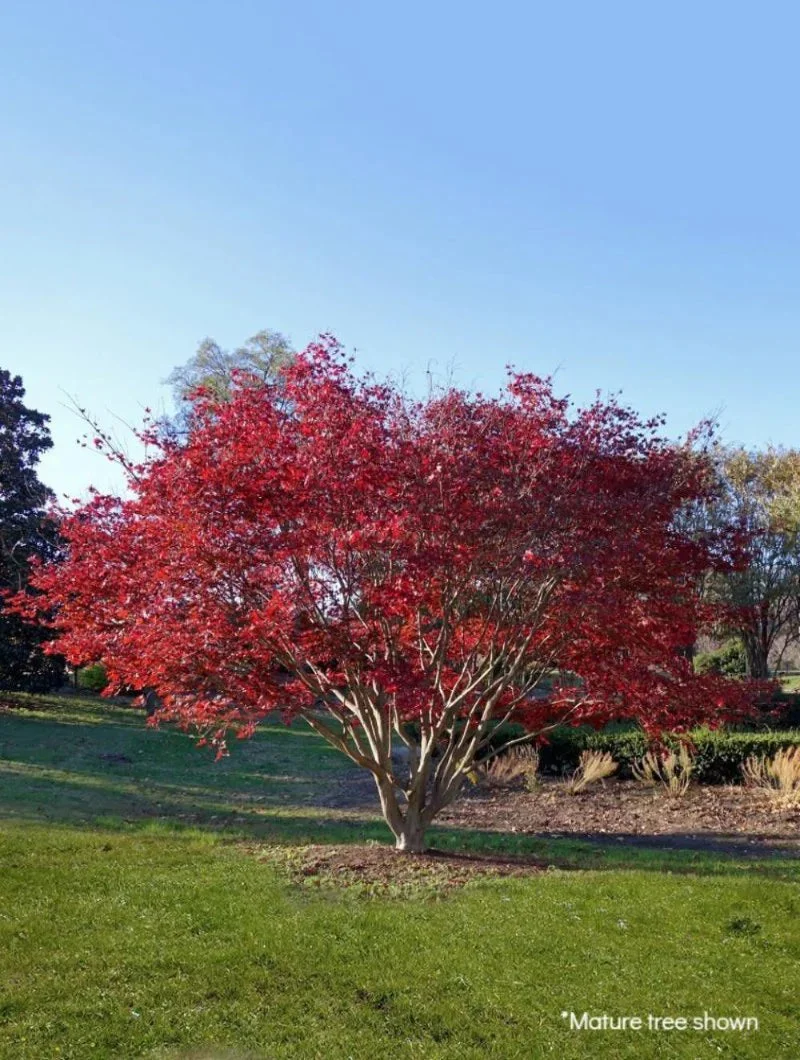
- Color through the year. The leaves of the red-leaf form turn red or purple in spring and may fade to green or bronze in summer heat.
- Size. The Japanese tree is small and slow, and the native red maple is a large shade tree.
We cover the full comparison in Japanese Red Maple vs Red Maple. For this question, the answer is that Acer rubrum is a tree people tap, and the ornamental in your front bed is not.
Sugar Maple Gets the Pot, Japanese Red Maple the Yard
Each maple earns its place for different work. Sugar maple belongs in a sugarbush, with sap sweet enough to boil and trunks big enough to tap. A Japanese Red Maple belongs in the yard, where it gives you spring color, a graceful form and, come autumn, fall color worth waiting for. If the syrup itch is real, tap a sugar maple that has room for it, with the owner's permission and your extension service's advice on tree size and season, or buy syrup from someone who boils it every year.
Leave the little red maple alone in March, and let the big sugar maple down the road do the work.
Japanese Red Maple
Nursery-grown Japanese Red Maple in sizes from 3 Gallon 2-3 ft, shipped to your door.
From $118.33
Shop Now →Sap, syrup and sugarbush talk aside, what we know about the Japanese Red Maple comes from raising it: we plant ours in soil that drains freely and runs from acid to neutral, and we leave it part of each day in shade. Whatever you buy from us was raised in our own rows from start to finish, so you are getting a tree we know well. If you would rather put the little red maple in your yard than on the tap list, come see what we have growing.