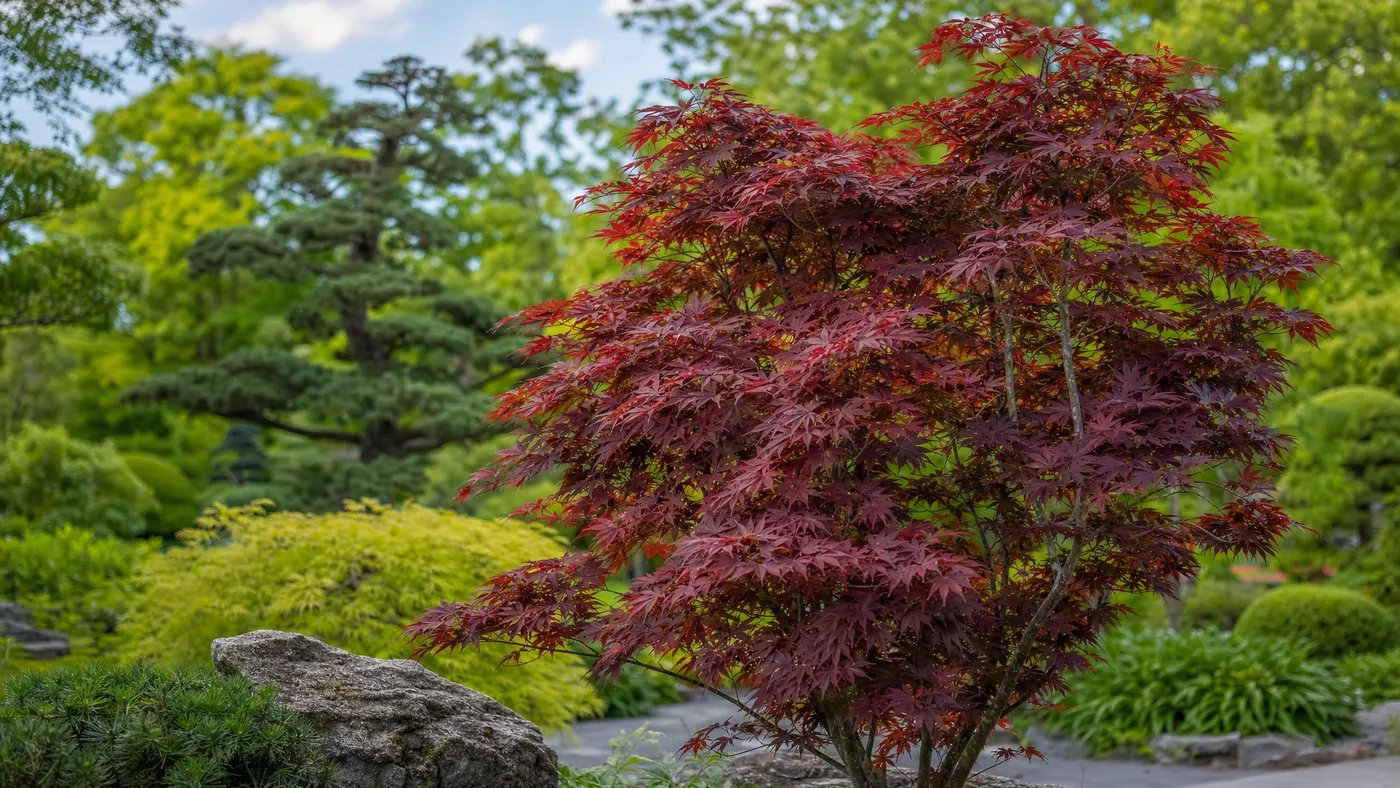
Japanese Red Maple Alternatives: Small Red-Leaf Trees Compared
Most people searching for japanese maple alternatives do not actually need one. They have a hot west-facing wall, a zone 5 winter, or a bad experience with a dried-out maple, and they assume the species is the problem. Sometimes it is. Often the cultivar or the placement is. This guide sorts out which is which, then compares the small red leaf trees that make sense when a Japanese maple truly cannot work.
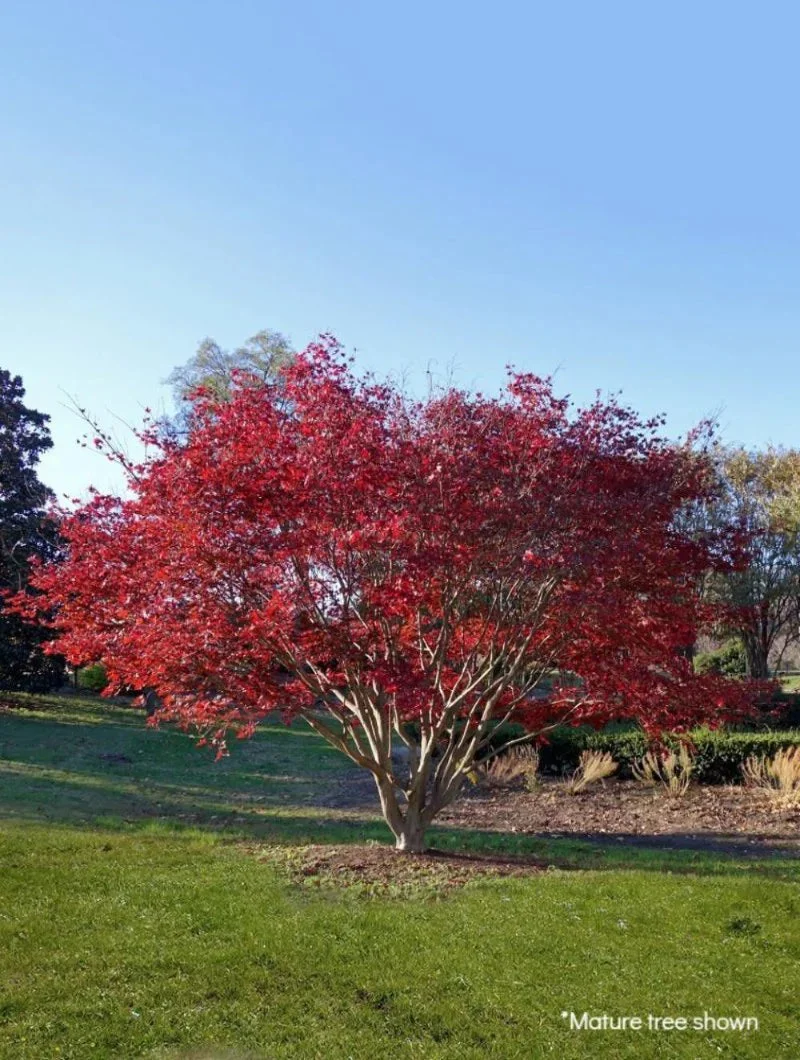
If you are still deciding between maples themselves, start with our comparison of Japanese red maple varieties and cultivars. This post is for the narrower question: what if the maple is off the table?
First, Is Your Site Really Disqualified?
Walk through this before you give up on the maple. Japanese red maple (Acer palmatum, red-leaved forms) is rated for USDA zones 5 to 8, and some cultivars tolerate zone 9 with afternoon shade. It wants rich, well-drained, slightly acidic soil (roughly pH 5.5 to 6.5), steady moisture, and protection from scorching wind.
Four conditions genuinely rule it out:
- Zone 4 cold. You are below the species range.
- Zone 9b and hotter. Heat tolerance can shift by a full zone depending on the genetic line, but sustained heat without shade is a losing bet.
- All-day blazing sun with no afternoon relief and no wind break.
- Alkaline, dry soil that you cannot amend. Poor drainage is just as bad, since root rot is a documented risk.
If none of those describe you, skip ahead to the section on staying with a maple. If one does, read on.
The Alternatives, Side by Side
Every alternative below gives up something. The table compares them on the axes that decide most purchases. Trait descriptions follow Missouri Botanical Garden (MBG) and cooperative extension profiles in general terms. Exact heights and zone limits vary by cultivar, so we deliberately avoid hard numbers for plants we do not grow. Check the specific cultivar's profile and your local extension office before buying.
| Tree | Size and form | Cold and heat | Sun and soil | What you give up |
|---|---|---|---|---|
| Japanese red maple (baseline) | 15-25 ft standard, 6-10 ft dwarf or cutleaf forms | Zones 5-8, some cultivars 9 with afternoon shade | Full sun to part shade, rich acidic well-drained soil | Nothing, if the site fits |
| Purple-leaf redbud (Cercis 'Forest Pansy' type) | Small, multi-stem or single trunk, broad head | Generally listed as hardier than palmatums; some heat tolerance | Sun to part shade, adaptable to many soils | Fine texture, tight form, true fall drama |
| Purple smokebush (Cotinus) | Large shrub, trainable as a small tree | Listed as cold hardy and heat tolerant | Full sun, tolerates poor and drier soil | Tree shape, winter silhouette |
| Purple crabapple (Malus) | Small to medium rounded tree | Widely cold hardy | Full sun, average soil | Foliage that stays truly red through summer |
| 'Crimson King' Norway maple | Large shade tree | Very cold hardy | Full sun, tolerant of many soils | Small scale, plus an invasiveness caveat |
| Purple-leaf sand cherry | Large shrub or small tree | Cold hardy | Full sun, well-drained soil | Lifespan |
Purple-Leaf Redbud: The Best All-Round Swap
For trees like japanese maple that also handle cold, a purple-leaf redbud of the 'Forest Pansy' type is where we would point most people. The leaves are heart-shaped rather than lobed, so the look is softer and broader than a maple. MBG profiles describe the spring flowers as pink and appearing before the leaves, which gives you an early show a maple's tiny red-purple flowers never will.
Pros: broader soil and temperature tolerance than a palmatum, a real small-tree shape, early flowers. Cons: leaf color tends to green up in hot summers by most accounts, and you lose the delicate texture entirely. It is a different tree, not a cheaper maple.
Purple Smokebush: Toughest in Poor Soil
Purple Cotinus is the pick for the alkaline, dry, sunny site that kills maples. Extension and MBG guidance describes it as tolerant of lean, dry soil and as a good performer in full sun. The airy plumes that give it the common name appear in summer.
Pros: forgiving of neglect, strong color in sun. Cons: it is a shrub by nature, so you must prune to a single or few stems to get tree form, and the winter outline is less graceful. Best for people who want color and survival over elegance.
Purple Crabapple: Cold-Climate Workhorse
Purple-leaf crabapples suit zone 4 and colder gardens where nothing else red will live. Cultivars differ a lot in disease resistance, mainly to apple scab, so look up the specific cultivar in extension disease-resistance lists rather than buying by color alone.
Pros: reliable cold hardiness, spring bloom, fruit for birds. Cons: foliage color often fades toward bronze-green by late summer, fruit litter on patios, and disease-prone cultivars look rough by August.
'Crimson King' Norway Maple: Use With Caution
This one is red-leaved and rugged, and it is also a big shade tree, so it is not a small tree at all. More important, Norway maple is listed as invasive in some regions. Before you even consider it, check your state invasive species list through your cooperative extension office. If it is listed where you live, choose something else. We would not plant it on a small lot regardless.
Purple-Leaf Sand Cherry: Short-Lived, Say So Up Front
Sand cherry is inexpensive, fast, and cold hardy. It is also short-lived, and extension guidance flags borers and other pest and disease problems that shorten its life further. Plant it as a temporary screen or a quick color accent, not as a specimen you expect to keep for decades. A Japanese maple, by comparison, can reach 80 to 100+ years with good siting.
When a Tougher Maple Beats Switching Species
Here is the position we will defend: if your site is merely imperfect, switching species is the wrong move. Hot afternoons and zone 5 winters do not disqualify a Japanese maple. They narrow your cultivar choice and your placement.
- Hot afternoons: plant where buildings or other trees shade the tree after midday, keep wind off it, and read our guide to sun-tolerant red Japanese maples for hot climates. Leaf scorch from sun, wind and drought stress is the common failure, and it is environmental, not a disease.
- Zone 5 cold: you are inside the species range. Check where Japanese red maple grows best by zone and use a sheltered spot. Container-grown trees need root protection in freezing winters.
- Small space: dwarf and cutleaf forms stay in the 6 to 10 ft range, as covered in Japanese red maples for small yards and patios.
If that describes you, you can shop nursery-grown Japanese red maples in 3-gallon, 5-gallon and 7-gallon sizes. Keep in mind that unnamed seedling-grown stock can vary in mature color and habit, which is worth knowing before you plan a precise color scheme.
Best For: Pick by Problem
- Zone 4 winters, want a flowering tree: purple crabapple, with a disease-resistant cultivar.
- Hot, dry, alkaline, full sun: purple smokebush.
- Want a tree shape and spring flowers: purple-leaf redbud.
- Need fast color for a few years: sand cherry, knowing it will not last.
- Zone 5 to 8 with decent soil: stay with Japanese red maple.
The Verdict
No alternative gives you the laceleaf texture or the layered branching of a Japanese maple. What these trees give you is survival on sites that kill palmatums, and a living redbud beats a dying maple every time. But do not pay that price for a site that is only imperfect. Afternoon shade, a sheltered corner, and a heat-tolerant cultivar solve most problems without leaving the species. For anything region-specific, such as invasive status or cultivar performance, your local cooperative extension office has the final word.
Quick Reference
| Your situation | Choose | Watch out for |
|---|---|---|
| Zone 5 to 8, good soil | Japanese red maple | Scorch in wind and hot sun |
| Zone 9 with afternoon shade | Heat-tolerant maple cultivar | Heat tolerance can shift a full zone |
| Zone 4 cold | Purple crabapple or redbud | Scab-prone crabapples, fading color |
| Dry alkaline full sun | Purple smokebush | Needs pruning to tree form |
| Quick, cheap color | Purple-leaf sand cherry | Short lifespan |
| Large lot, cold | 'Crimson King' Norway maple | Check state invasive lists first |
Japanese Red Maple
Nursery-grown Japanese Red Maple in sizes from 3 Gallon 2-3 ft, shipped to your door.
From $118.33
Shop Now →