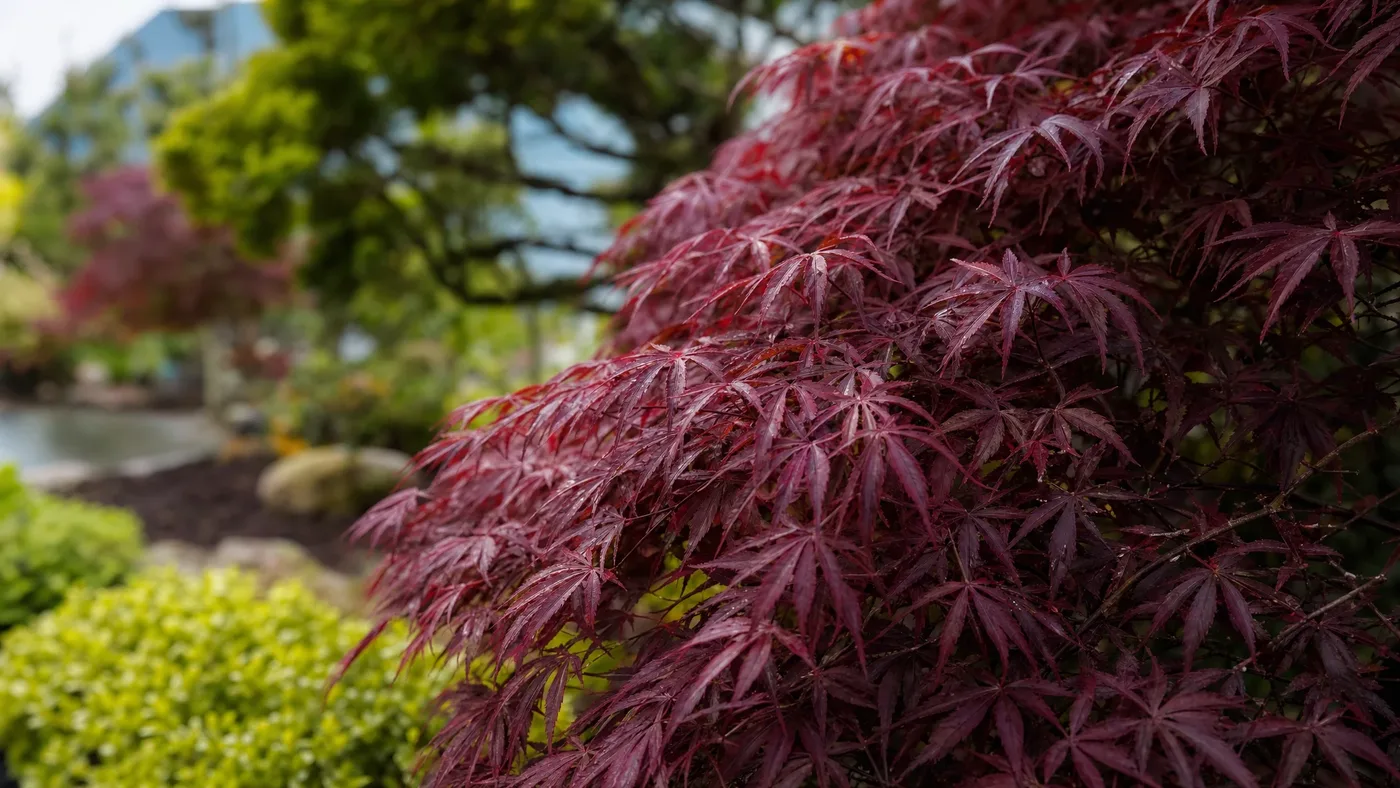
Mulching a Japanese Red Maple the Right Way
If you have 20 minutes and one task to spend them on, spend them on mulch. Mulching a Japanese maple is the cheapest, fastest thing you can do for it, and it is also where most trees get hurt. The rule fits on a sticky note: donut, never volcano. That means 2-3 inches of coarse organic mulch, spread wide, with a bare 3-4 inch gap right at the trunk.
This guide covers the full routine. For everything else the tree needs, see our Japanese Red Maple care guide.
Why mulch matters more for this tree than most
Japanese Red Maple is shallow-rooted. Its fine feeder roots sit near the surface, which is exactly where bare soil swings from hot to dry to cold. The PLANT FACTS for this species call for consistent, even moisture, and note that it handles neither standing water nor drought extremes well. Mulch is the cheapest buffer against both.
- Moisture buffering: a mulch layer slows evaporation, so the soil dries out more gradually between waterings.
- Root-zone temperature: mulch shades the soil in summer and insulates it in winter, which matters for a tree prone to leaf scorch from heat and drought stress.
- Slow feeding: as bark and wood chips break down, they add organic matter to the soil. This species wants rich, high-organic soil with a slightly acidic pH of roughly 5.5-6.5, and mulch moves the soil that way over time.
That last point is why we treat mulch as a replacement for most of the fertilizer people buy. Our position, covered in the fertilizing post, is that a light, low-nitrogen feeding in early spring is usually enough. Overfeeding can cause leggy growth and weaker color. A good mulch ring does more of the work than another bag of fertilizer.
What you need
- Coarse organic mulch: shredded bark or wood chips. Chunky beats fine and powdery.
- A flat garden rake or hard-tined rake
- A trowel or hand cultivator
- A tape measure or ruler (to check depth, not to guess it)
- Gloves
How to mulch, step by step
- Water first. Mulch locks in whatever moisture is already there. If the soil is dry, soak it slowly before you spread anything. Our watering guide explains how deep and how often.
- Clear the area. Pull weeds and grass out by the roots. Remove old, matted mulch if it has built up past 3 inches. Matted mulch sheds water instead of passing it through.
- Find the trunk flare. The flare is the widening where trunk meets root. It should be visible at the soil line. If you cannot see it, soil or mulch has been piled on top, so scrape it back until you do. If the tree was planted too deep, the planting guide shows what correct depth looks like.
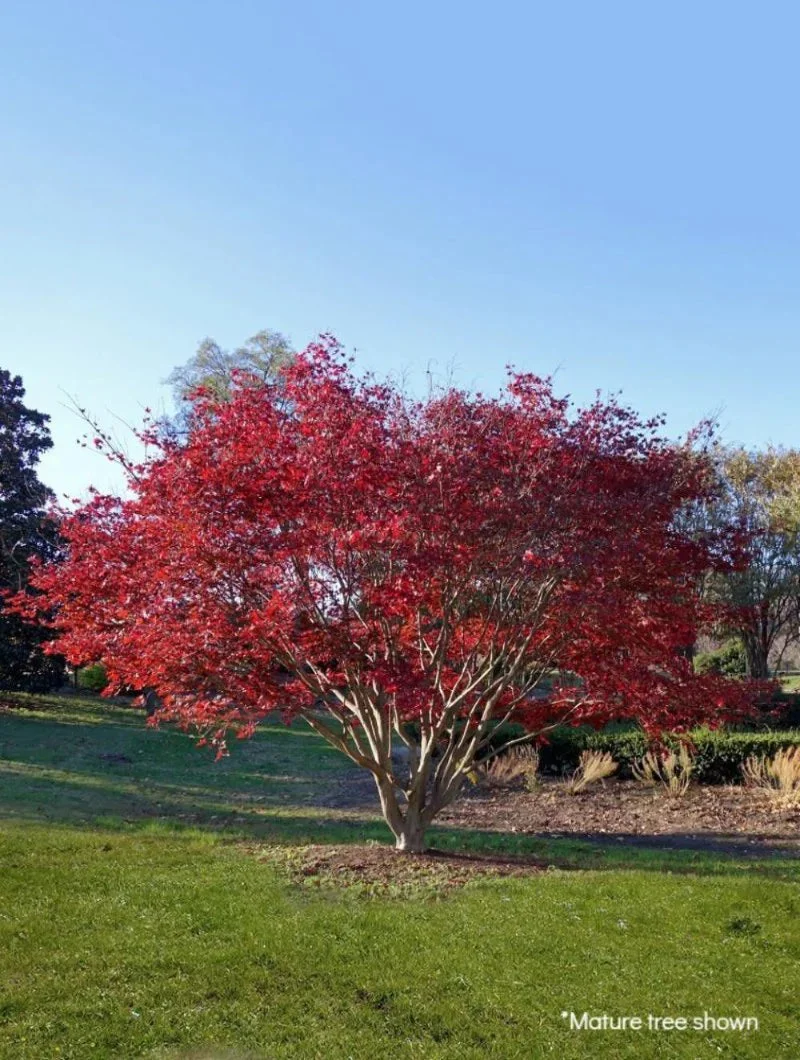
- Mark your radius. Mulch out to the drip line if you can. That is the circle under the outer tips of the branches. A young tree has a small drip line, so just make the ring as wide as is practical and widen it as the tree grows. Standard upright forms reach 12-20 ft wide at maturity, so plan to enlarge the ring over the years.
- Spread 2-3 inches. Lay the mulch evenly, then check the depth with your ruler in a few spots. Three inches is the ceiling.
- Pull it back from the trunk. Leave a bare 3-4 inch gap all the way around. Your finished shape should look like a donut with the trunk in the hole, not a cone with the trunk buried in it.
- Refresh as needed. Mulch breaks down. Rake it loose once a year and top up only enough to return to 2-3 inches total.
How much mulch around a tree is too much?
This is the question behind most mistakes, and the answer is: more than 3 inches. Deeper does not mean better. A thick layer holds water against the soil surface and cuts off air to the roots, and this tree does not tolerate poorly drained conditions. Root rot in wet soil is one of the documented diseases for the species.
The mulch volcano: why it kills trees
A mulch volcano is a tall cone of mulch piled against the trunk, often 6 inches or more at the base. It looks tidy, and that is why it spreads. Arborist and extension guidance describes the same sequence of damage:
- Mulch pressed against the bark stays wet.
- Bark that stays wet softens and rots, and the rot can spread around the trunk until it girdles the tree, cutting off the flow between roots and canopy.
- Roots start growing up into the damp pile instead of down into the soil. Those roots can circle the trunk and tighten over the years.
Thin-barked young maples are especially exposed. Here is our blunt opinion: the volcano is the most common mistake we see made by paid landscapers, not by homeowners. If a crew has built one around your tree, you do not need to ask permission to fix it. Rake the pile back into a flat donut yourself. Check the trunk while you are there. If you find soft, dark bark or roots wrapped around the trunk, call a certified arborist.
Tips and common mistakes
| Mistake | What goes wrong | Fix |
|---|---|---|
| Mulch piled against the trunk | Constant moisture on bark, rot, girdling | Keep a 3-4 inch bare gap |
| Layer deeper than 3 inches | Soggy soil, less air to roots | Rake back to 2-3 inches |
| Fine, powdery mulch | Packs down and sheds water | Use coarse shredded bark or chips |
| Mulching over dry soil | Roots stay dry under the cover | Water deeply first |
| Rock or gravel mulch | Stores and reflects heat | Switch to organic mulch |
About rock mulch: stone absorbs afternoon heat and releases it back at the roots and low branches. For a shallow-rooted tree that scorches in hot sun and wind, that is the wrong trade, and it is worst in hot-summer climates. It also does nothing to feed the soil. Skip it for this tree.
Seasonal timing
You can mulch whenever the ground is not frozen, but two windows work best. Early spring, with the light fertilizing, sets the tree up before summer heat. Fall, after planting or before the ground freezes, helps insulate the roots. In freezing winters, the winter care guide covers protecting roots, especially for container-grown trees. For region-specific timing, your local cooperative extension office is the best source.
What to expect
Mulch is not a miracle. Used correctly, it may help soil moisture stay steadier, may reduce summer stress on the roots, and could lessen how often you need to water. It may also help keep weeds from competing with a young tree. Leaf color, growth rate, and fall color still depend on the cultivar and the season, and this species grows slowly, roughly 6-12 inches per year. Do not expect a visible change in a week.
Quick reference
| Item | Target |
|---|---|
| Mulch type | Coarse shredded bark or wood chips |
| Depth | 2-3 inches, never more |
| Gap at trunk | Bare, 3-4 inches all around |
| Spread | Out to the drip line if you can |
| Avoid | Volcano piles, rock mulch, fine powdery mulch |
| Best timing | Early spring or fall, on moist soil |
| Upkeep | Rake loose yearly, top up to 2-3 inches |
Japanese Red Maple
Nursery-grown Japanese Red Maple in sizes from 3 Gallon 2-3 ft, shipped to your door.
From $118.33
Shop Now →