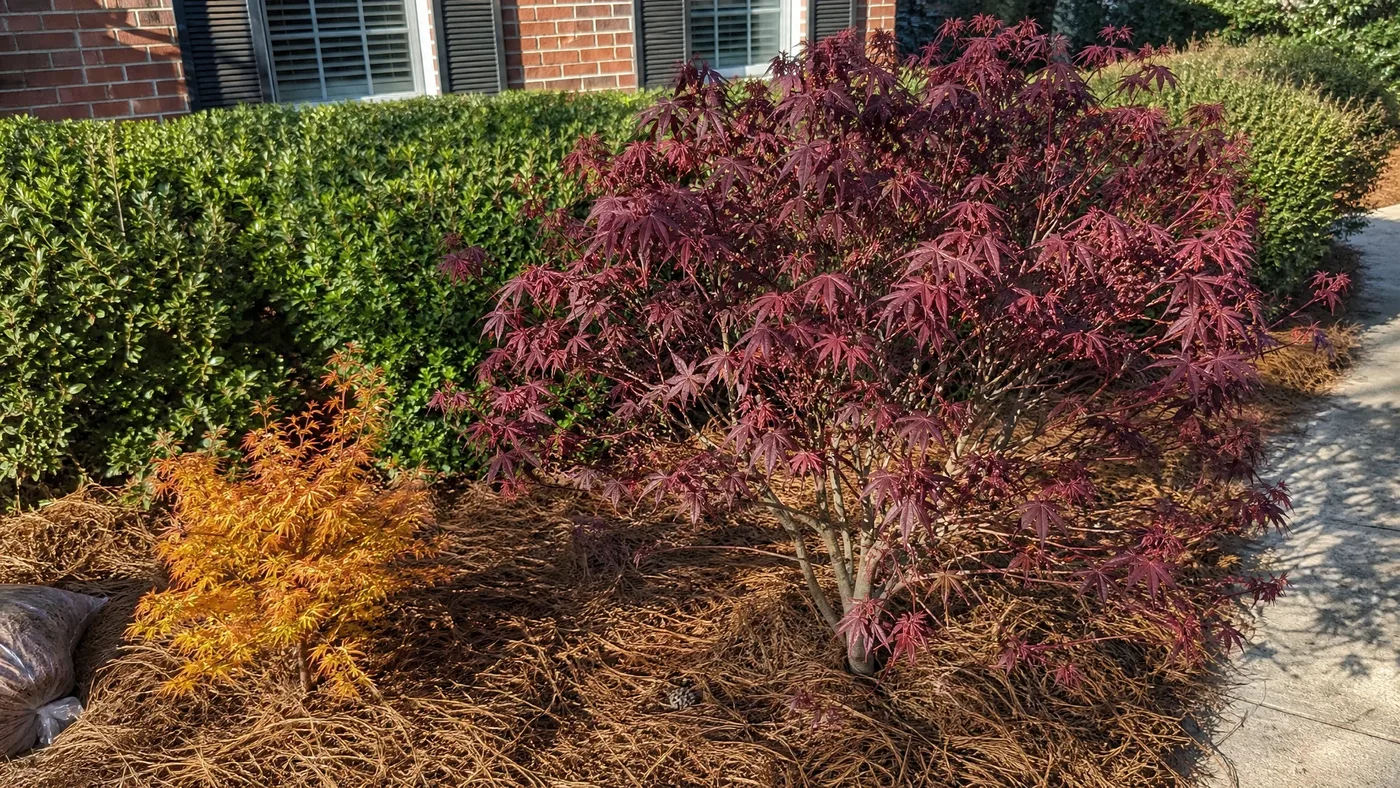
Orange, Gold and Yellow Maples to Pair With a Japanese Red Maple
Six hours of direct sun is the number that decides most of what follows. The red-leaf form of Japanese Red Maple suits both partial shade (2–6 hours) and full sun (6 or more hours). Pale-leaved partners are less forgiving, and a gold maple that takes six hours of afternoon sun can look scorched by August.
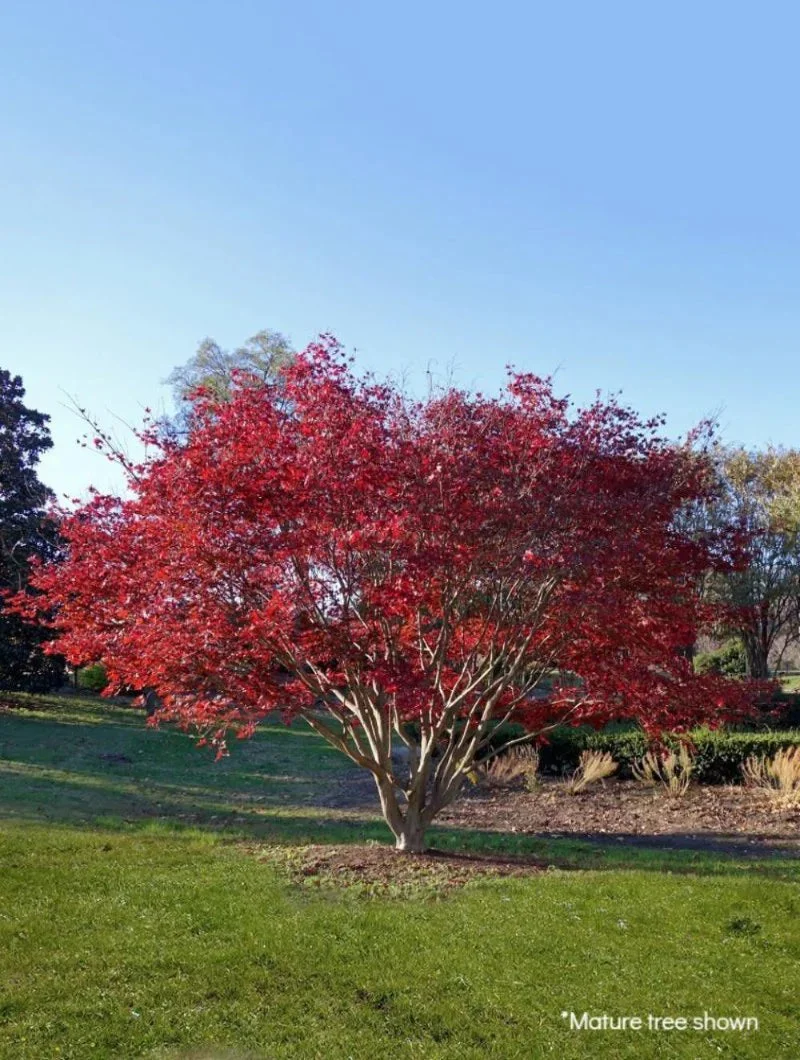
Before you choose a partner, decide what you mean by "gold." On a maple the word covers a leaf that opens yellow and turns green, a leaf that is orange-red all season, a leaf that only lights up in fall, and a true golden leaf that holds its color. Each behaves differently beside red.
This guide covers everything you need to know about pairing orange, gold and yellow maples with a red tree, from the vocabulary of contrast and harmony to Orange Dream, Orangeola, Katsura and Summer Gold, their sun limits, and how to arrange them.
What Pairing Colors Beside a Japanese Red Maple Means
Three terms do most of the work in this guide. Contrast is a pairing where two leaf colors sit far apart, such as bright yellow-gold beside the deep red-purple of a Japanese Red Maple. Harmony is a pairing where the colors sit close together, such as orange-red beside red. Overlap is about timing rather than color: two trees showing their best color in the same weeks, which for most partners here means fall.
Think of a choir and a trumpet. Harmony is two voices singing in the same key, blending until you hardly notice the join. Contrast is the trumpet over the strings: you hear both, and each sounds sharper for the other. Neither is better. Contrast gets noticed from the street, while harmony reads as calm.
One fact complicates the picture, which is that the red tree changes too. The leaves turn red/purple in spring but may fade to green/bronze in summer heat, and the name covers many red-leaved seedlings, so the exact shade varies from tree to tree. A partner that contrasts sharply in May may sit closer to bronze by July. Judge a pairing across the whole season, not on a nursery-bench day.
One of the most common questions we get is whether a gold maple will clash with a red one. Yellow-gold beside deep red almost never does. The trouble is nearly always sun, not color.
Orange Dream as a Spring Partner
Orange Dream changes color more than any other partner here, so its job depends on the month. It has yellow leaves in spring, greenish in summer and orange-yellow in autumn, on a bushy shrub reaching about 10 feet. That is smaller than a red tree that can reach 25 feet.
In spring the yellow is your contrast, and a clean yellow beside a red tree just leafing out is the strongest pairing in this guide. By midsummer the leaves turn greenish and the pairing stops being a color play. Orange Dream becomes a soft green backdrop that makes the red look richer. In autumn the orange-yellow overlaps with the red tree's fall color and moves toward harmony.
Where to Put It for the Best Color
Leaf color is best in partial shade, although full sun can be tolerated. Tolerated is not the same as ideal. We would give it morning sun and shade from the hottest afternoon hours. A taller red tree planted to its west can supply that shade, which is one reason this pairing works so well.
Orangeola and Its Heat Tolerance
Orangeola is the closest of these partners to red, which makes it the harmony choice. It is a fine-textured, laceleaf type whose foliage runs orange-red rather than yellow, so beside a red-purple Japanese Red Maple it reads as a warmer, brighter relative instead of a separate color. Our sources give no mature size for it, so check the tag or your local extension service for dimensions in your zone.
Why It Handles Heat Better Than the Yellows
Growers generally find that orange-red leaves cope with heat better than pale yellow ones, because deeper pigment gives the leaf more protection. Treat that as a tendency, not a guarantee. Maple scorch can be caused by lack of soil moisture or excessive exposure, and that applies to Orangeola as much as to any other.
We often see customers choose it because they want yellow-orange color but have a hot west-facing wall. For that site it is a sensible compromise. If heat is your main worry, our guide to sun-tolerant red Japanese maples covers the red side of the pairing.
Katsura for Fall Overlap With Japanese Red Maple
Katsura gives you two seasons of color with a green summer in between. It is an upright shrub with 5 to 7 lobed yellow-orange foliage with pink margins in spring, becoming green in summer and turning bright orange in autumn. Leaf color is best in partial shade, though full sun can be tolerated.
The pink margins matter in spring. They pick up the red of the larger tree, so the pairing is part contrast (yellow-orange against red-purple) and part harmony (pink against red). It is a more subtle effect than Orange Dream's plain yellow.
Reading the Fall Overlap
The practical test is timing. Note the week your red tree turns, then compare it with when Katsura goes bright orange. Where the two peak together, orange and red glow side by side. Where they are a week or two apart, you get a longer show instead. Our fall color guide explains how much the red tree itself varies year to year.
Summer Gold and the Problem of Sun
Yellow-leaved maples scorch first because pale leaves have less pigment to protect them than red or green ones. The first sign is crisp brown margins, usually on the side facing afternoon sun. Wind and dry soil make it worse. Our guide to leaf scorch and brown, crispy leaf edges shows how to tell it from other problems.
Summer Gold is the exception in this group. It is sold as a golden full-moon maple, a close relative of the Japanese Red Maple rather than the same species, and our guide to Acer palmatum vs Acer japonicum explains the difference. The golden full-moon maple 'Aureum' tolerates full sun without scorching.
What to Expect From a Golden Full-Moon Maple
The type has pale golden yellow foliage in spring, with fall color in a good year of orange and gold that can sometimes be muted. It forms a rounded, shrubby tree of 10–15 feet high and wide, reached slowly. We are describing the type, so check your plant's tag for Summer Gold's own size. Even a sun-tolerant young maple needs steady water in its first summers.
Sun and Heat Limits for Each Japanese Red Maple Partner
Sun is the number of hours of direct light, and heat is what the site adds on top, such as a south wall or a driveway that reflects it back. A site can have only four hours of sun and still be hot. The table grades each tree from most to least sun-tolerant, using only what our sources say.
| Tree | What the sources say | Grade |
|---|---|---|
| Summer Gold (golden full-moon type) | Tolerates full sun without scorching | Most tolerant |
| Orangeola | No figures. Orange-red leaves generally handle heat better than yellow | Tolerant |
| Japanese Red Maple | 2–6 hours of sun to 6 or more, but may fade to green/bronze in heat | Adaptable |
| Orange Dream | Best color in partial shade, full sun tolerated | Shade the afternoons |
| Katsura | Best color in partial shade, full sun tolerated | Shade the afternoons |
The grades only rank the trees against each other. They do not make any of them a desert plant. The red-leaf form grows in zones 5a–8b, and the others should be checked against your zone with your local extension service.
The lower the grade, the more the placement matters. Orange Dream and Katsura want morning sun and afternoon shade, though shading the red tree too much for their sake costs it color, so keep the red tree in the brightest spot.
Arranging Gold Beside a Japanese Red Maple
Arrangement comes down to three decisions: how far apart, which tree stands in front, and what stands behind. Get them in that order and most pairings work.
Spacing the Trunks
A red tree can spread 10–25 feet and often 15–25 feet, while Orange Dream stays near 10 feet and a golden full-moon maple reaches 10–15 feet. As a working rule, set the trunks about half the sum of their mature widths apart, so the canopies just meet. Closer than that, the shaded leaves lose color.
Front, Back and Backdrop
Plant the smaller, paler tree in front and to the east of the red one, so morning sun reaches it and the red tree throws afternoon shade over it. Then follow these steps:
- Stand where you will see the pair most often and mark where each canopy will reach.
- Put dark evergreens or a plain fence behind the gold tree, never a yellow or tan wall.
- Keep the red tree's best side facing the same viewpoint.
- Mulch both trees and water them on the same schedule.
Our landscape ideas guide covers the non-maple plants for around them.
Choosing Your Pair From the Japanese Red Maple Palette
Start with the site, then the effect. If the spot gets hot, reflected afternoon sun, choose Summer Gold for contrast or Orangeola for harmony. If it has morning sun and shade after lunch, Orange Dream gives the sharpest spring contrast and Katsura gives the subtler spring and the strongest orange in fall.
If you want contrast, go for Orange Dream or Summer Gold, whose yellows stand clearest against deep red. If you want harmony, pick Orangeola or Katsura, whose oranges and pinks sit closer to the red. Either way, remember that two of these trees spend summer green. Place them where spring and fall are what you will actually see.
Two Questions That Settle Your Maple Pairing
Pale leaves scorch before red ones do, so sun decides the partner and color decides the effect. Orange Dream and Katsura are spring and fall trees that need afternoon shade, Orangeola is the warm, heat-tolerant neighbor, and Summer Gold is the gold that can face the sun.
Ask two questions before you plant. How many hours of hot sun does the site get? And do you want contrast, with yellow popping against red, or harmony, with orange blending into it? Answer those and the choice usually follows.
Japanese Red Maple
Nursery-grown Japanese Red Maple in sizes from 3 Gallon 2-3 ft, shipped to your door.
From $118.33
Shop Now →Orange, gold and yellow all look their best next to red leaves that have been grown with care, so we raise our Japanese Red Maples in loose soil that drains freely yet stays damp, with shade through the hot part of the afternoon. Each tree we ship was grown in our own rows, top quality from the first season on. When you have chosen the partners for your maple, browse our Japanese Red Maples for the red one to set them against.