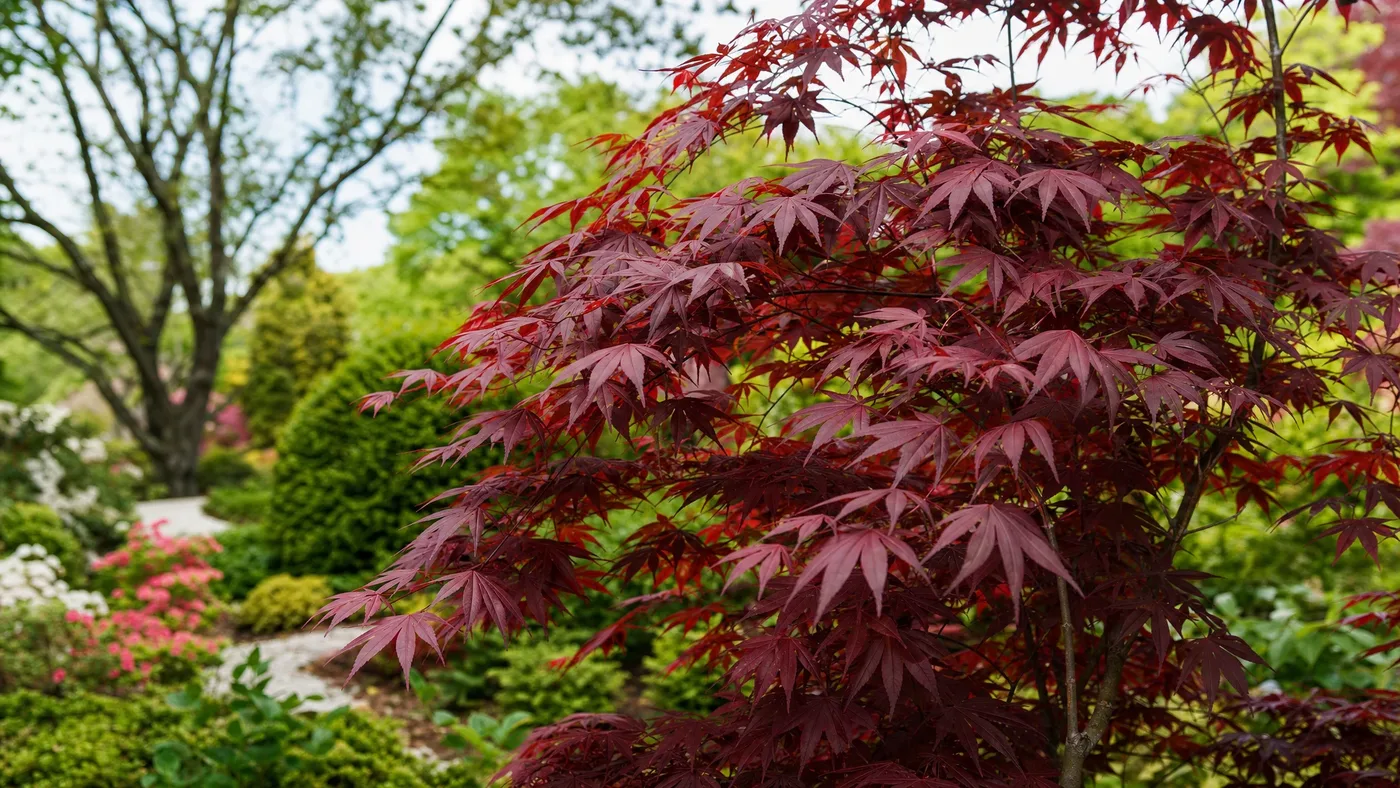
Pruning an Upright Japanese Red Maple
An upright Japanese Red Maple needs less pruning than almost any tree you own. Most of the damage we hear about comes from owners who cut too much, too early, in search of tidiness. This guide covers pruning an upright Japanese maple in the order that protects the tree: fix the real problems first, then thin lightly. For the full calendar and the broader approach, start with our complete pruning guide for Japanese Red Maple, then come back here for the upright-specific technique.
Start With a Hard Truth: Less Is More
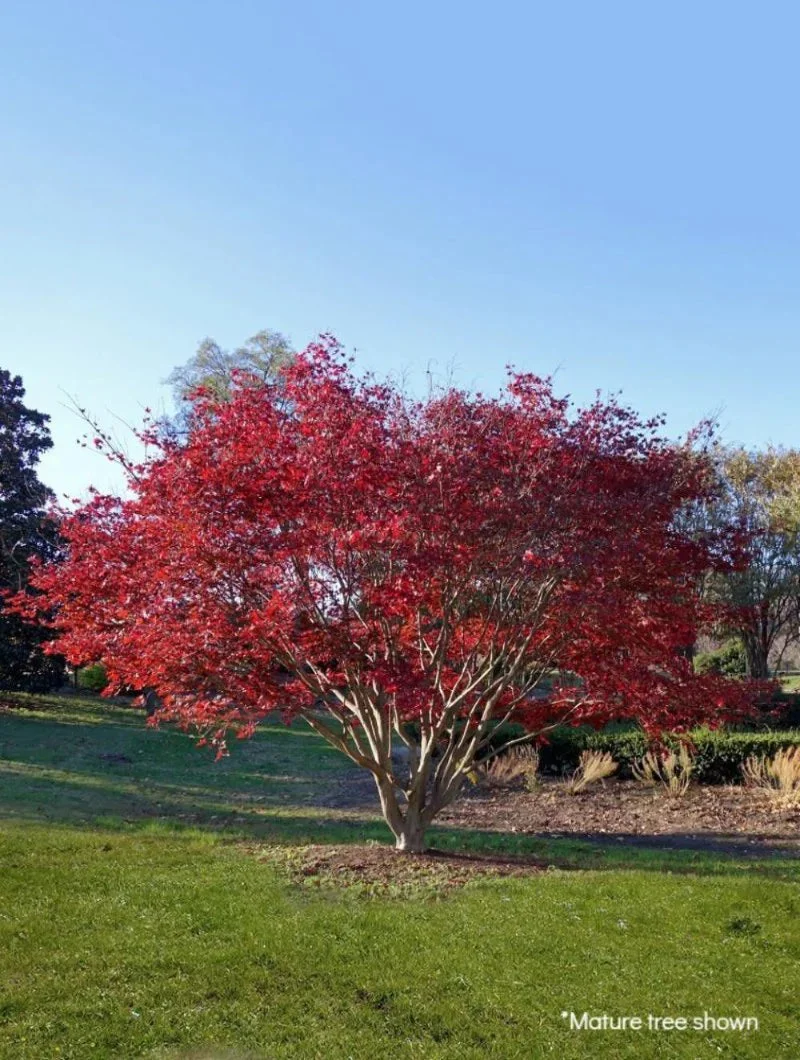
The layered, see-through look that makes a mature specimen so striking is mostly age plus restraint. Upright forms grow slowly to moderately, roughly 6 to 12 inches a year, and standard upright red types typically reach 15 to 25 feet over many years. Significant landscape size takes 10 to 15 years. You cannot shear your way to that structure. Every unnecessary cut trades future branching for today's neatness, and the tree has no fast way to give it back.
So the goal is not to shape the tree. It is to remove what is wrong and let the tree's own habit show. If your tree looks fine, the right amount of pruning this year may be none.
Materials You Need
- Bypass hand pruners (for twigs up to about a pencil's width)
- Bypass loppers (for branches up to about 1 inch)
- A fine-tooth pruning saw (for anything larger)
- Rubbing alcohol or a disinfecting wipe to clean blades between cuts, and especially after removing any diseased wood
- Gloves and eye protection
- A tarp to catch cuttings
Use bypass blades, not anvil types. Anvil pruners crush the thin bark of a maple.
When to Cut
Do structural and corrective work in late fall to midwinter dormancy. Pruning then avoids heavy sap bleed and lets you see the whole branch framework without leaves. Dead wood can come out any time you spot it. Our guide on when to prune a Japanese Red Maple breaks the timing down further, including what to do if you missed the window.
Step-by-Step: Pruning in Priority Order
Work through these steps in sequence. Many trees will be finished after step 3.
1. Walk the tree before you cut
Stand outside the drip line (the circle under the outermost branch tips) and look at the whole tree. Then circle it slowly. Check the silhouette from at least four sides. Note dead, crossing, and inward-growing branches with a strip of flagging tape if you like. Do not touch a tool yet.
2. Remove dead and damaged wood
Dead twigs are brittle, often dull in color, and snap cleanly. Scratch a small spot with a fingernail: green underneath means alive. Cut dead or broken branches back to the branch collar, the slightly swollen ring where the branch meets its parent. Do not cut flush with the trunk, and do not leave a stub.
3. Remove crossing and rubbing branches
Where two branches rub, the bark wears through and opens a door for disease. Pick the weaker or worse-placed branch of the pair and remove it at the collar. Leave the other one.
4. Remove inward-growing branches
Branches that grow back toward the trunk crowd the center and fight the layers. Take them off at their origin. One caution: do not clear the whole interior. Some small inner branching is normal and helps shade the trunk.
5. Choose one leader on a young tree
Young upright trees sometimes develop two competing central stems. Pick the straighter, stronger one and remove the other at the base. Do this while the competing stem is still small. A forked trunk can split under load as the tree matures.
6. Thin lightly for the layered look
This is the step where restraint matters most. Thinning the canopy of a Japanese maple means removing whole small branches, not trimming their tips. Look for two or three small shoots that crowd each other or block the view of the branch tiers behind them. Cut each one back to its collar. Never leave stub cuts, and never shorten a branch partway along its length, which creates a broom of weak twigs.
After each cut, step back outside the drip line and look again. Stop when you can see the branch structure through the foliage in places. You are aiming for a see-through effect, not a hollow one.
7. Check your total
Follow the one-fifth rule: remove no more than about a fifth of the live canopy in a single year. Dead wood does not count toward that limit, but live cuts do. If your list of "problems" exceeds a fifth, spread the work over two or three winters. For a tree that is already badly overgrown, see how to restore an overgrown Japanese Red Maple for a multi-year plan.
Common Mistakes
| Mistake | What goes wrong | Do this instead |
|---|---|---|
| Shearing or tip-trimming | Creates dense outer twiggy growth and a hollow interior | Remove whole small branches at the collar |
| Stub cuts | Stubs die back and invite decay | Cut to the branch collar |
| Heavy cuts in one year | Stresses the tree and removes structure you cannot replace quickly | Stay near the one-fifth limit |
| Topping to control height | Ruins the natural form permanently | Choose a smaller cultivar when planting |
| Pruning in a growth flush | Heavy sap bleed and a poorer view of the branching | Prune in dormancy |
| Working only from one side | Lopsided result | Circle the tree after every few cuts |
Who Should Not Do This Themselves
Call a certified arborist for any cut over 2 inches in diameter, and for anything you can only reach from a ladder. A fall from a ladder with a saw in hand is a bigger risk than a badly placed cut. An arborist can also assess storm damage or a suspected disease problem before you start removing wood.
One more point on fit. If you want a mature layered look immediately and your tree is a young one, pruning will not get you there. A more developed starting tree will. Our Japanese Red Maple trees come in 3-gallon, 5-gallon and 7-gallon sizes, with the larger sizes giving you more existing structure to work with. Tree size at planting still matters less than the decades of restraint that follow.
Which Upright Types Need the Least Work
Named upright selections such as 'Bloodgood' are grafted and tend to be more predictable in habit. Unnamed seedling-grown red maples can vary in form, so you may need to watch for more irregular branching early on. Our Bloodgood size, growth rate and care guide gives a closer look at how a common upright cultivar grows. Dwarf and cutleaf cultivars typically stay 6 to 10 feet and have a different, weeping-leaning habit that this guide does not cover.
What to Expect
Light, well-chosen cuts may leave the tree looking almost unchanged at first, which is the point. Over several seasons, thinning can help sunlight and air reach the interior and may make the branch tiers more visible. Results depend on the cultivar, the tree's age and your local climate. Do not expect a dramatic change in one winter. Your local cooperative extension office can advise on region-specific timing and any local pest or disease concerns that affect when to cut.
Quick Reference
| Item | Guideline |
|---|---|
| Best timing | Late fall to midwinter dormancy |
| Cut order | Dead or damaged, crossing, inward-growing, competing leaders, then light thinning |
| Annual limit | About one-fifth of live canopy |
| Cut location | At the branch collar, never a stub |
| Where to stand | Outside the drip line, circling the tree between cuts |
| Call an arborist | Cuts over 2 inches, or anything off a ladder |
| Typical growth | About 6 to 12 inches a year |
Japanese Red Maple
Nursery-grown Japanese Red Maple in sizes from 3 Gallon 2-3 ft, shipped to your door.
From $118.33
Shop Now →