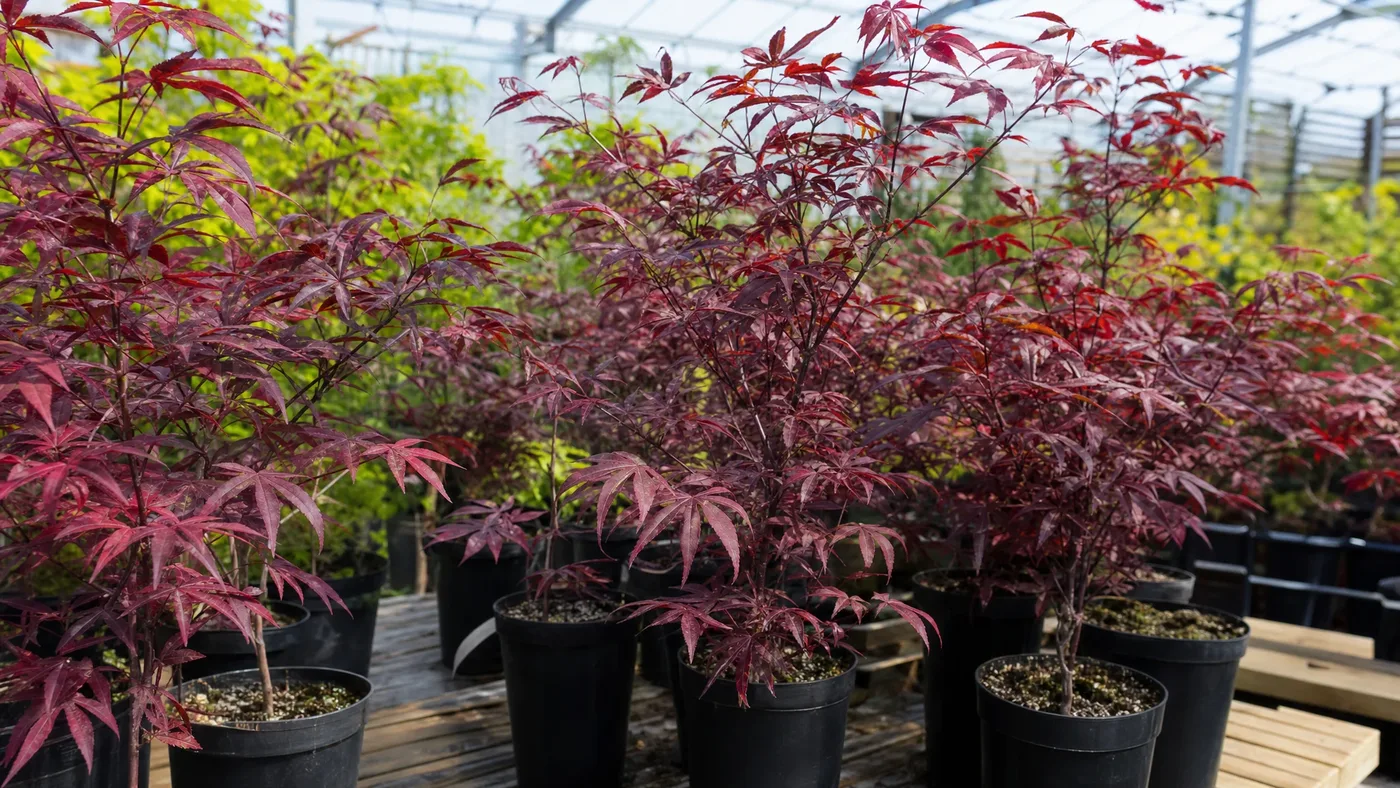
Bloodgood Japanese Maple: Size, Growth Rate and Care
The Bloodgood Japanese maple is the upright red that most buyers picture when they say "Japanese red maple." It earns that spot with deep burgundy summer leaves and scarlet fall color. It also comes with a catch that surprises people: it is not a small tree. If you are still weighing it against other reds, the Japanese red maple varieties and cultivars compared guide lays out the whole field. This article covers what Bloodgood does at maturity, how fast it gets there, and how to look after it.
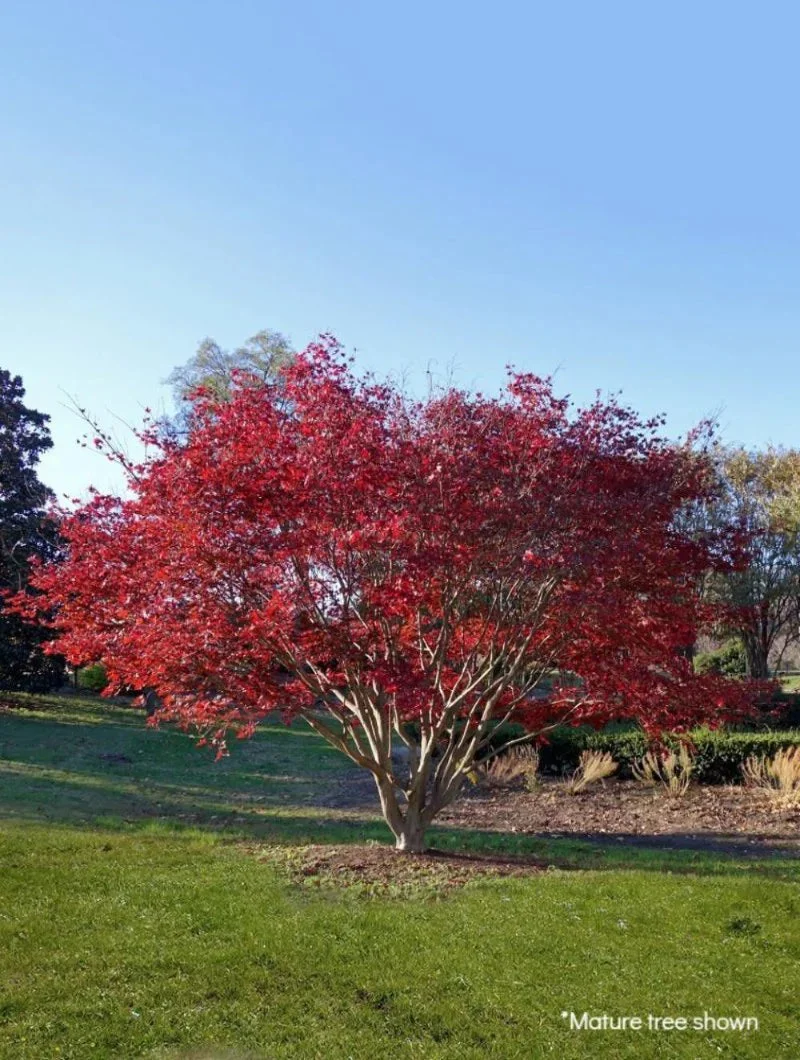
The cultivar figures below are the ones commonly listed in Missouri Botanical Garden (MBG) and extension profiles. We have not run our own growth trials, so treat every number as a range and not a promise.
Bloodgood at a glance
| Trait | What profiles commonly list |
|---|---|
| Habit | Upright, rounded with age |
| Mature size | 15-20 ft tall and wide |
| Growth rate | Slow to moderate, roughly 6-12 in per year |
| Hardiness | USDA zones 5-8 |
| Leaf color | Deep burgundy in spring and summer, scarlet in fall |
| Sun | Full sun to part shade; afternoon shade helps in hot summers |
| Soil | Rich, well-drained, slightly acidic (pH roughly 5.5-6.5) |
| Spacing | 10-15 ft from structures and other trees |
How big a Bloodgood really gets
The common misconception is that a slow grower stays small. Slow only changes how long the wait is. A tree adding 6-12 in a year still ends up 15-20 ft tall and wide, and the width matters as much as the height. Plan for a canopy that spreads over a 15-20 ft circle.
Here is the arithmetic for a young tree starting at about 3 ft, which is the size of our larger container trees.
| Yearly growth | Time to add 12 ft (reaching about 15 ft) |
|---|---|
| 6 in per year | About 24 years |
| 9 in per year | About 16 years |
| 12 in per year | About 12 years |
Species-level guidance is that a Japanese maple reaches significant landscape size in 10-15 years. That lines up with the fast end of the table, which needs rich soil, steady moisture and a good site. A tree in poor soil or dry conditions will sit at the slow end. For more on pace and the factors behind it, see how big a Japanese red maple gets and how fast.
Color through the seasons
- Spring: Small red-purple flowers appear before or with leaf-out. They are easy to miss. The new leaves are the show.
- Summer: Leaves are deep burgundy. Profiles describe Bloodgood as holding that color in sun better than seed-grown reds, which can drift greener in heat or deep shade. Color can still fade in intense heat or heavy shade.
- Fall: Scarlet is the usual description. Intensity changes with the season, and a warm autumn tends to mute it.
- Winter: The bare branching shows well once the leaves drop.
Climate fit
Bloodgood is listed for zones 5-8 and is regarded as one of the more heat-tolerant upright reds. Heat tolerance is relative, though. In a hot-summer climate, give it afternoon shade so the leaves do not scorch. Salt tolerance is poor, so keep it away from road spray and de-icing runoff. Zone limits can shift by a full zone depending on the genetic line, so check with your local cooperative extension office if you are on the edge.
Who should not buy a Bloodgood
- Anyone with under 15 ft of open space. Go dwarf instead. The varieties guide lists the compact reds, and 'Shaina' is commonly listed at 4-6 ft.
- Anyone planning to keep one in a pot for life. Smaller selections suit containers better.
- Anyone with heavy clay that stays wet, or a spot with no way to water through dry spells. Root rot and drought stress are the usual ends.
- Anyone on a windy, exposed, or salt-sprayed site.
Materials you will need
- A container-grown tree
- Shovel and garden fork
- Compost or other organic matter to work into poor soil
- Shredded bark or similar mulch
- Balanced, low-nitrogen fertilizer for early spring
- Clean bypass pruners
- A hose or drip line, plus a soil pH test kit
Bloodgood care, step by step
1. Choose the site
Pick a spot with morning sun and some afternoon shade, shelter from hard wind, and soil that drains. Stay 10-15 ft from walls, eaves and other trees. Test the pH. You want roughly 5.5-6.5.
2. Plant in early spring or fall
Avoid peak summer heat. Plant at the same depth the tree sat in its pot and loosen the soil well beyond the root ball. Our planting walkthrough covers the hole, depth and backfill in detail.
3. Water on a schedule
Young trees need consistent, even moisture for the first 2-3 years. Water deeply and let the top of the soil firm up between sessions. Standing water is worse than dry soil. Established trees have only low to moderate drought tolerance, so do not stop watering in a dry summer.
4. Mulch, not pile
Spread mulch across the root zone to hold moisture and moderate temperature. Keep it pulled back from the trunk so the bark stays dry.
5. Feed lightly
One light application of a balanced, low-nitrogen fertilizer in early spring is usually enough. Overfeeding causes leggy growth and weaker color.
6. Prune only when dormant
Do structural or corrective cuts in late fall to midwinter to avoid heavy sap bleed. Remove dead, crossing or crowded branches and leave the rest. The natural shape is the point of the tree.
7. Watch for trouble
| Problem | Likely cause | Fix |
|---|---|---|
| Brown, crisp leaf edges | Leaf scorch from hot sun, wind or drought | Add afternoon shade or a windbreak and water more steadily |
| Split or damaged bark on a young trunk | Sunscald in full sun | Shade the trunk while the tree is young |
| Wilting branches, one side dying | Verticillium wilt | Prune out dead wood in dormancy and ask your extension office to confirm |
| Sticky leaves, curling tips | Aphids | Use IPM first (water spray, hand removal) |
| Chewed, skeletonized leaves | Japanese beetles | Hand-pick, and use IPM first |
| Yellowing, wilting despite watering | Root rot in poorly drained soil | Improve drainage or replant on a mound |
Scale and borers are also on the pest list. If you use a pesticide, always read and follow the pesticide label; the label is the law.
Common mistakes
- Planting too close to the house. A 15-20 ft spread outgrows a 5 ft bed quickly.
- Heavy nitrogen. It buys fast, floppy growth and duller leaves.
- Pruning in spring or summer. Fresh cuts bleed sap.
- Deep shade. Color fades toward green.
- Letting a new tree dry out. The first 2-3 years decide how it establishes.
Bloodgood versus similar upright reds
'Emperor I' is upright at around 15 ft, zones 5-8, and leafs out roughly two weeks later than Bloodgood. That helps where late frosts hit tender spring growth, and it holds color in heat. 'Fireglow' is smaller, commonly listed at 12-15 ft. If space is the limit, it is the easier fit. The varieties comparison puts all three side by side, along with the weeping and dwarf options.
Which tree to buy
We sell nursery-grown Japanese Red Maple in 3-gallon, 5-gallon and 7-gallon sizes at our shop. That is the species form, not a named Bloodgood. Seed-grown reds can vary in mature color and habit. If you want a grafted Bloodgood specifically, ask any nursery whether the tree is a graft of the named cultivar. Named cultivars are grafted, and that is how you get a true-to-type tree.
What to expect
With a good site and steady care, a Bloodgood may add about 6-12 in a year and may take a decade or more to look like a real tree. Color, size and pace depend on your climate and soil. A local extension office can tell you what to expect in your area. Acer palmatum is not generally listed as toxic to pets or people. If you have a specific concern, call your veterinarian or the ASPCA Animal Poison Control Center. Do not confuse it with Acer rubrum, the native red maple, which is a different species.
Quick reference
| Item | Guideline |
|---|---|
| Size | 15-20 ft tall and wide (commonly listed) |
| Growth | 6-12 in per year |
| Zones | 5-8 |
| Planting time | Early spring or fall |
| Spacing | 10-15 ft from structures |
| Light | Sun with afternoon shade in hot climates |
| Water | Even moisture, first 2-3 years especially |
| Soil | Well-drained, pH roughly 5.5-6.5 |
| Feeding | Light, low-nitrogen, early spring |
| Pruning | Late fall to midwinter, minimal |
| Skip it if | You have under 15 ft of space or soggy soil |
Japanese Red Maple
Nursery-grown Japanese Red Maple in sizes from 3 Gallon 2-3 ft, shipped to your door.
From $118.33
Shop Now →