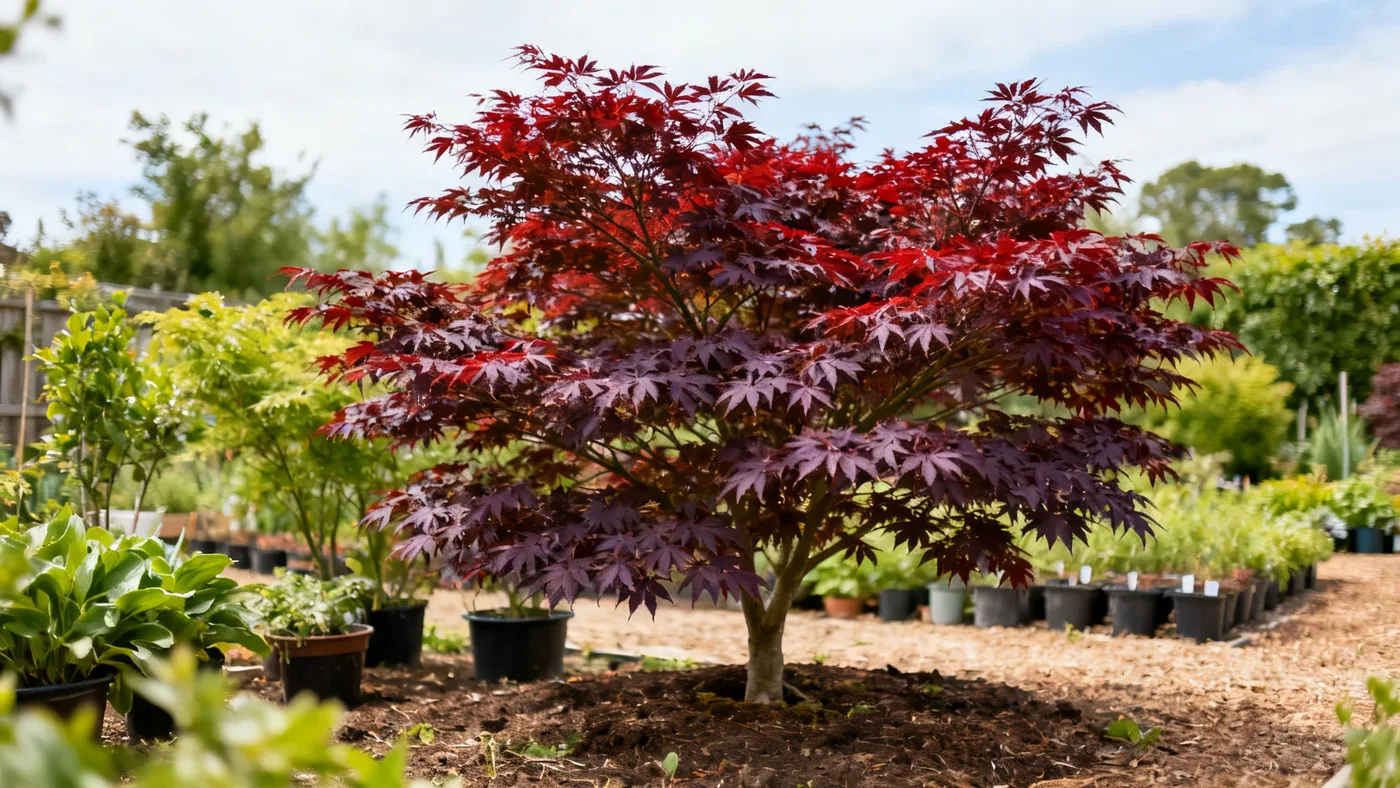
Japanese Red Maple Pests, Diseases and Common Problems
Japanese Red Maple trees are prized for their elegant palmate foliage and vivid crimson fall color, but they are not immune to setbacks. In the right conditions, they thrive for decades. Without proper care, they become vulnerable to specific pests and diseases that weaken their structure and color. This guide walks you through the most common issues you may encounter, and what to do about each one.
1. Aphids
Aphids are small, soft-bodied insects that cluster on new growth and leaf undersides, particularly in spring. They feed by piercing leaf tissue and sucking sap, leaving behind a sticky residue called honeydew. A heavy infestation turns leaves yellowish, stunts new shoots, and attracts sooty mold, a black fungal coating that further weakens the tree.
Early detection is your best defense. Inspect new growth weekly during the growing season. A strong spray from the hose can dislodge light populations. For heavier infestations, insecticidal soap applied to leaf undersides works well and breaks down quickly without harming the tree. Neem oil is another option but use it in cool morning or evening to avoid leaf burn.
Takeaway: Catch aphids early on tender shoots; a hose spray often solves the problem without chemicals.
2. Scale Insects
Scale insects appear as tiny, hard bumps on bark and branches that you might mistake for part of the tree itself. Unlike aphids, scales hide under a waxy or hard covering that protects them from spray. They feed continuously by inserting a long feeding tube into the branch, weakening twigs and sometimes killing them outright. Repeated heavy infestations can defoliate entire limbs.
Small scale populations can be hand-picked or brushed off with a soft cloth. Heavier infestations respond to horticultural oil applied in late fall or early spring before buds break. Timing matters: oil suffocates the insects but can scorch new leaves if applied when they are flushed out. A crawler spray (specifically labeled for scale) targets the mobile young stages in mid-to-late spring. If a branch is heavily infested and cannot be saved, prune it out cleanly.
Takeaway: Prune infested branches first; reserve oil or crawler sprays for smaller populations on branches you want to keep.
3. Borers
Borers are insect larvae that tunnel through the wood and bark of weakened or stressed trees. They create small exit holes and can girdle branches or compromise the main trunk if populations build up. A tree under drought stress or recovering from transplant shock is far more susceptible than a well-watered, established specimen. By the time you see damage, the larvae are already inside.
Prevention is more effective than treatment. Keep your tree healthy by maintaining consistent moisture during the first 2 to 3 years after planting and providing afternoon shade in hot-summer climates. Avoid wounding the bark with equipment or careless pruning. If you spot entrance holes, remove and dispose of the affected branch if it is small, or consult a certified arborist for trunk damage. No chemical spray reaches larvae once they are inside the wood.
Takeaway: Prevent borers by avoiding stress; a healthy tree resists infestation far better than a struggling one.
4. Japanese Beetles
Japanese beetles are iridescent green and copper insects that skeletonize foliage, leaving lacy holes between the veins. They often feed in groups during summer and can defoliate a tree in days if populations are high. While Japanese Red Maple is not their preferred host, beetles will feed on it, especially if other food sources nearby are depleted.
Small populations can be hand-picked in early morning and dropped into soapy water. For heavy infestations, insecticide sprays labeled for Japanese beetles work best when applied in the evening to minimize harm to beneficial insects. Check the label to confirm it is safe for Japanese Red Maple. Do not use beetle traps near the tree itself; they attract beetles from a wide area and can worsen local populations. Instead, use traps at the perimeter of your property, away from your maples.
Takeaway: Hand-pick small numbers; reserve sprays for high populations, and always follow label directions.
5. Verticillium Wilt
Verticillium wilt is a soil-borne fungal disease that invades the tree's vascular system, blocking water and nutrient flow. Symptoms develop slowly: one branch begins to wilt and decline while the rest of the tree looks normal. The diseased branch may show early fall color while surrounding branches are still green. Eventually, the branch dies back, and the disease can spread to other parts of the tree.
There is no cure for verticillium wilt once it is established in the tree. Your goal is to slow its progress. Prune out affected branches as soon as you spot them, cutting back to healthy wood. Sterilize your pruning tools between cuts with rubbing alcohol or a 10 percent bleach solution to avoid spreading the fungus. Avoid wounding the tree elsewhere, as fresh wounds can serve as entry points. Water deeply but infrequently to keep the tree from drought stress, which speeds decline. If the disease eventually kills the tree, do not replant another maple in the same location without replacing the soil.
Takeaway: Prune out wilting branches promptly and sterilize tools; verticillium cannot be cured, only managed.
6. Anthracnose
Anthracnose is a fungal leaf spot that appears as small, brown or tan spots with darker edges. Spots often merge into larger dead areas. In wet springs, anthracnose can cause defoliation. Young leaves are more susceptible than mature ones, and stress (such as frost or drought) exacerbates the disease.
Most years, anthracnose causes cosmetic damage but not serious harm to an established tree. Improve air circulation around the canopy by thinning out crossing branches; fungi thrive in humid, dense foliage. Remove and discard fallen leaves and twigs, as they harbor spores for next season. If wet weather persists and spot damage is heavy, a fungicide labeled for anthracnose can be applied to new growth. Copper fungicides and sulfur-based products are common options, but follow label directions and avoid spraying during heat or direct sun. Stress management is equally important: consistent watering and protection from wind reduce susceptibility.
Takeaway: Improve drainage and air flow; fungicide is optional for cosmetic leaf spots on healthy trees.
7. Root Rot in Poorly Drained Soil
Japanese Red Maple tolerates moisture but does not tolerate standing water. Roots are designed for well-drained loam high in organic matter, roughly 5.5 to 6.5 pH. When soil stays soggy for weeks, whether from poor drainage, over-watering, or a low spot that collects runoff, root tissues begin to rot. A tree with root rot wilts despite adequate water, drops leaves prematurely, and eventually dies back branch by branch.
Prevention is far simpler than recovery. If you are planting, choose a site with good drainage and amend heavy clay soil with compost before planting. For an established tree showing wilt, stop watering and allow the soil to dry somewhat between rains. If the tree is in a low area or surrounded by impermeable hardscape, install a drain or raise the planting bed. If root rot has already advanced significantly, the tree is unlikely to recover fully. Focus on preventing further stress: avoid compacting soil, do not apply heavy mulch against the trunk, and refrain from pruning aggressively until the tree shows vigorous new growth.
Takeaway: Prevent root rot by ensuring excellent drainage at planting time; it cannot be reversed once it sets in.
8. Leaf Scorch from Sun, Wind, and Drought
Leaf scorch is an environmental problem, not a disease. It occurs when the tree loses water faster than roots can replace it. Hot sun, strong wind, and soil drought stress all trigger scorch. The edges of leaves turn papery and brown, sometimes the entire leaf dries and drops. Scorch is most visible in summer heat but can also occur in late spring when trees break dormancy and face unexpected frost or drying winds.
The key to preventing scorch is consistent moisture and afternoon shade in hot climates. Japanese Red Maple performs best in zones 5 to 8 with some afternoon shade, especially in zone 8 or warmer regions. Young trees need regular watering for the first 2 to 3 years after planting. In drought years, deep watering once or twice per week may be necessary. Mulch the soil surface (not piled against the trunk) to retain moisture. If scorch appears, do not strip scorched leaves; they still feed the tree. Once the growing season ends and moisture is restored, you can prune off fully dead twigs, but the tree itself will recover if conditions improve.
Takeaway: Prevent scorch with consistent moisture and afternoon shade; recovery happens naturally once water stress ends.
9. Trunk Sunscald on Young Trees
Young Japanese Red Maple trees can suffer sunscald damage on the south or west-facing side of the trunk in winter. On cold nights, the sun warms the bark during the day, then freezing temperatures at night cause cells to rupture and crack. You may see a vertical split or section of dead, darkened bark. Trees in their first few years after planting are most vulnerable.
Prevent sunscald by wrapping the trunk loosely with burlap or tree wrap in late fall, removing it in early spring. Do not wrap so tightly that you trap moisture and invite rot. Alternatively, plant in a location with afternoon shade during winter, or position the tree so larger evergreen plants or structures shield it from intense afternoon sun. If sunscald occurs, do not seal or bandage the wound; allow it to heal naturally. The tree will compartmentalize the damage if it is otherwise healthy. Avoid further stress by maintaining consistent soil moisture and protecting the tree from physical damage.
Takeaway: Wrap young trees in fall to prevent sunscald; avoid sealing wounds once damage occurs.
10. Foliage Color Fading in Deep Shade or Summer Heat
Red-leaf Japanese Maple is prized for its deep crimson or reddish-purple summer foliage, but color can fade to dull green or brownish-red in certain conditions. Deep shade (six or more hours without direct sun) reduces pigment production. Intense summer heat, especially in zones 8 or warmer, can also cause colors to shift greener as a heat-stress response. While the tree remains healthy, the ornamental impact diminishes.
The solution depends on your situation. If the tree is in deep shade and you have the option, relocate it to a spot with at least three to four hours of morning or dappled sun. If relocation is not possible, select a more shade-tolerant cultivar for future plantings. In hot-summer regions, afternoon shade is not just cosmetic; it preserves foliage color and prevents heat stress. Ensure the tree receives consistent moisture, as drought stress exacerbates color fading and can trigger early leaf drop. Rich, well-drained soil with adequate organic matter also supports deeper pigmentation and overall tree vigor.
Takeaway: Provide three to four hours of sun and afternoon shade in hot zones to maintain rich red foliage color.
Quick Reference: Problems, Causes, and Fixes
| Problem | Primary Cause | Quick Fix |
|---|---|---|
| Aphids on new growth | Insect feeding | Hose spray or insecticidal soap |
| Scale bumps on bark | Insect feeding under waxy coat | Prune infested branches or horticultural oil in fall/spring |
| Borer holes in trunk/branches | Weakened/stressed tree | Keep tree healthy, avoid stress; remove small infested branches |
| Lacy, skeletonized leaves (summer) | Japanese beetle feeding | Hand-pick or spray if heavy infestation; use traps away from tree |
| One branch wilting, early fall color | Verticillium wilt (soil fungus) | Prune wilting branch; sterilize tools; cannot be cured |
| Brown leaf spots, defoliation (wet spring) | Anthracnose fungus | Thin canopy for air flow; remove fallen leaves; fungicide if severe |
| Wilting despite water; early leaf drop | Root rot in standing water | Improve drainage; stop watering; cannot reverse once severe |
| Brown, papery leaf edges (summer) | Leaf scorch from heat/drought/wind | Consistent moisture, afternoon shade in zones 7 to 8 |
| Vertical crack or dead bark (south side of trunk) | Sunscald on young trees | Wrap trunk in fall; do not seal wound |
| Foliage fades from red to dull green | Deep shade or intense summer heat | Provide 3 to 4 hours sun and afternoon shade in hot zones |
Supporting Your Tree Through Challenges
Most Japanese Red Maple problems can be prevented or managed through proper care and maintenance. Start with the right foundation: plant in well-drained soil with adequate sun and afternoon shade, especially in warmer zones. Maintain consistent moisture during the first 2 to 3 years, then back off slightly as the tree establishes. Prune only to remove dead, crossing, or crowded wood, and do this in late fall through midwinter dormancy to avoid heavy sap bleed.
When problems do arise, act promptly. Early detection of pests and diseases makes management easier. Prune out diseased branches, sterilize tools, and dispose of fallen debris. Most environmental issues resolve once you adjust water, light, or drainage. If you are uncertain about a specific symptom, take a photo or leaf sample to your local extension service; they can identify the cause and recommend solutions tailored to your region.