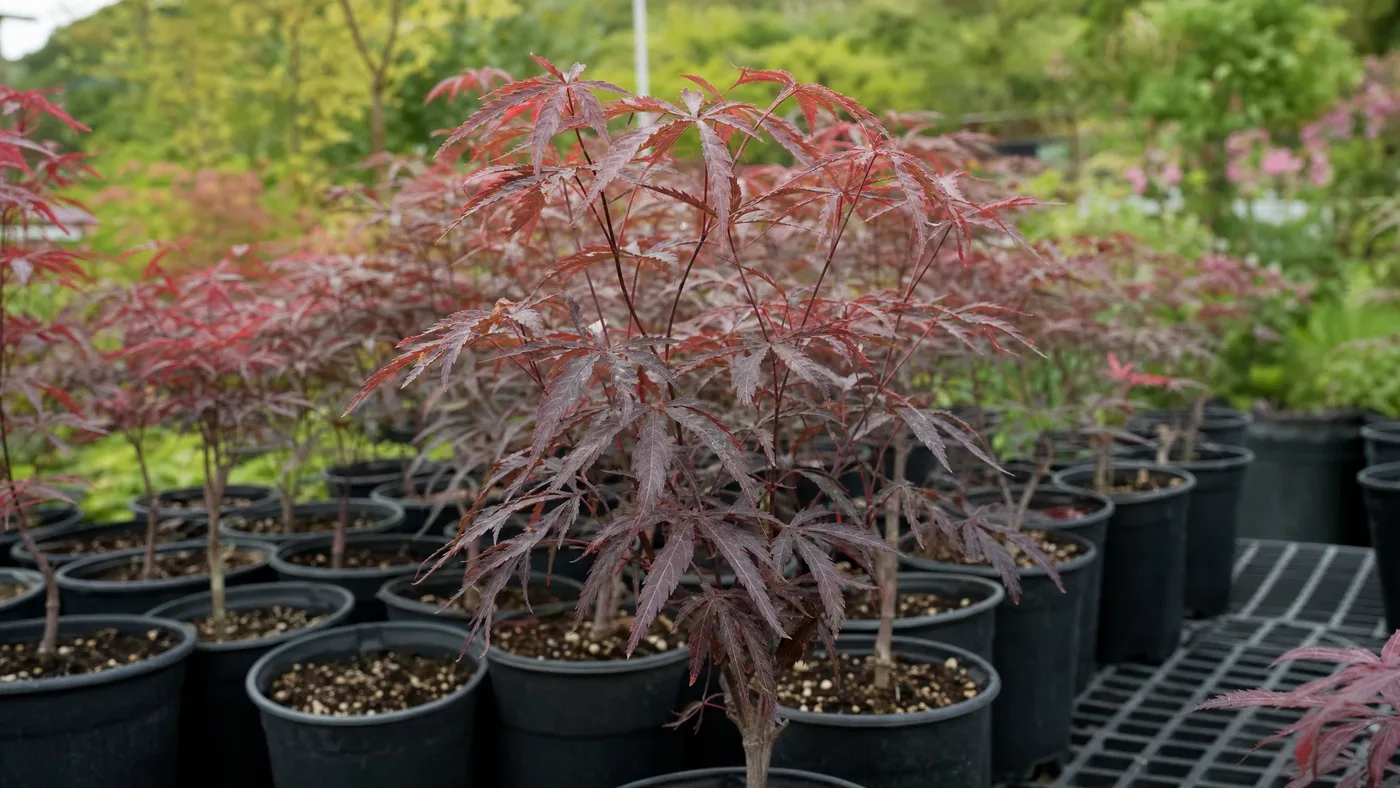
What Size Japanese Red Maple Should You Buy?
Buy the biggest Japanese red maple you can water, not the biggest you can afford. For most home gardeners that means the 5-gallon size. Choose a 3-gallon (2-3 ft) if you are patient or working to a budget, and a 7-gallon (3-4 ft) if you want it to look like a tree this year or your site is rough.
This post covers the size decision only. For the wider picture, including how to judge any tree before you pay for it, start with our Japanese red maple buying guide. Here we stay on one question: what size Japanese maple to buy, and why the answer is less obvious than the price tag suggests.
The Size Ladder at a Glance
| Container | Typical height | Best for | Main risk |
|---|---|---|---|
| 3-gallon | 2-3 ft | Patient gardeners, tight budgets, pots and patios | Looks small for a few seasons |
| 5-gallon | 2-3 ft, more developed | Most home landscapes | Costs more than a 3-gallon without a big jump in height |
| 7-gallon | 3-4 ft | Instant presence, rough or exposed sites | Heavier to plant and ship, needs steady watering |
The 5-gallon is the one that confuses people. It is in the same height range as the 3-gallon, but the trunk and branching are more developed and the root mass is larger. You are paying for maturity in the pot, not extra inches.
Why Bigger Is Not Automatically Better
A nursery tree lives or dies by its roots. When a tree is dug or moved, it loses part of its root system. A small tree keeps a higher share of its roots relative to its leaf area, so it has less canopy to feed and less water to find while it recovers. Extension and arboriculture transplant research generally reports that smaller nursery stock establishes faster and often catches up to larger-planted trees within a few years. The exact timing depends on your soil, climate and watering, so treat it as a pattern, not a promise.
The trade-off runs both ways. A larger tree buys you instant presence in the landscape. It also tolerates casual neglect better, because a bigger root ball holds more moisture between waterings.
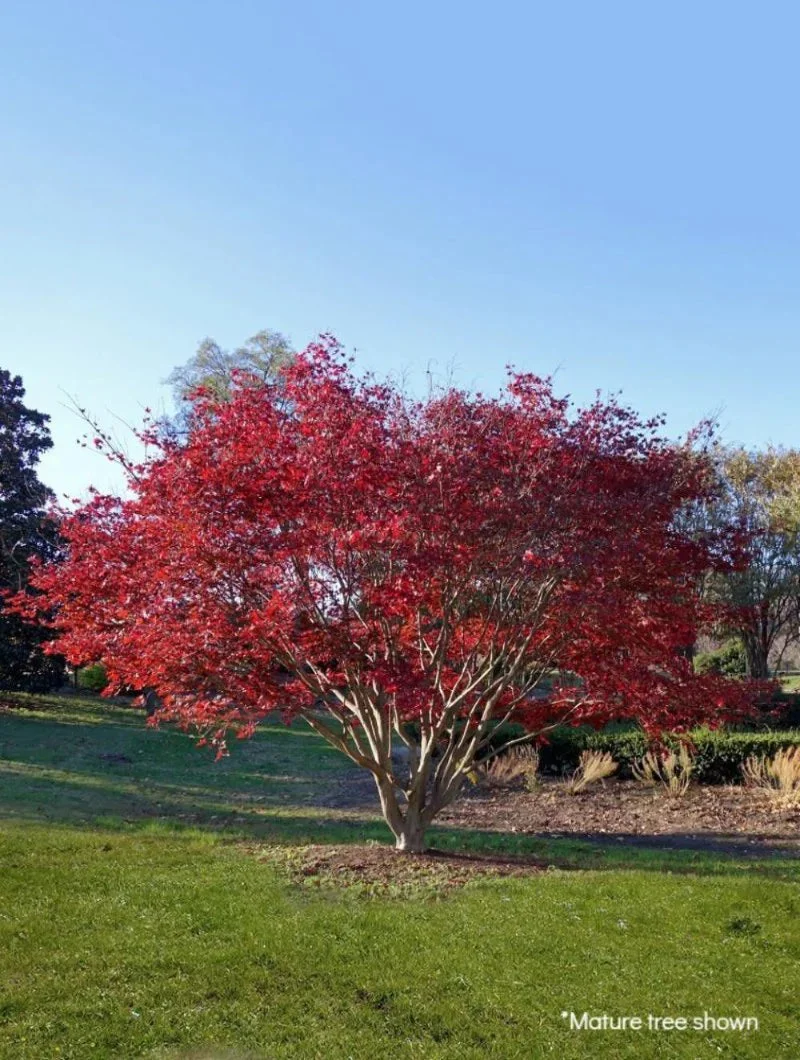
Japanese red maple is a slow to moderate grower, roughly 6-12 inches a year, and standard upright forms reach 15-25 ft over 10-15 years. At that pace, a 3-gallon tree and a 7-gallon tree do not stay a full size apart forever. Our piece on how big a Japanese red maple gets and how fast shows what the long game looks like.
3-Gallon vs 7-Gallon Tree: How to Decide
Here is the 3 gallon vs 7 gallon tree decision the way we would walk you through it at the nursery bench. Start with the buyer, not the tree.
Choose the 3-gallon if you are patient or budget-minded
You accept a small tree for a few seasons in exchange for a lower cost and an easier planting day. It is also the sensible size for pots. Container-grown maples need root protection in freezing winters, and a smaller root mass is easier to manage in a container. Our container sizes and tips are in the container and buying guide.
Choose the 5-gallon if you want a balance
Same starting height as the 3-gallon, but with a sturdier structure and more roots behind it. This is the best size tree to plant for most yards: still easy to handle, noticeably more forgiving, and not a heavy lift for one person.
Choose the 7-gallon if you want it to look like a tree this year
At 3-4 ft, it reads as a landscape tree from day one. It is also the better pick for a rough site: a windy corner, an entry bed that gets traffic, or a spot where a tiny tree would be stepped on or lost. A bigger root mass gives you a longer cushion on a dry week.
Our Position: Water Capacity Beats Budget
The usual advice is to buy the largest tree your budget allows. We disagree. Japanese red maple wants consistent, even moisture, especially in the first 2-3 years, and it tolerates neither standing water nor drought extremes. Drought tolerance is low to moderate even once established.
A 7-gallon tree that dries out in a July heat wave will do worse than a 3-gallon tree that gets a slow soak twice a week. Be honest about your routine. If you travel often, have no hose reach, or tend to forget, a bigger tree does not solve that. It just has more to lose.
What to Look For When the Tree Arrives
- Leaf color: reddish-purple, evenly colored, with palmate leaves usually showing 5-7 lobes. Some shift greener in deep shade or summer heat.
- Clean leaf edges: brown, crisp margins point to leaf scorch from sun, wind or drought stress.
- Sound trunk: no cracks, sunken patches or small bore holes. Borers are on the pest list for this species.
- Healthy roots: a root ball that holds together with light, fibrous roots, not a dense wall circling the container.
- Balanced branching: a framework that looks even, not a single whip with a tuft on top.
- Moist, not soggy, mix: root rot is a risk in poorly drained soil, and it can start in a waterlogged pot.
One caveat on color. Plants sold as a generic "Japanese Red Maple" at quart or small container sizes are often seed-grown. Seedlings can vary in mature color and habit. Named cultivars are grafted, which is how they stay true to type. Expect some variation if you are buying an unnamed selection.
Red Flags to Avoid
| Red flag | What it usually means |
|---|---|
| Crisp, brown leaf margins | Scorch from heat, wind or dry roots |
| Dead or brittle twig tips | Stress, winter damage or possible disease such as verticillium wilt |
| Sticky leaves or bumps on stems | Aphids or scale insects |
| Roots circling the pot hard | Tree has been in the container too long |
| Soggy, sour-smelling mix | Poor drainage, possible root rot |
| Seller will not state container size or height | You cannot compare value |
| Cultivar name claimed with no source | Possibly a seedling with variable color |
Who Should Not Buy a Japanese Red Maple
This tree is a poor fit for sites with salt exposure, since salt tolerance is poor, and for soggy ground. It is also not the right choice if you live outside USDA zones 5-8, unless you can provide afternoon shade in zone 9 or winter protection for a pot. Check your zone against the USDA Plant Hardiness Zone Map, and ask your local cooperative extension office about local heat and wind.
Shipping and Cost by Size
Larger sizes cost meaningfully more to ship. That is physics, not margin: a 7-gallon tree weighs far more than a 3-gallon one and takes more space in the box. When you compare sizes, compare the delivered cost, not just the plant. Our breakdown of what a Japanese red maple costs explains where the money goes.
Where to Buy
Buy from a nursery that states container size and height, ships with the plant in good condition, and tells you whether the stock is seed-grown or grafted. You can see our three sizes, 3-gallon (2-3 ft), 5-gallon (2-3 ft, more developed) and 7-gallon (3-4 ft), in the Japanese red maple shop, shipped to your door. A local garden center works too if you can inspect the tree in person, which is the best way to check the roots and trunk.
Whatever you buy, plant in early spring or fall and skip peak summer heat. Follow our planting steps and read what to do in the first days after delivery. Give standard forms 10-15 ft from structures and other trees.
Quick Reference
| If this is you | Buy |
|---|---|
| Patient, budget-minded, or planting in a pot | 3-gallon (2-3 ft) |
| Want a balance of cost, handling and sturdiness | 5-gallon (2-3 ft, more developed) |
| Want a tree look this year, or a rough site | 7-gallon (3-4 ft) |
| Can only water irregularly | Smaller size, closer to the hose, or reconsider the site |
| Planting window | Early spring or fall |
| Standard form spacing | 10-15 ft from structures and other trees |
| Hardiness | USDA zones 5-8, zone 9 only with afternoon shade |
Japanese Red Maple
Nursery-grown Japanese Red Maple in sizes from 3 Gallon 2-3 ft, shipped to your door.
From $118.33
Shop Now →