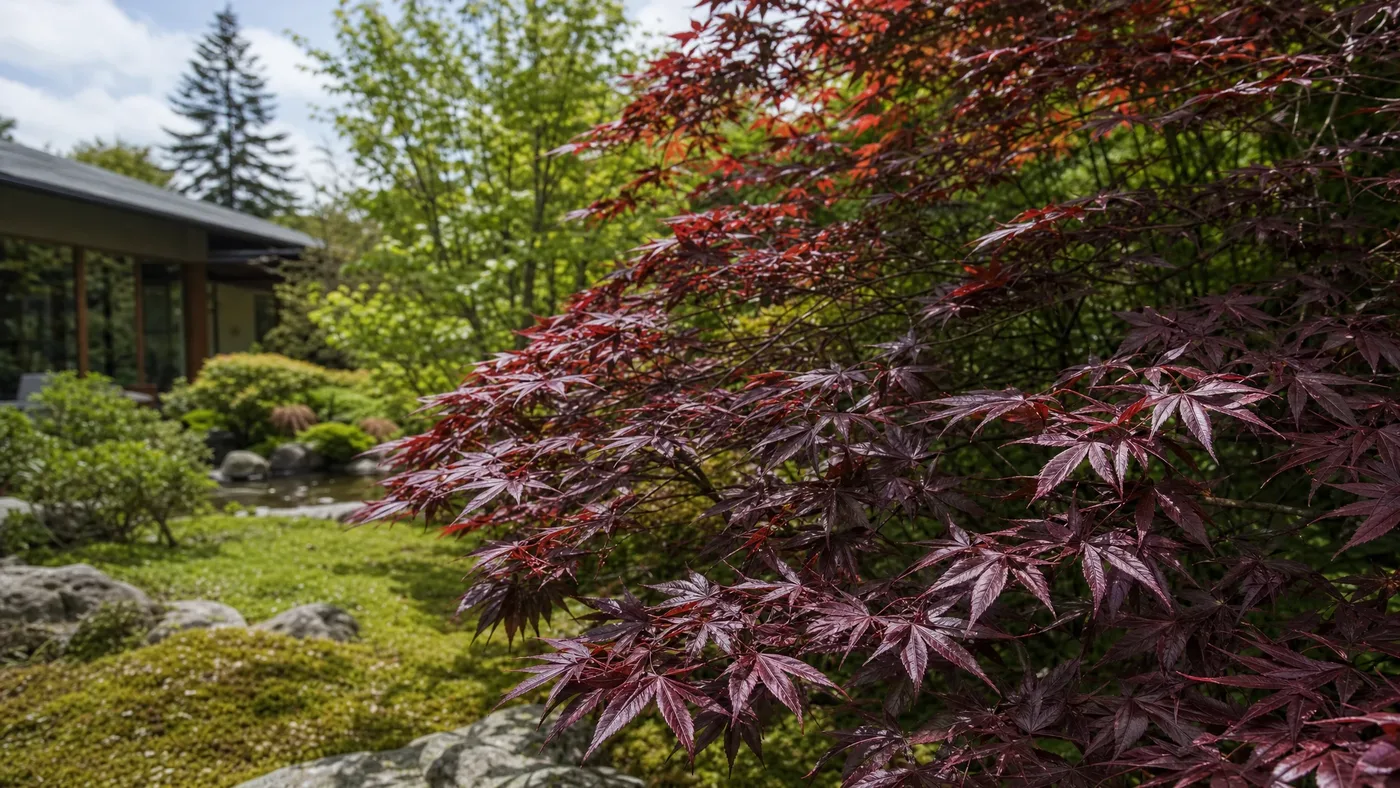
Can a Japanese Red Maple Grow Indoors?
No. A Japanese red maple will not live long as an indoor houseplant. It is a temperate deciduous tree that needs a cold winter rest to reset its growth cycle. Indoors it gets no dormancy, dim winter light and dry furnace air, and the usual result is slow decline and death within 6 to 18 months.
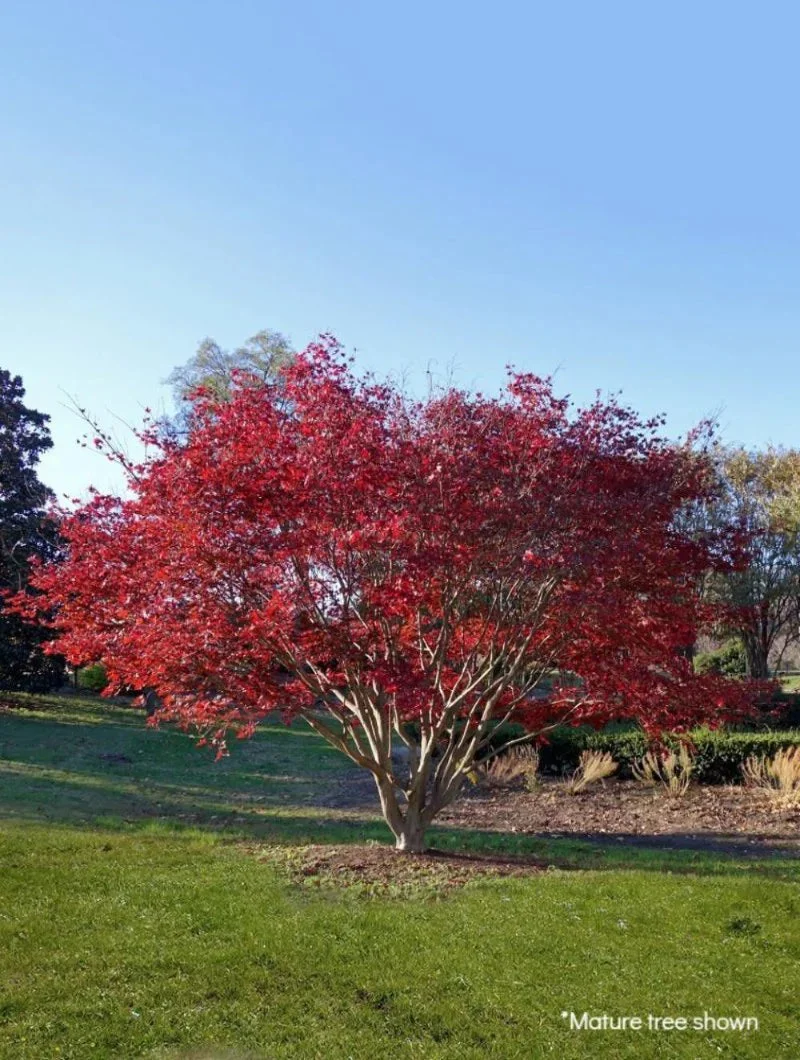
That is a hard answer, and no watering schedule changes it. If you love the look of the leaves and want the tree close to your living space, the better move is a pot set outside, covered in our guide to growing Japanese red maple in pots and containers. The rest of this page walks through the myths that keep people trying a Japanese maple indoors.
The myths at a glance
| Myth | Fact |
|---|---|
| It is a small tree, so it is a houseplant. | Size does not set where a plant belongs. Climate does. Dwarf forms still need winter cold. |
| A sunny window equals outdoors. | Glass, short winter days and heated air all work against it, and a window cannot supply dormancy. |
| Bonsai maples live inside. | Bonsai maples are kept outdoors and protected through winter, not displayed in rooms. |
| Good care can make up for it. | No care technique replaces a biological requirement. |
Why the biology says no
Acer palmatum is native to Japan, Korea and parts of China, and the USDA zones we list for it are 5 to 8. Those are places with real winters. Woody-plant physiology references and university extension guidance describe the same pattern for temperate deciduous trees: they need a stretch of weeks near freezing to reset their growth cycle. Evidence indicates that without that chilling, buds break unevenly or weakly and the tree runs down its stored energy.
A heated house never delivers it. Your living room sits at roughly the same temperature in January as in June, which is exactly the signal the tree is built to ignore for no longer than a season.
Myth 1: "It's a small tree, so it's a houseplant"
The myth: A Japanese maple stays small, so it must suit a pot by the sofa.
The fact: Size and hardiness are separate questions. Standard upright red forms reach 15 to 25 ft, and dwarf or cutleaf cultivars often stay 6 to 10 ft, but even the smallest are still deciduous trees from a cold-winter climate. Growth is slow to moderate, roughly 6 to 12 in a year, so a young tree looks like a tidy houseplant for a while. That is what makes the myth stick.
Why it exists: Garden centers sell small trees in small pots, and a 2-ft plant looks like a plant for a room. Its shape and leaf size resemble those of tropical foliage plants. The comparison ends there.
Myth 2: "A sunny window equals outdoors"
The myth: Put it in your brightest south window and it will be fine.
The fact: Research suggests that even a bright window delivers a fraction of the light a tree gets in open air, and winter days are short. The leaves on a red-leaved form also need the right balance of light to hold their color. Our plant facts note that color can fade in deep shade, so dim indoor light works against the very trait you bought it for. Meanwhile furnace air is dry, and sun through glass can scorch leaves. Leaf scorch from heat, wind or drought stress is one of the most common problems we list for this tree, even outdoors.
Why it exists: Many houseplants do fine on a windowsill. People assume that if a window works for a fern, it works for a tree.
What the decline looks like
The pattern is predictable, which is useful if you already have a tree inside and want to recognize where it stands. Expect 6 to 18 months from start to finish.
- Missed dormancy. The tree never gets its cold rest. It may drop leaves in autumn or hold them oddly, but its growth cycle does not reset.
- Weak, spindly spring flush. New growth comes out thin, stretched and pale for lack of light. Leaves are smaller and the red may look dull or greenish.
- Leaf drop. Dry air and low light cause browning edges, then leaves fall in summer rather than autumn.
- Exhaustion. With another skipped winter and not enough photosynthesis to refill its reserves, the tree fails to leaf out. Twigs go brittle and the tree dies.
Overwatering a stressed tree speeds this up, because root rot is a known problem in poorly drained soil.
Myth 3: "Bonsai maples live inside"
The myth: Bonsai are indoor trees, so a Japanese maple can be too.
The fact: Bonsai growers keep maples outdoors and protect them from hard freezes, because the dormancy requirement applies to a 10-inch tree just as it does to a 20-ft one. A bonsai may be brought into a cold, unheated space for a short stretch, but not into a warm room for the winter.
Why it exists: Photos of bonsai are taken indoors, on a table or in an exhibition hall. The staging suggests where the tree lives. It does not.
What to do instead
Option 1: A pot outside the window
Put the tree in a container on the patio, porch or courtyard where you would have put it indoors, so you still see it through the glass. Smaller or dwarf-growing selections suit this best. Container-grown trees need root protection in freezing winters, since roots in a pot have less insulation than roots in the ground. Provide afternoon shade in hot-summer climates. When roots fill the pot, our repotting guide covers the timing and steps.
Option 2: Plant it in the ground
In zones 5 to 8 (some cultivars tolerate 9 with afternoon shade), a tree in rich, well-drained, slightly acidic soil is the lowest-effort route. If that is where you are headed, our nursery-grown trees are available at /shop/ in 3-gallon, 5-gallon and 7-gallon sizes. Check your zone with the USDA Plant Hardiness Zone Map and ask your local cooperative extension office about heat and winter specifics.
Option 3: A true indoor tree
If it has to live inside, choose a plant that evolved without winter cold. A ficus is the usual example. Pick that and enjoy it, rather than watch a maple fade.
Who should not buy one for indoors
Skip it if you have no outdoor space at all, no balcony, step or sill outside the window. Skip it if your winters never get cold, since the tree has no dormancy to rely on. And skip it if you want guaranteed foliage for the whole year. A deciduous tree is bare in winter by design, with only a graceful branching silhouette to show.
Quick reference
| Question | Answer |
|---|---|
| Can it live indoors long term? | No. Expect decline over 6 to 18 months. |
| What does it need that a house lacks? | Weeks of winter chilling, strong light, humid air |
| Hardy zones | 5 to 8, some cultivars to 9 with afternoon shade |
| Growth rate | Roughly 6 to 12 in a year |
| Best pot placement | Outdoors, in view of a window, with root protection in freezing winters |
| Dwarf mature size | 6 to 10 ft |
| If it must be indoors | Choose a true houseplant such as ficus |
Japanese Red Maple
Nursery-grown Japanese Red Maple in sizes from 3 Gallon 2-3 ft, shipped to your door.
From $118.33
Shop Now →