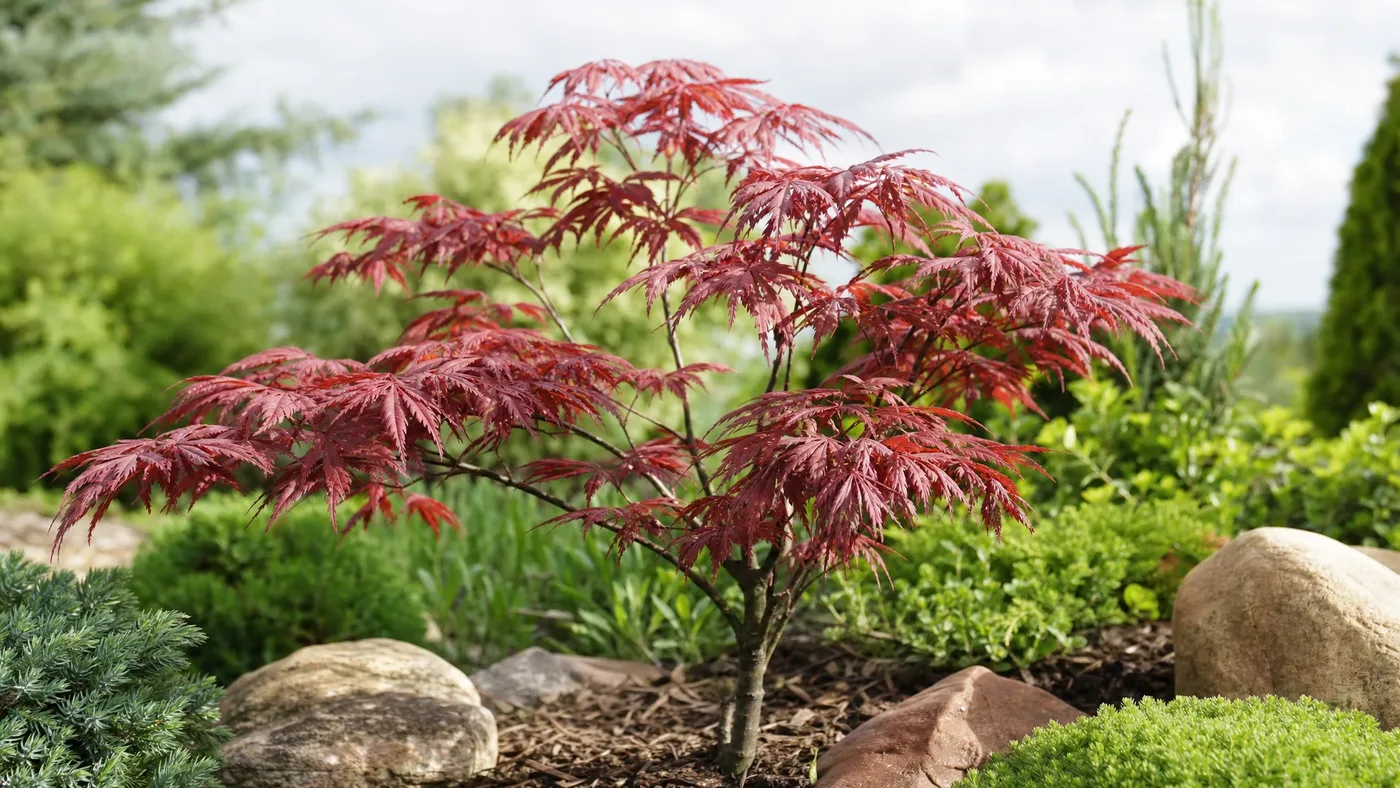
Japanese Garden Design With Red Maples
Most failed Japanese-style gardens share one cause: the ornaments arrived first. The lantern, the bridge and the bamboo fence get bought, and then the plants and stone are squeezed in around them. Design literature on classical Japanese gardens works in the opposite order. Stone and planting set the structure, and decoration comes last, if at all.
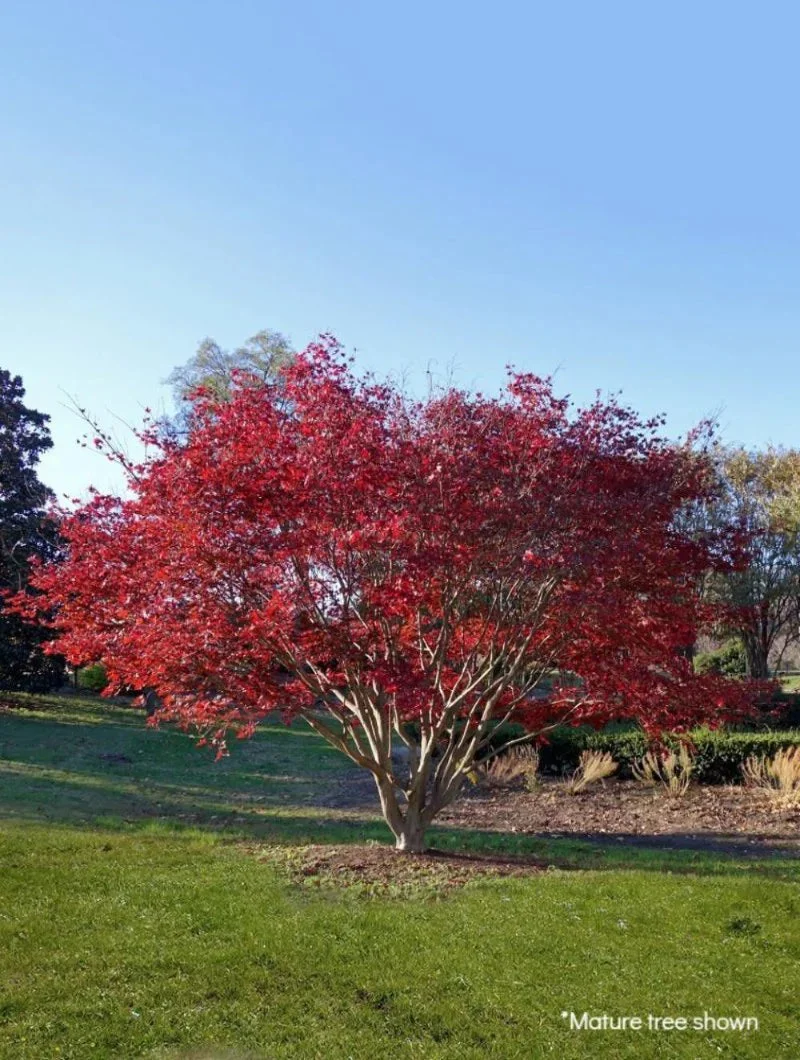
This guide covers the principles behind a believable japanese garden layout and how to translate them to an ordinary western yard, with one Japanese Red Maple as the centerpiece. It is written from design literature and horticultural references, not from a designer's portfolio. For the wider planting palette, see our pillar guide on Japanese Red Maple landscape ideas and companion plants.
Is this approach right for your yard?
A japanese garden design maple scheme works best in a defined corner or courtyard. It is a poor fit if you want a big, busy planting bed, a lawn that children play on, or a yard that is mostly full-day hot sun. Japanese Red Maple is rated for USDA zones 5-8 (some cultivars tolerate zone 9 with afternoon shade), and it scorches in hot sun, wind and drought stress. Salt tolerance is poor, so keep it away from road de-icing spray.
Be honest about size, too. Standard upright red forms reach 15-25 ft tall and 12-20 ft wide, and dwarf or cutleaf types often stay 6-10 ft. Growth is slow, roughly 6-12 inches a year, and a significant landscape presence takes 10-15 years. A tiny courtyard needs a dwarf or weeping selection. Our upright vs laceleaf comparison helps you choose before you plan the space.
Materials and plants to gather
- One Japanese Red Maple. Resist the urge to buy several.
- Stones: three or five, in different sizes, with at least one large enough to look anchored.
- Gravel for a raked area, or a simple edging to hold it.
- Moss or a low groundcover for shaded ground near the trunk.
- Clipped evergreens as rounded "shell" forms behind and beside the maple.
- One lantern. Buy it last.
- Organic-rich, well-drained loam with a slightly acidic pH, roughly 5.5-6.5.
Step-by-step: laying out the garden
1. Choose the view first
Decide where the garden will be seen from: a window, a patio chair, the entry path. Design the picture for that one position. Classical gardens are composed for specific viewpoints, which is why a corner vignette beats a scattered yard-wide effort.
2. Set the stones before any plant
Use odd numbers: three stones, or five in a loose cluster. Vary their size and avoid lining them up. Bury each one partway so it looks like an outcrop rather than a delivered boulder. The second fastest way to fail is symmetry: a matching pair of anything reads as a suburban entrance, not a Japanese garden. Offset the elements and balance them by weight, not by mirroring.
3. Place the maple where light passes through it
This is the main decision. Traditional compositions sit a red maple near water, whether a real pond or an area of raked gravel standing in for one. They also place it at a turn in the path and in front of dark evergreens. The evergreen backdrop makes red foliage glow, and the turn gives the tree a reason to be noticed.
In a western yard, face it so morning or low-angle sun comes through the leaves, while hot afternoon sun is blocked by a building or a taller tree. Afternoon shade preserves leaf color and prevents scorch in hot-summer climates. Allow 10-15 ft from structures and other trees for a standard form, and less for dwarf cultivars. Plant in early spring or fall, not in peak summer heat.
4. Build a path that conceals and reveals
Do not run the path straight at the maple. Curve it so the tree is partly hidden, then fully visible only at the turn. A screen of evergreen, a stone, or the maple's own branching can do the hiding. The goal is a few seconds of anticipation, not a maze.
5. Borrow the scenery beyond your fence
The principle of shakkei, or borrowed scenery, pulls a distant view into the composition. In a small yard that might be a neighbor's mature tree, a hillside, or a gap between two fences. Frame it with your planting and leave that sightline open. Hide the things you do not want in the picture, such as a utility box or a trampoline, behind evergreens.
6. Leave empty space on purpose
Ma is the empty space between elements, and it is treated as part of the design. Raked gravel, a plain moss carpet or bare ground gives the maple room to read as a form. Fill every square foot and the tree becomes one item among many. Leave gravel and mulch pulled back from the trunk flare.
7. Add the shell layer, then moss and groundcover
Clipped evergreens form the dark, rounded backdrop. For the softer layer, our companion plant guide covers azaleas, rhododendrons, hostas, ferns and hakone grass, which share the maple's preference for acidic, moist, well-drained soil. Choose a few, repeated, not one of everything.
8. Add the lantern last
Put a single lantern at the water's edge or beside the path turn, never in the middle of the gravel. If the composition already works without it, you may not need one.
The one-maple rule
Common advice is to plant a grove for impact. The design literature argues for restraint: one specimen, placed where light moves through its leaves, outperforms five maples competing for attention. Five trees also mean five times the water and five trees that eventually need 10-15 ft each. If you want a first tree, our nursery-grown Japanese Red Maples come in 3-gallon, 5-gallon and 7-gallon sizes. One of them is enough.
One caveat: unnamed seedling-grown red stock can vary in mature color and habit, while named cultivars are grafted and more predictable. If exact color matters to your composition, plan the surrounding materials after the tree has shown its character, not before.
Common mistakes and fixes
| Mistake | Why it fails | Fix |
|---|---|---|
| Buying ornaments first | Objects dictate the layout instead of stone and plants | Place stones, then the tree, then everything else |
| Symmetrical pairs | Reads as formal, not naturalistic | Use odd numbers and offset placement |
| Hot, exposed site | Leaf scorch from sun, wind and drought stress | Provide afternoon shade and shelter from wind |
| Full-sun trunk on a young tree | Trunk sunscald | Shade the trunk with companions or evergreens |
| Too many maples | Crowding, lost focal point | One specimen, with evergreens as support |
| Poor drainage in the gravel zone | Root rot in wet soil | Check drainage before planting; amend or raise the bed |
Container version for patios
A courtyard or patio can host a pot, a stone and a gravel top-dress as a miniature vignette. Dwarf or smaller selections suit this best. In freezing winters, container-grown trees need root protection, and as the tree grows you will eventually need to repot your Japanese Red Maple.
What to expect
Growth is slow, so the first few years will look sparse, and that is partly the point: ma is built into a young planting. With suitable siting, the tree may develop a graceful branching silhouette that shows well in winter, and its fall color is usually vivid red, orange or crimson, though intensity varies by cultivar and season. See our guide to Japanese Red Maple fall color for realistic expectations. Pruning is minimal: do corrective work in late fall to midwinter and remove only dead, crossing or crowded branches. For a zen garden japanese maple focal point, the tree may live 80-100+ years with good siting and care, so the layout you choose now is a long commitment.
Quick reference
| Item | Guideline |
|---|---|
| Order of work | View, stones, maple, path, shell evergreens, groundcover, lantern |
| Numbers | Odd groupings; avoid matching pairs |
| Tree count | One specimen maple |
| Light | Backlit by low sun; afternoon shade in hot climates |
| Zones | 5-8 (zone 9 with afternoon shade for some cultivars) |
| Spacing | 10-15 ft from structures for standard forms; less for dwarf |
| Soil | Rich, well-drained loam, pH roughly 5.5-6.5 |
| Planting time | Early spring or fall |
| Pruning | Late fall to midwinter, minimal |
| Local advice | Check your cooperative extension office for regional conditions |
Japanese Red Maple
Nursery-grown Japanese Red Maple in sizes from 3 Gallon 2-3 ft, shipped to your door.
From $118.33
Shop Now →