Japanese Red Maple Flowers and Seeds: When and What to Expect
Why does a tree we grow for its leaves bother making flowers and seeds at all, and what is it spending to do it? The expectation is a plant that does one job, holding red foliage from spring to fall. Under the color, though, every Japanese Red Maple is still a seed-making tree, and a healthy one will flower and set seed whether or not you planned for it.
That surprise sits behind many of the questions we get, usually after a tree shows tiny red blooms in spring or drops a handful of helicopters on the patio in fall. We'll walk you through what a nursery tree can and cannot promise about flowers, then the first small blooms, the reasons young trees skip them, what to do about winged seeds and what they cost the tree, and finally the seedlings that follow.
What a Nursery Tree Can Promise About Flowers
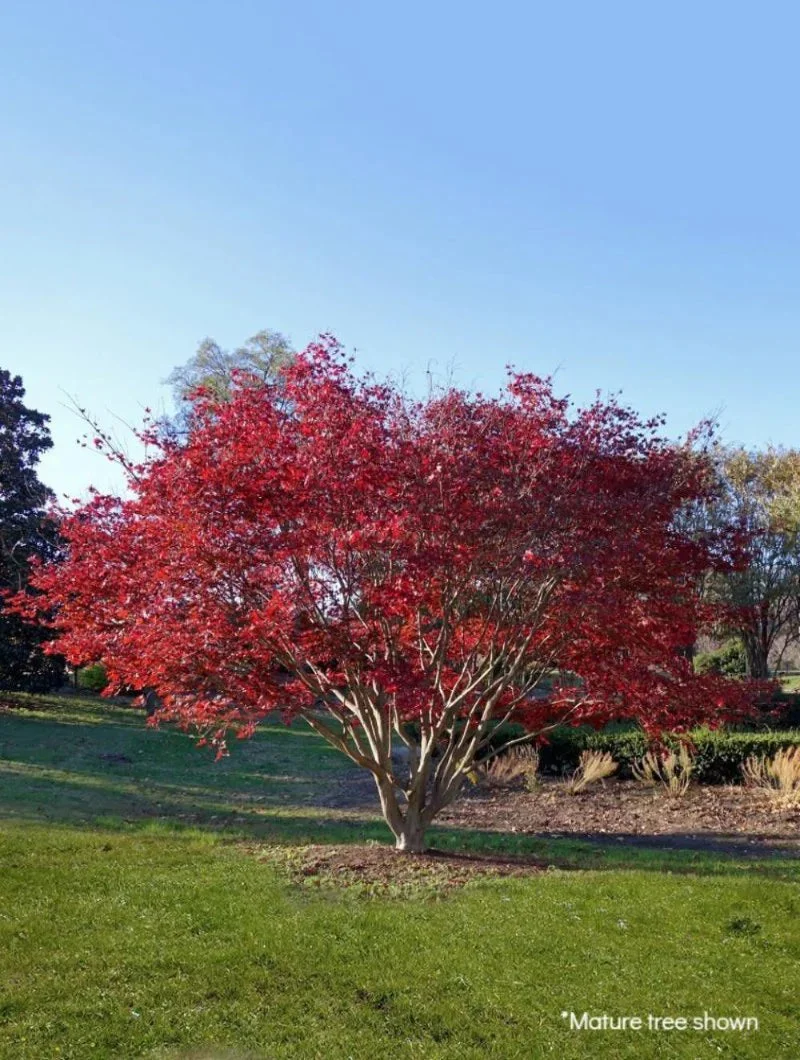
Before you buy, set one expectation: a nursery tree is grown for roots, a sound trunk and good leaf color, and flowers are a bonus that arrives later. A young tree puts most of what it makes into new shoots and roots, because those let it reach a mature size of roughly 15 to 25 feet. Flowers need spare energy, and a small tree has little of it.
That is why we would not promise a bloom in the first spring after planting. The sources we rely on give no age at which Japanese maples begin to flower, so we won't invent one. If a date matters to you, ask your local extension service what trees in your area are doing.
Size and Age at Purchase
A quart-size tree is the youngest plant you can buy, and we treat flowers on it as a pleasant surprise rather than something to plan around. A larger, older tree has more stored energy and more branch tips, so it is the likelier candidate for early blooms. Even then the flowers are small and sit among the opening leaves, so you may have to look closely to find them.
Seedling-Grown Trees Vary
Many red-leaved trees are raised from seed, and the red-leaf name is used for many red-leaved seedlings. Yale's Nature Walk adds that seedlings from one parent differ in leaf size, shape and color, so two trees bought the same day can differ in how they leaf out and when they flower. Our grafted versus seedling guide explains what each type gives you.
What you can count on is the flower itself, not the schedule. Whatever the leaves do later, the blooms are small and red to purple. Plan around the foliage and treat the flowers as a bonus.
Tiny Dark Red Flowers on a New Japanese Red Maple
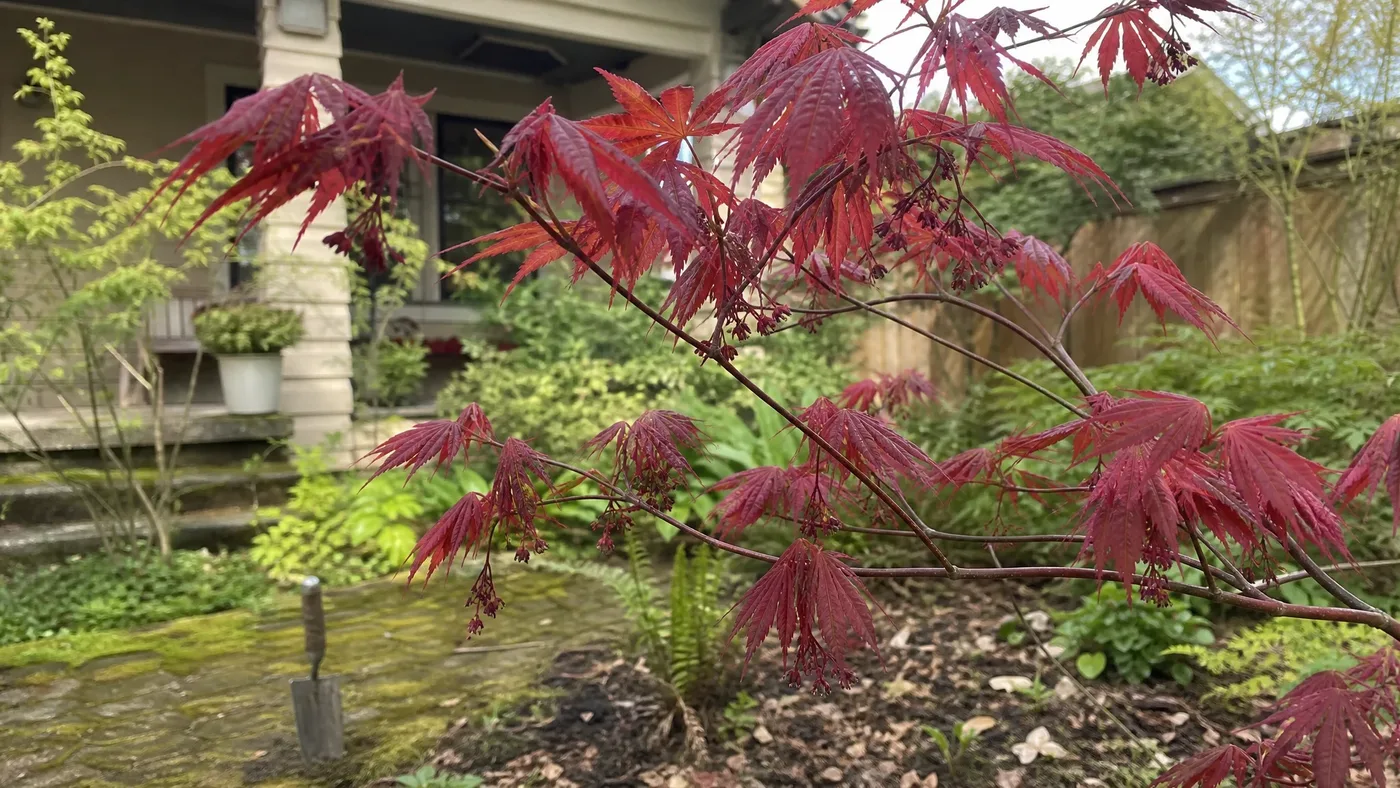
The flowers open as the buds break, right alongside the first leaves. Oregon State's plant database describes them as small, red to purple, and appearing along with new leaves. On a red-leaved tree the new foliage is red as well, so the blooms nearly vanish into it. Customers usually tell us they noticed the flowers only after they had dropped.
What the Flowers Look Like
Each flower is small and inconspicuous, with red or purple sepals rather than showy petals, and the Yale page notes they do not attract insects. Expect a dusting of dark red specks among the leaf buds, not a display. If you want a tree for blossoms, this is the wrong tree, because the color here is in the leaves.
One term is useful here. The species is monoecious, meaning both male and female flowers grow on the same plant. That is why a single tree standing alone can still produce the winged seeds that follow. We cannot say from our sources how many of those seeds will be viable, so treat a seed crop as likely, not certain.
Timing and Late Frost
Bloom follows leaf-out, so it follows your spring. In most of zones 5 through 8, where this tree is rated hardy, we think of flowers showing by late April, earlier in warm springs and later in cold ones. Watch your own buds rather than the calendar, because swelling buds are the real signal that flowers are coming.
The risk at this stage is frost. Frost damage, especially from late frosts, is among the problems the species can have. Flowers ride on the same tender new growth as the leaves, so a hard freeze after bud break can take that year's blooms and with them that year's seeds. A blackened flower is a small loss next to blackened leaves, but both come from the same cold night.
Why a Young Japanese Red Maple Skips Flowering
A tree that skips flowers is usually making a sound trade. Flowers and seeds are paid for with sugars made in the leaves, and a young tree still needs those sugars for roots, trunk and branch tips. Anything that tightens the budget, whether age, low light, damaged roots or unbalanced feeding, pushes the tree toward growth and away from flowers. A skipped bloom alone is rarely a sign of a sick tree.
Youth and Light
Youth is the simplest cause. A plant has to reach a certain size before it diverts energy to reproduction, and this maple's growth is rated slow to moderate, so the wait can run several seasons. You cannot hurry it, and pushing growth with fertilizer tends to backfire, as the next section explains.
Light comes second. The red-leaf form takes both partial shade (2 to 6 hours of direct sun) and full sun (6 or more hours). A tree at the dim end of that range has less to spend, yet we still advise shade from hot afternoon sun, so the answer is bright morning light rather than deep shade. Our sun requirements guide covers that balance.
Root Stress and Heavy Nitrogen
Roots come before flowers. A tree that is drying out, sitting in wet soil or still recovering from planting spends its sugars rebuilding roots, and the flowers wait. The species wants evenly moist, well-drained soil, and meeting that is the best thing you can do for future blooms.
Heavy nitrogen gives the opposite signal. The tree reads it as plenty and answers with soft, leafy shoots instead of flowers. Our fertilizing guide keeps amounts modest for exactly this reason.
Sorting Out the Cause
The table below pairs each cause with what you will see on the tree and what we would do about it.
| Cause | What you see | What we would do |
|---|---|---|
| Youth | Healthy leaves, steady growth, no blooms | Wait and keep care steady |
| Too much shade | Long, thin shoots and sparse leaves | Open up light, keep afternoon protection |
| Root stress | Small leaves, short shoots, edge scorch | Fix watering and drainage first |
| Heavy nitrogen | Lush, soft growth and no flowers | Stop feeding and let growth firm up |
| Late frost | Blackened new tips in spring | Nothing to fix, try again next year |
Winged Seeds in the First Year: Leave or Pull?
If flowers do open and get pollinated, a pair of winged seeds follows. Each fruit is a pair of samaras, which are the seed-and-wing units children call helicopters. Yale's Nature Walk gives them as about an inch long with a seed around a quarter inch across, and Oregon State says they ripen in early fall. The wings are often red, so a loaded branch can look like a second round of flowers.
What we tell customers is to pull them in the first year after planting. A newly planted tree is busy putting out roots into native soil, and every sugar it spends on seed is one it does not spend there. Removal is cheap, takes minutes, and costs the tree nothing, which is why we call it worth doing on a young tree.
How to Remove Samaras Safely
Do the work while the seeds are small and easy to see, from midsummer onward, well before they ripen and fall. Follow these steps:
- Work from a stable stance and look for the thin stalk that holds each pair of samaras.
- Pinch the stalk off between thumb and finger, or snip it with clean hand pruners, leaving the twig behind it untouched.
- Keep clear of the bud at the base of the stalk, because that is next year's growth.
- Bag the seeds and put them in the trash rather than the compost, or you will find seedlings there next spring.
Never pull downward on a whole branch, because the bark tears more easily than the stalk gives way. If you have pets, our toxicity guide covers samaras in its own section.
What Seed Set Costs a Japanese Red Maple
Seeds are built from sugars the leaves make, and a branch loaded with samaras is a branch sending those sugars to seed instead of to shoot tips and roots. We do not have a measured figure for Japanese maples, so we can only describe the pattern we expect and see. After a heavy seed year, a young tree often shows shorter new shoots and a smaller increase in size the following season.
That matters most because this is already a slow tree. The red-leaf form stays quite small in colder climates, around zone 5, so a season lost to heavy seeding is a larger share of its growth than it would be on a fast maple.
When Removal Matters
Removal earns its time in specific situations, and these are the ones we would act on:
- The tree is in its first year or two in the ground and is still building its root system.
- The tree is small for its age, stressed by drought or heat, or recovering from frost or leaf scorch.
- The tree is in a pot, where roots and soil are limited and the energy budget is tighter.
When to Leave Them Alone
Common advice says to strip every seed from every maple every year. We do not follow that on an established tree in good health. A mature tree of 15 to 25 feet has far more leaf area than a young one, so the seed crop is a small share of what it makes, and stripping branches overhead risks more damage than it prevents. Cut seed on a young tree and ignore it on an old one.
Seedlings Under an Established Japanese Red Maple
If samaras are left in place, some fall and some seeds sprout under the canopy the following spring. The seeds need a cold period before they germinate, which Yale's Nature Walk calls stratification. Seeds that drop in fall sit through winter, which supplies that cold, and sprouts appear as the soil warms. That is why the seedlings are a spring job, not a fall one.
The good news is that this is a modest nuisance. The species is not known to be invasive, so you are not fighting a plant that takes over a yard. Expect a patch of small seedlings near the drip line, thinning out with distance from the trunk.
Pulling Seedlings Young
Pull them while they are small, ideally after rain when the soil is damp, because the roots come out whole and easily. Waiting makes the job harder, since a seedling that has spent a season or two in the ground resists, and a hoe that slices off the top often leaves a root that resprouts. Mulch under the canopy also reduces how many seeds reach bare soil.
Keeping a Seedling on Purpose
A seedling will not necessarily match its red parent. As the Yale source says, seedlings of one tree vary in leaf size, shape and color. In our rows, a single parent gives a mix of leaf colors and forms, and only some will be as dark red as you hoped. If you want to grow one on, move it while it is small to a spot with room, and see our propagation guide for the seed route.
Flower to Samara, Year After Year
The cycle for a mature tree is simple and repeats yearly: buds swell in spring, small red flowers open with the new leaves, samaras form through summer and ripen in early fall, and seedlings emerge after the winter cold. In a young tree, the same cycle is quieter, with fewer flowers and seeds. Your job changes with the tree's age: remove seeds early, then step back and let it manage itself.
Flowers by late April, samaras by late summer, seedlings next spring, with timing shifting a little with your zone and your year. Pull the first-year seeds and the seedlings, and ignore the flowers and the seed crop on a mature tree.
Japanese Red Maple
Nursery-grown Japanese Red Maple in sizes from 3 Gallon 2-3 ft, shipped to your door.
From $118.33
Shop Now →Young Japanese Red Maples are slow to flower, so we raise ours on our farms with steady moisture and shade from the harshest afternoon sun, which lets the roots settle before the blooms come. Our own growers pot and pack every top-quality tree that leaves us. If the flowers and samaras in this guide have you picturing one at home, our nursery has young trees ready to go.