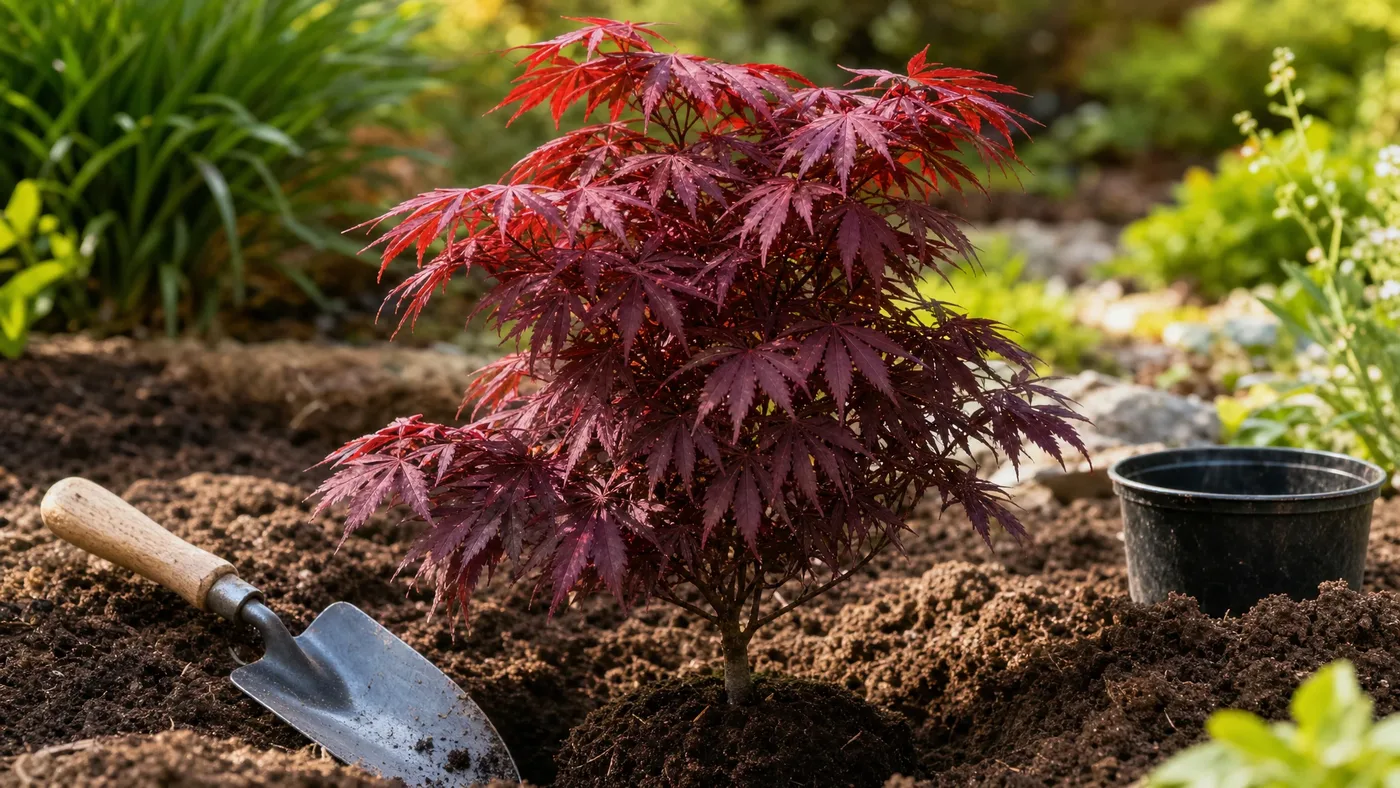
Transplanting a Japanese Red Maple Safely
Transplanting a Japanese maple is one of those jobs where the tree's size decides your odds more than your technique does. Under 1 inch of trunk caliper, it is a homeowner project. At 2 inches, it is a gamble. Anything bigger belongs to a professional with a spade truck. If you are moving a young tree, this guide walks you through it. If you are planting a brand new one, start with how to plant a Japanese red maple the right way instead.
First, Decide Whether to Move It at All
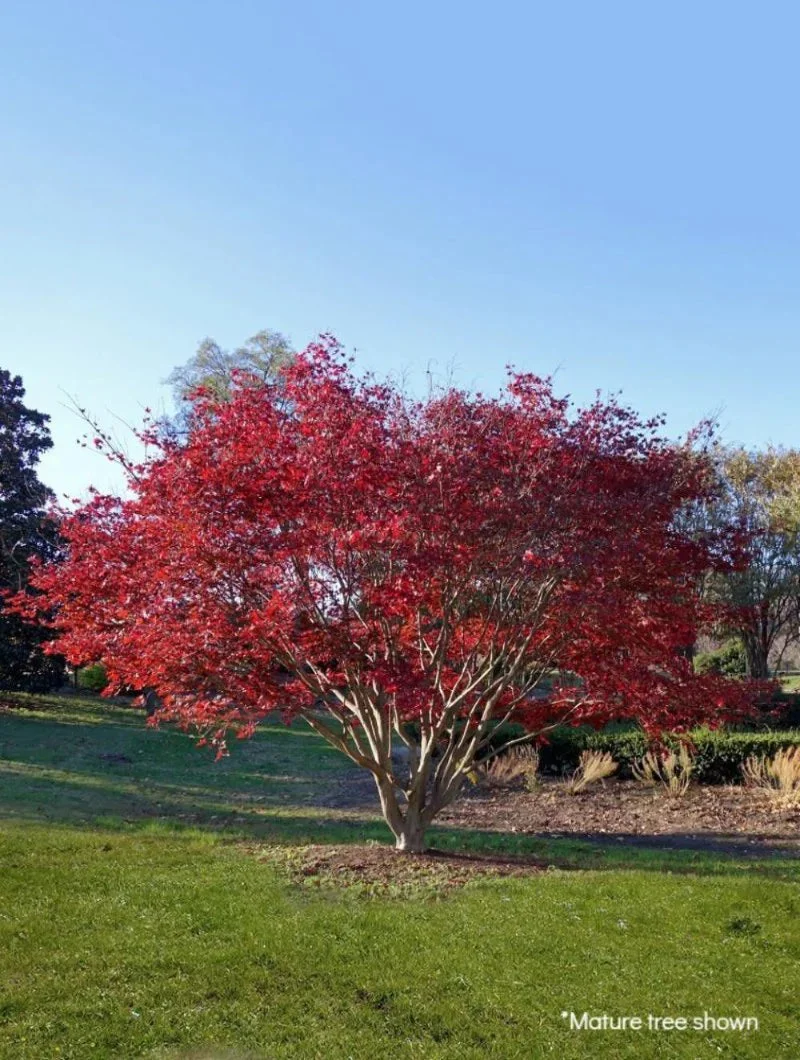
Moving a maple is not free. Every transplant cuts off a large share of the fine feeder roots that do the drinking, and the tree spends a season or two rebuilding them. A mature Japanese red maple is a 15-25 ft tree that grows only about 6-12 inches a year, so it took a long time to get where it is. It is often worth more than the patio, addition, or garden bed it is in the way of.
Before you grab a shovel, ask three questions:
- Can the project move instead? Shifting a path or a fence line by a few feet is usually cheaper than moving a tree.
- Is the trunk under 1 inch across? If so, go ahead. If it is near 2 inches, accept the odds. If it is thicker, hire an arborist.
- Is it a small tree? A young tree that you can replace is a different decision from a 10-footer.
Here is the honest trade-off. A new nursery-grown tree is often cheaper than paying a professional to move a 10-foot specimen. A 3-gallon, 5-gallon, or 7-gallon Japanese red maple starts fresh with an intact root system and no shock from being dug. If your tree is large, sentimental value is the only good reason to move it. Otherwise, replacing it is the better choice.
Materials You Need
- Sharp, round-point spade and a flat-edge spade for cutting roots cleanly
- Burlap or a tarp, plus twine
- Hand pruners and loppers (clean, sharp, wiped with rubbing alcohol)
- Wheelbarrow or a sturdy sheet to drag the ball
- Mulch (shredded bark or leaf mold)
- Garden hose
- Stakes and soft ties, only if the tree needs them
Step-by-Step: How to Move a Japanese Maple
1. Time it for dormancy
Move the tree in late fall or early spring, while it is dormant and before buds swell. The same window applies to planting (see the best time to plant a Japanese red maple). Avoid peak summer heat completely. A leafed-out maple in July loses water faster than a cut root system can replace it.
2. Root-prune months ahead if you can
This is the step most people skip, and it matters most. Months before the move, slice a circle around the trunk with a flat spade at the diameter of your planned root ball. Cut straight down, then backfill the trench. The tree responds by growing fresh fibrous roots inside the circle, which is exactly the part you will carry. If the move can't wait, do it anyway, but expect a harder recovery.
3. Size the root ball to the trunk
The standard arborist rule is roughly 10-12 inches of root ball diameter per inch of trunk caliper. A tree with a 1-inch trunk therefore needs a ball about 10-12 inches across. A 2-inch trunk needs about 20-24 inches, and that ball is heavy. Wet soil weighs more than most people expect, so plan for help lifting.
4. Prepare the new hole first
Dig the new hole before you lift the tree, so the roots are never out of the ground longer than necessary. Make it wider than the ball but no deeper. Japanese maples want rich, well-drained loam with a slightly acidic pH of roughly 5.5-6.5, and they develop root rot in poorly drained soil. If water stands in the hole after rain, pick a different spot. Check spacing too: standard forms need 10-15 ft from structures and other trees, and dwarf cultivars need less.
5. Dig and keep the ball intact
Cut down along your root-pruning circle, then undercut the ball at an angle. Keep the soil firmly attached to the roots. A ball that crumbles will not do the job. Wrap it in burlap or a tarp and tie it snug, then slide the tree onto a tarp rather than lifting it by the trunk. Never carry the tree by the trunk. That breaks the roots away from the soil.
6. Replant at flare height
Set the tree so the trunk flare, where the trunk widens into the roots, sits at or slightly above the surrounding soil. Planting too deep is a common cause of slow decline. Cut away any synthetic twine, and pull the burlap back from the top of the ball. Backfill with the native soil, water as you go to settle out air pockets, and avoid piling soil against the trunk.
7. Stake only if it wobbles
If the ball rocks when you push the trunk, stake it loosely with soft ties and remove the stakes after the first season. If it stands firm, skip staking. A little movement helps the trunk thicken.
8. Mulch and water like a brand-new tree
Spread mulch over the root zone, keeping it off the trunk. Then water consistently. Treat the tree as newly planted for at least two seasons, and the facts for the species point to the first 2-3 years of regular watering. Aim for even moisture, never soggy and never bone dry. The details are in our watering guide for Japanese red maples. Skip fertilizer in the first year, because the roots can't use it yet, and overfeeding later can cause leggy growth and weaker color.
Japanese Maple Transplant Shock: Normal vs. Not Normal
Some stress is expected after moving a Japanese maple. Here is how to tell routine recovery from trouble.
| What you see | Likely meaning | What to do |
|---|---|---|
| Thin canopy, smaller leaves, little growth in year one | Normal recovery while roots rebuild | Keep watering evenly, be patient |
| Crisp brown leaf edges in summer | Leaf scorch from heat, wind, or dry roots | Check soil moisture, add mulch, consider afternoon shade |
| Wilting with wet soil | Possible root rot from poor drainage | Check drainage, ease off watering |
| No leaf-out by late spring | Not normal. Roots may be failing | Scratch a twig for green tissue, then check the roots and moisture |
A thin year is fine. A tree that has produced no leaves by late spring needs attention. Scratch a small twig with a thumbnail. Green underneath means the branch is alive, and the tree may just be slow. Brown and dry all the way along means those branches are dead. Wait a little longer before giving up, because a stressed tree sometimes leafs out late. If you see sunscald on a young trunk, which is more likely after the move exposes bark that was shaded before, shade the trunk until it adjusts.
Common Mistakes to Avoid
- Moving in summer. Dormancy is your friend.
- Skipping root-pruning. If you can plan ahead by months, do.
- Digging too small. A ball much smaller than 10-12 inches per inch of caliper leaves the tree short of roots.
- Letting the ball fall apart. Bare roots dry out in minutes.
- Planting deep. Keep the flare at soil level.
- Choosing a poorly drained or salty site. Drainage matters, and salt tolerance is poor.
- Pruning heavily to "balance" the roots. Remove only dead, crossing, or crowded branches, and do it in late fall to midwinter to avoid heavy sap bleed.
What to Expect
With a small tree, careful timing, and consistent watering, many moved Japanese red maples can recover and return to normal growth within a couple of seasons. Results vary with tree size, soil, weather, and how much root you kept. Seed-grown red forms also vary in habit and color, so a tree may look a bit different once it settles. Check with your local cooperative extension office for timing that suits your region. The species is generally hardy in zones 5-8.
Quick Reference
| Item | Guideline |
|---|---|
| Trunk size, homeowner job | Under 1 inch caliper |
| Trunk size, gamble | About 2 inches caliper |
| Trunk size, hire a pro | Larger than 2 inches |
| Best timing | Late fall or early spring, dormant |
| Root-prune | Months before the move, if possible |
| Root ball size | Roughly 10-12 inches per inch of caliper |
| Planting depth | Trunk flare at or slightly above soil level |
| Staking | Only if the ball wobbles |
| Watering | Even moisture for two seasons or more |
| Warning sign | No leaf-out by late spring |
Japanese Red Maple
Nursery-grown Japanese Red Maple in sizes from 3 Gallon 2-3 ft, shipped to your door.
From $118.33
Shop Now →