Japanese Red Maple Through the Seasons: Year-Round Interest
The usual objection to a Japanese red maple is that it is bare for half the year. We think that objection has it backwards. Japanese maple year round interest comes from four different shows, and an evergreen-only yard gives you one show twelve times. This guide walks through each season, what the tree does, and where to plant it so you can see it. If you are still planning the wider planting, our landscape ideas and companion plants guide covers the bigger picture.
What You Need Before You Start
- A tape measure and a stake or garden hose to mark the planting spot
- A compass or phone compass app to find east and west
- A plan of the windows you actually look out of (kitchen, living room, home office)
- An evergreen, fence, or wall to serve as a winter backdrop
- Organic mulch, and a balanced, low-nitrogen fertilizer for early spring
- Clean bypass pruners for dormant-season cleanup
Step 1: Stand at the Window First, Not in the Yard
Most people choose a planting spot by walking the yard. Do the opposite. Stand at the two or three windows you use most in January and note what you see. That sightline is where the maple earns the most, because winter is the season when nothing else in the garden competes with it.
Mark the spot with a stake. Standard red forms reach 15-25 ft tall and 12-20 ft wide, so keep the stake 10-15 ft from the house and from other trees. Dwarf and cutleaf selections often stay 6-10 ft, and can sit closer. Cultivar size varies a lot, and our cultivar comparison helps you match a form to the space.
Step 2: Plant for the Winter Silhouette
Winter is the underrated season. Once the leaves drop, you see the branching structure that nursery people and garden designers buy these trees for: a layered, graceful frame with fine twig tracery. The Japanese maple winter structure reads best against something plain and dark.
Place the tree in front of an evergreen hedge, a conifer, a fence, or a plain wall. Against open sky or a busy background the twigs disappear. Against a solid evergreen they look drawn in ink.
Snow adds to the show. Wet snow outlines the horizontal branch tiers, so a tree sited in a winter window gets a second display on snowy days. In heavy-snow regions, ask your local cooperative extension office about knocking snow off young branches. Do not shake an iced tree, since brittle wood can snap.
Step 3: Catch the Spring Leaves
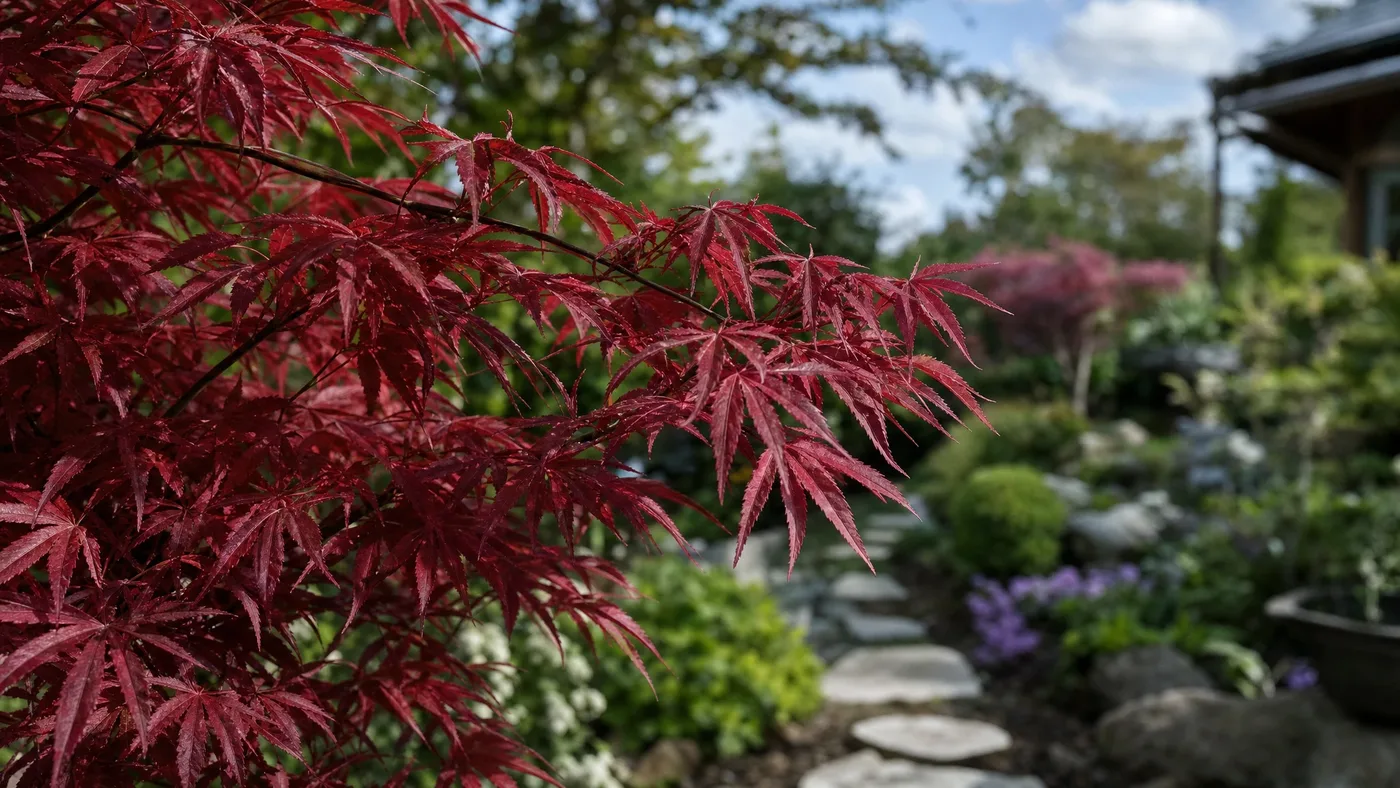
Japanese maple spring leaves are often the brightest red of the whole year. New foliage opens in early to mid spring, and the small red-purple flowers appear before or with the leaves. They are easy to miss, and that is fine. Winged seeds (samaras) follow later.
To get the most from spring color, give the tree morning sun or bright part shade. In deep shade, red-leaf forms can shift greener. A spot where early light comes through the leaves, such as an east-facing exposure, lights the new growth up from behind.
Step 4: Use the Summer Canopy as a Backdrop
In summer the foliage settles into burgundy or reddish-purple. Think of it as a color wall behind your perennials rather than the star. Plant companions that contrast with it: hostas, ferns, and hakone grass all work, and azaleas and rhododendrons share its preference for slightly acidic soil (roughly pH 5.5-6.5).
For the evening payoff, site the tree so the low sun shines through it from behind as you look at it. West-side light at the end of the day turns the canopy translucent. The catch: hot afternoon sun is also what scorches leaf edges. In hot-summer climates, put the tree where a building or taller tree shades it after midday, and view it from the shaded side.
Step 5: Set Up the Fall Crescendo
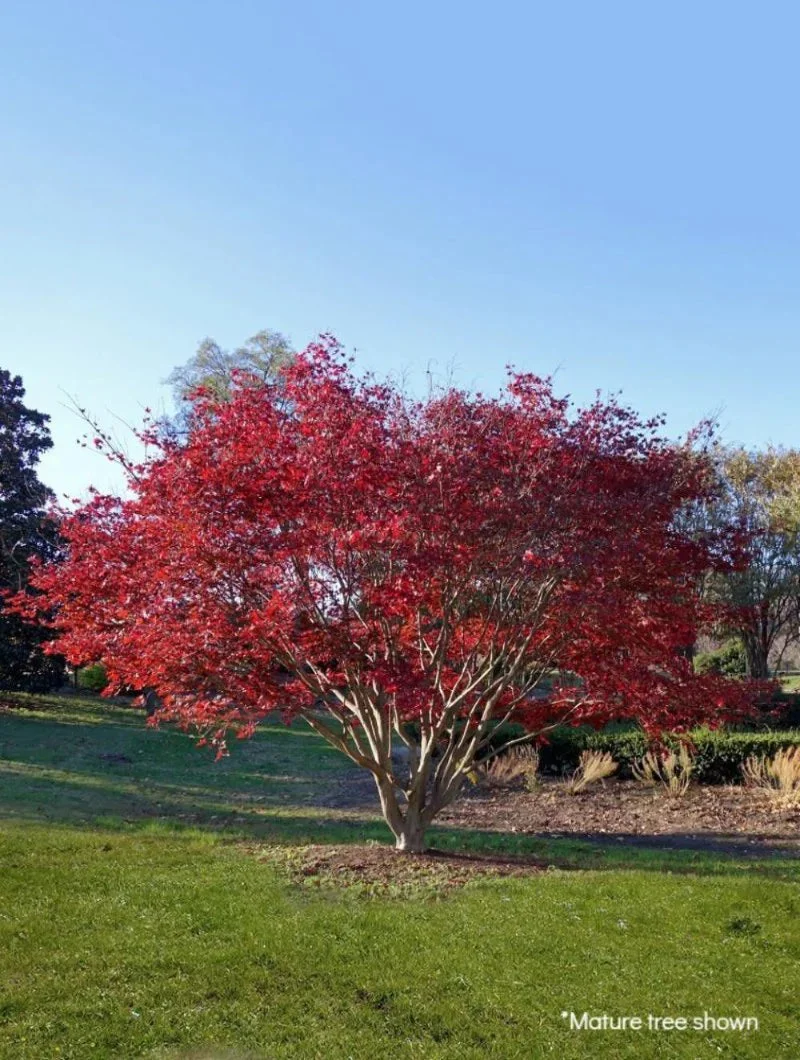
Fall color runs vivid red, orange, or crimson, with intensity varying by cultivar and season. Cool nights and steady moisture through late summer help. Dry stress tends to brown the leaf edges. Our fall color guide goes deeper on what to expect and why some years are better than others.
Keep the soil evenly moist but never soggy. The tree needs rich, well-drained loam. Standing water leads to root rot, and that matters far more than any seasonal color tip.
Step 6: Keep the Frame Clean in Dormancy
- Prune from late fall to midwinter. Dormant pruning avoids heavy sap bleed.
- Remove only what is dead, crossing, or crowded. The goal is to reveal the existing structure, not reshape it.
- Mulch in late fall. Spread organic mulch to a depth of 2-3 inches, and keep it off the trunk.
- Feed lightly in early spring. Use a balanced, low-nitrogen fertilizer. Overfeeding causes leggy growth and weaker color.
Common Mistakes to Avoid
| Mistake | What happens | Fix |
|---|---|---|
| Planting where winter windows never see it | You miss the best season | Plan from the interior sightline |
| Open sky or busy background | Twig detail vanishes | Plant against an evergreen or plain wall |
| Full afternoon sun, exposed to wind | Leaf scorch, faded color | Afternoon shade and wind shelter |
| Heavy pruning for shape | Spoils the natural form, bleeds sap | Dormant, minimal cuts only |
| Wet, compacted soil | Root rot | Amend with organic matter or choose another spot |
Who Should Skip This Tree
Be honest about the fit. Zones 5-8 are the comfortable range, and some cultivars tolerate zone 9 with afternoon shade. Salt tolerance is poor, so roadside or coastal-spray sites are a bad match. If you have heavy clay that stays wet, or a hot, windy, all-day-sun spot you cannot shade, choose a different tree. Deer pressure matters too. The tree is moderately resistant but not deer-proof, as covered in our deer resistance guide.
Nursery-grown stock that is sold unnamed is often seed-grown, so mature color and habit can vary a little. If you are ready to choose a size, our Japanese red maples come in 3-gallon, 5-gallon and 7-gallon sizes.
What to Expect
Growth is slow to moderate, roughly 6-12 in per year. Flowers can appear within a few years, but a significant landscape presence usually takes 10-15 years. With good siting and care, a tree may live 80-100+ years, though results depend on your climate and soil. A well-placed tree should give you something worth looking at in every season, with winter often the surprise.
Quick Reference
| Season | What you see | Placement tip | Task |
|---|---|---|---|
| Spring | Bright new red leaves, small red-purple flowers, then samaras | Morning sun or east light | Light low-nitrogen feeding |
| Summer | Burgundy canopy, evening backlighting | Afternoon shade, view from the west side | Even watering |
| Fall | Red, orange, or crimson | Steady moisture through late summer | Mulch 2-3 in |
| Winter | Bare silhouette, twig tracery, snow outlines | Evergreen or plain backdrop, in a window view | Minimal dormant pruning |
Japanese Red Maple
Nursery-grown Japanese Red Maple in sizes from 3 Gallon 2-3 ft, shipped to your door.
From $118.33
Shop Now →